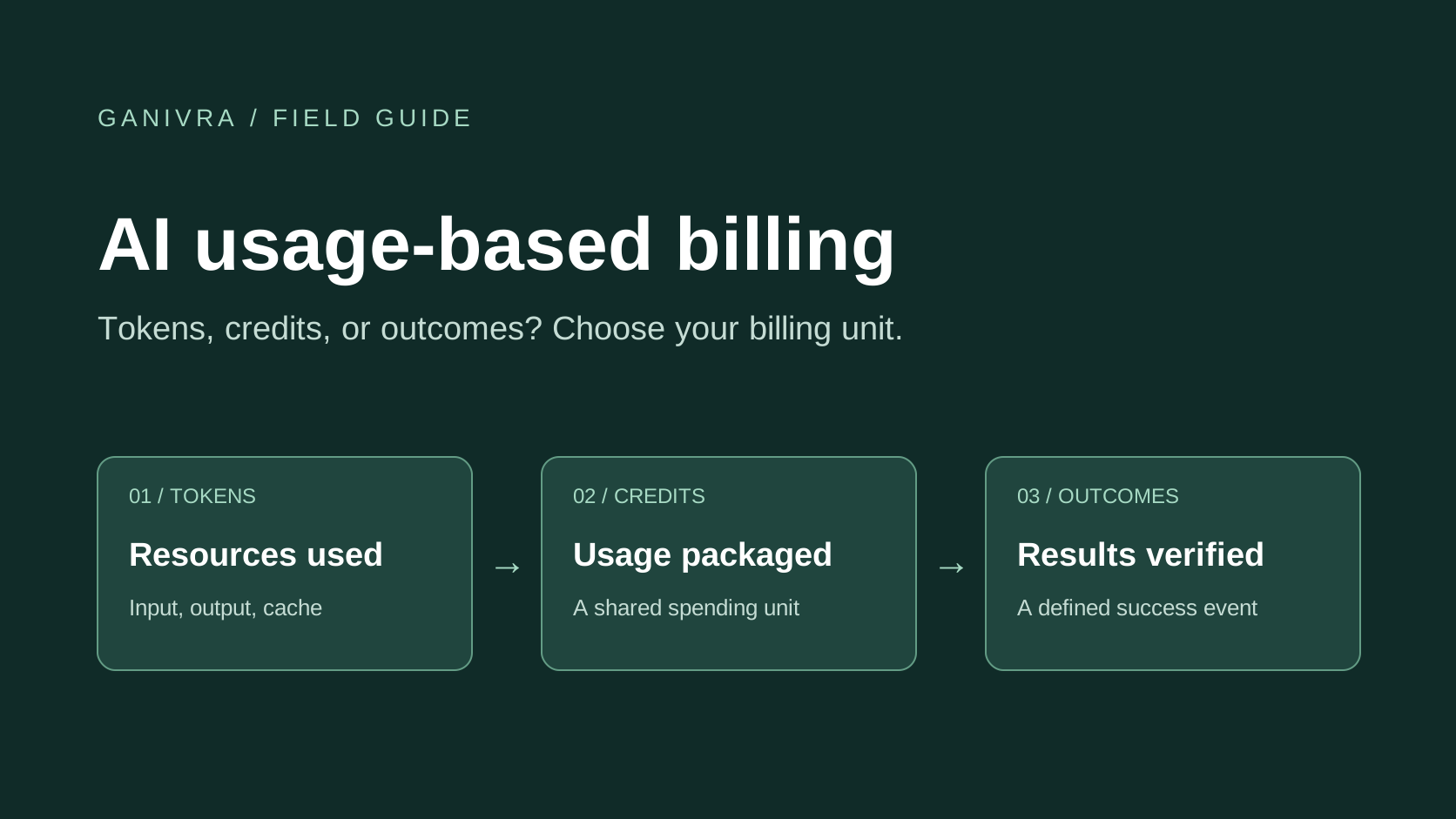
Use tokens when customers want resource-level control, credits when you need one unit across different AI features, and outcomes when success can be verified. All three require accurate usage measurement underneath. A base subscription with an included allowance can make spending more predictable, but it does not remove the need to understand cost per customer.
What is AI usage-based billing?
AI usage-based billing calculates customer charges from measured consumption or completed work. The customer might pay per million tokens, per credit consumed, per minute, or per resolved ticket. A plan can be entirely variable or combine a fixed subscription with usage charges.
Separate three concepts before setting a price: AI metering records consumption; rating applies a selling price; billing applies allowances, credits, and adjustments to produce a charge. Your provider cost is a separate calculation from your customer’s bill.
For example, Stripe’s meter documentation describes aggregation of usage events over a billing period and attaching meters to prices. Your application still needs to decide which activity is billable and which customer caused it.
Tokens vs. credits vs. outcomes: a comparison
| Model | Customer pays for | Useful when | Main tradeoff |
|---|---|---|---|
| Token-based billing | Measured input, output, and other priced token categories | Technical buyers want control over model consumption | Customers must understand resource units and variable request sizes |
| Credit-based billing | A defined number of credits consumed by each action | A product bundles several models, tools, or media types | Unclear conversion rules make prices hard to predict |
| Outcome-based pricing | A verified result under a published success definition | Buyers value a repeatable business result | The vendor carries retries, failures, and outcome disputes |
These choices can overlap. A product can sell prepaid credits that are consumed per successful report, or include token usage in a subscription. Distinguish the billing unit from the payment timing and plan structure.
Token-based billing: charge for model consumption
LLM token billing is a natural fit for APIs, model gateways, and developer tools where the buyer controls prompts, context length, and model choice. Publish the unit size and selling rate for each relevant category, such as uncached input, cache reads, and output.
Σ (billable tokens in each category ÷ rate unit × selling rate)
Keep supplier rates and selling rates separate. A provider discount does not automatically change the customer’s contract price, and a provider price increase does not automatically authorize a new customer rate.
Where token billing gets difficult
The same user request can consume more tokens after a prompt update, retrieval change, or agent retry. Buyers may struggle to forecast the cost of a task even when the token rate is transparent. Tool charges and audio costs also need their own units or a documented conversion.
Show model and token categories in the usage breakdown. State whether internal retries are billable and how missing streaming usage is reconciled. Avoid silently turning a single customer action into several unexplained charges.
Credit-based billing: package different AI actions
AI credits provide a shared product unit across resources that are otherwise hard to compare. A short answer could consume one credit, a research report twenty credits, and an image ten credits. Those numbers are product pricing decisions, not universal conversions.
Credits may be prepaid, included in a subscription, or billed after consumption. Publish both how customers obtain credits and how actions spend them. If consumption varies by model or task size, provide an estimate or maximum before expensive work begins.
Make the conversion visible
- Show the credit price of each action or the calculation that determines it.
- Explain expiration, rollover, refunds, and the order in which balances are used.
- Keep a history of purchases, grants, consumption, and corrections.
- Version conversion rules so historical usage can be explained at its original rate.
A product credit is not necessarily a monetary billing credit. Stripe’s billing credits overview describes applying eligible credits to invoices. If your product sells abstract action credits, you still need to map those units to the monetary charges your billing system expects.
Prepayment improves cash collection timing, but it does not prove that every action is profitable. A discounted credit pack combined with expensive model routing can still leave too little revenue per action.
Outcome-based AI pricing: charge for verified results
Outcome pricing connects the charge to something the customer recognizes: a validated report delivered, a qualified appointment booked, or a support ticket resolved. It can make the buying decision simpler when the result has a clear definition.
The definition must survive real production behavior. A tool returning success may mean only that an API accepted a request. A report might be empty, an appointment might be duplicated, or a closed ticket might reopen immediately.
Define a billable outcome before shipping
- Success: what evidence proves the promised result happened?
- Identity: which stable identifier prevents charging twice for one result?
- Window: when is the result final enough to charge?
- Reversal: what happens if it is invalidated, cancelled, or reopened?
- Attribution: how are human-assisted results or repeated attempts treated?
For example, a support product could require a resolved ticket that stays closed for an agreed period. Specify whether human escalation qualifies and how reopening affects a charge. Our AI customer support economics guide explores why durable resolution matters.
Under this model, the vendor usually absorbs the resource cost of unsuccessful attempts and internal retries. Measure those costs against successful outcomes, including work that never creates a billable result.
The same AI workload under three billing models
Consider a reporting product with 1,000 attempted jobs and 900 verified reports. Across all attempts, it uses 2 million input tokens, 400,000 output tokens, and 1,000 paid tool calls. Assume total supplier cost is $20, including failed attempts. The following selling prices are illustrative, not market benchmarks or provider rates.
| Billing model | Example calculation | Usage charge |
|---|---|---|
| Tokens plus tool usage | 2M input × $10/M + 0.4M output × $30/M + 1,000 tools × $0.01 | $42 |
| Credits per attempted job | 1,000 attempts × 5 credits × $0.01 per credit | $50 |
| Verified outcomes | 900 accepted reports × $0.06 | $54 |
After the assumed $20 supplier cost, these charges leave $22, $30, and $34 respectively before hosting, support, payment fees, and other delivery costs. The difference comes from the chosen prices and billing rules; it does not demonstrate that one model inherently earns more.
The credit example explicitly bills attempts, including unsuccessful ones. If credits were consumed only for accepted reports, the charge would instead be $45. Describe this distinction before customers use the feature.
Now suppose retry costs push supplier cost to $35 while accepted outcomes stay at 900. The outcome charge remains $54, leaving $19 before other costs. Token billing may increase the customer’s charge if those extra resources are billable. The billing model decides who absorbs variability; it does not eliminate it.
Hybrid pricing: a subscription with included usage
A hybrid plan charges a base fee, includes an allowance, and applies a stated overage rate. For example, a $99 monthly subscription might include 2,000 standard reports, with additional reports at $0.06 each. At 2,300 billable reports, the charge is $117 before taxes or adjustments.
Specify what qualifies as a standard report, when the allowance resets, and whether unused units roll over. Let customers see usage and choose what happens at exhaustion: stop, request approval, or continue under an agreed overage policy.
Evaluate the plan at full allowance consumption as well as average usage. In this example, the base fee provides $0.0495 per included report if all 2,000 are used. The later overage rate does not rescue an allowance that costs too much to deliver.
Build a reliable AI usage-based billing pipeline
- 01Capture resource events
Record customer, execution, event ID, occurrence time, model or tool, quantities, and status. Keep failures and retries in the internal cost record.
- 02Decide what is billable
Apply the customer contract and outcome rules. A resource event and a customer charge are different records; retain a link between them.
- 03Apply a versioned selling rate
Use the applicable plan, unit conversion, allowance, and effective date. Preserve enough information to reproduce a historical charge.
- 04Deliver without duplicate charges
Use stable billing event IDs and idempotent delivery. Replaying telemetry must not consume credits twice. A new paid model attempt still belongs in supplier costs.
- 05Reconcile and correct
Compare internal usage, submitted billable events, and invoice totals. Define handling for late events and outcome reversals. Preserve adjustments instead of hiding the original transaction.
For prepaid balances or hard limits, reserve enough allowance before starting work and settle against actual usage afterward. Concurrent requests need an atomic balance check or reservation mechanism; a delayed usage dashboard cannot enforce a hard cap.
Give customers an explanation of each charge in their chosen unit. Engineering may need a full execution trace, while a buyer needs a clear list of reports, credits, or resource usage that adds up to the invoice.
Which AI billing model should you choose?
Choose tokens when buyers understand and control model usage, and want detailed resource pricing. Choose credits when a shared allowance makes a varied product easier to buy, provided conversion rules remain clear. Choose outcomes when the result is verifiable and you can absorb variation in delivery cost.
Before launch, replay representative customer workloads through the proposed rate card. Include heavy users, long inputs, expensive tools, failed jobs, and repeated attempts. Compare customer bills with total cost-to-serve and inspect the customers with the weakest margins.
Ganivra connects model and MCP consumption to customers, features, workflows, and executions so you can evaluate the cost side of these choices. Use the integration guide to collect attribution data and the AI metering guide to design the underlying measurements. Customer invoicing, credit balances, and real-time entitlement enforcement require billing and application logic beyond cost analytics.
Frequently asked questions
What is AI usage-based billing?
AI usage-based billing charges customers according to measured consumption or completed work. The billable unit can be tokens, credits, requests, minutes, or verified outcomes, with or without a base subscription.
Are AI credits the same as tokens?
No. Tokens are a model usage unit. Credits are a product-defined unit that can represent tokens, tool calls, or actions. A product needs a clear conversion schedule showing how each action consumes credits.
Should customers pay for AI retries?
That depends on the published billing policy. Infrastructure products may bill consumed resources, while outcome-priced products typically include internal retries in the price of one result. In either case, record every charged provider attempt internally and prevent duplicate customer charges.
When does outcome-based AI pricing work?
It works when success is objectively verifiable, attributable to the product, and defined within an agreed window. A completed API call is not necessarily a successful customer outcome.
Can a subscription include usage-based billing?
Yes. A hybrid plan combines a base subscription with an included allowance and a published overage rate. Specify the allowance unit, reset date, rollover policy, and behavior when the allowance is exhausted.
Price with cost visibility
Understand the cost behind every billable unit.
Connect customer usage to model and tool costs before choosing your next rate card.