For research context, explore AI Customer Service Statistics: Adoption, Costs, and ROI in 2026, with original sources and clearly labeled forecasts.
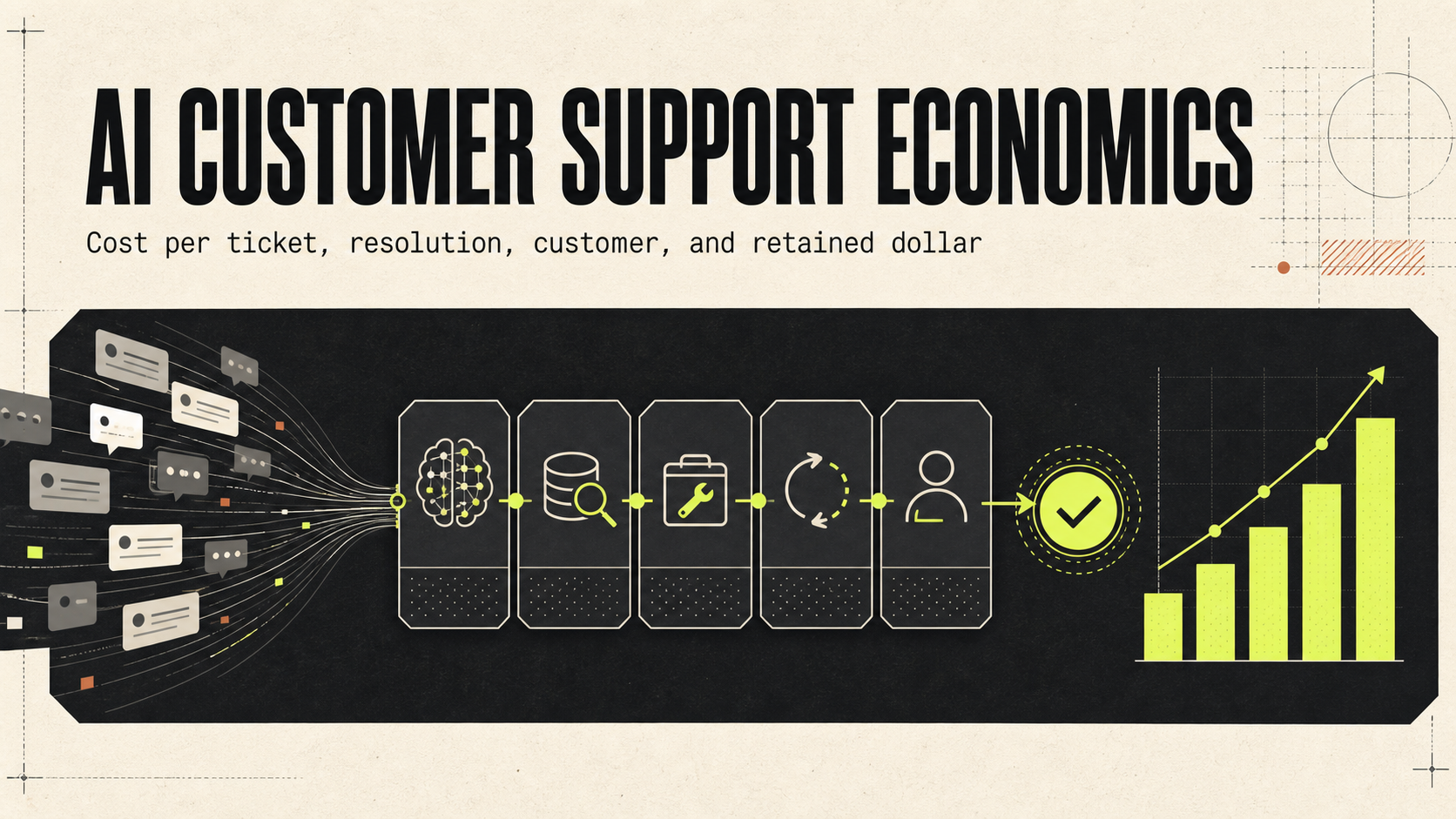
AI customer-support economics measures the cost and value of each support outcome. Add AI platform, model, retrieval, tool, review, retry, escalation, helpdesk, and implementation costs. Divide the loaded total by durable resolutions, attribute it to customers, and compare it with the human baseline and revenue retained. Tickets touched and conversations deflected are operational counts; cost per durable resolution and support margin are economic decisions.
A ticket touched is not a problem solved
AI customer support ROI depends on the denominator. A ticket can be answered, contained, closed, or deflected without the customer’s problem being durably resolved. Reopens, repeat contacts, refunds, cancellations, and human cleanup belong in the economics.
Count a resolution only when the issue meets a defined outcome and remains solved through an appropriate reopen or repeat-contact window.
That outcome definition should change by issue. “Where is my order?” may be resolved when verified status is delivered. A refund request may require successful policy validation and a completed refund action. A technical incident may need a working fix and no repeat contact for a defined period.
| Metric | What it actually says | Economic limitation |
|---|---|---|
| AI handled | The AI participated in the ticket | May include failed answers and eventual human work |
| Deflected | The normal human queue did not receive it | May include abandonment or unresolved silence |
| Contained | The interaction stayed in the automated channel | Does not prove the underlying issue was completed |
| Closed | The helpdesk reached a closed state | Can reflect workflow rules rather than customer success |
| Durably resolved | A defined outcome occurred and remained solved | Requires an outcome rule and observation window |
The denominator is also a pricing issue. If a vendor bills per resolution, your invoice depends on its definition. Your internal economics should use a consistent definition across vendors, model versions, and support channels.
The AI customer support cost stack
A complete support ledger connects the helpdesk and AI platform to model inference, knowledge retrieval, tool actions, evaluation, human escalation, and customer-specific service costs.
- 01Helpdesk and channel
Seats, ticket or conversation fees, messaging, email, voice, and channel infrastructure.
- 02AI support platform
Per-resolution, per-conversation, credit, seat, or committed platform charges.
- 03Model inference
Input, output, cached tokens, routing, classifiers, guardrails, and evaluation calls.
- 04Knowledge retrieval
Search, embeddings, vector storage, reranking, freshness, and content operations.
- 05Tool actions
CRM, order, refund, account, billing, identity, and other downstream APIs.
- 06Retries and review
Regeneration, validation, quality sampling, human approval, and exception handling.
- 07Human escalation
Transferred handle time, queueing, supervision, and duplicated investigation.
- 08Implementation and operations
Integration, workflow design, knowledge maintenance, monitoring, and governance.
Pricing comparisons fail when one quote represents a platform fee and another represents a billed resolution. Normalize both into your own ledger: total cost per ticket routed to AI, total cost per durable resolution, escalation cost, fixed cost allocation, and overage exposure.
AI customer support unit-economics formulas
State the scope beside every metric. A cost per resolution that excludes implementation or escalations should not be compared with a fully loaded human baseline.
loaded_cost_per_resolution = (platform + model + retrieval + tools + review + implementation + escalation) ÷ durable_AI_resolutions
blended_cost_per_resolution = total_support_cost ÷ total_durable_resolutions
support_ROI = (baseline_support_cost − new_support_cost) ÷ AI_program_cost
customer_contribution = customer_revenue − product_delivery_cost − attributed_support_cost
When revenue retention is included, show it separately. Cost avoided is directly observable; revenue retained usually requires experimental or cohort evidence.
Worked example: from deflection headline to support P&L
The following numbers are illustrative—not a vendor quote, performance claim, or industry benchmark. They demonstrate the calculation.
| Input | Illustrative value | Economic result |
|---|---|---|
| Monthly ticket volume | 20,000 tickets | $160,000 baseline at $8 loaded human cost each |
| Tickets routed to AI | 12,000 tickets | 60% AI handle share |
| Durable AI resolutions | 7,200 tickets | 60% of AI-routed tickets; 36% of total volume |
| AI platform, model, retrieval, and tools | $10,800 | All variable AI service cost |
| QA and implementation allocation | $4,200 | Review, knowledge work, and rollout allocation |
| Human-resolved tickets | 12,800 × $8 | $102,400, including AI escalations |
| New monthly support cost | $117,400 | $5.87 blended cost per resolution |
| Monthly cost avoided | $42,600 | 26.6% below the illustrative baseline |
A useful adoption number that says nothing about resolution quality or cost.
$15,000 AI program cost divided by 7,200 durable AI resolutions.
This view exposes the next decisions. Raising durable resolution, reducing expensive escalations, or improving eligibility can matter more than shaving a small amount from token cost.
How AI support economics change by industry
The formula is stable; the outcome and risk model are not. Content should speak to the operational unit each industry actually values.
| Industry | Useful resolution unit | Costs and risks that disappear in averages |
|---|---|---|
| B2B SaaS | Issue fixed, account unblocked, or escalation correctly routed | Technical complexity, customer tier, engineering escalation, and churn risk |
| Ecommerce | Order located, return approved, address changed, or refund completed | Seasonality, carrier APIs, refund leakage, repeat contact, and order value |
| Fintech | Account issue completed within policy or safely escalated | Identity checks, compliance review, fraud risk, and specialist labor |
| Marketplaces | Buyer or seller issue resolved across the transaction | Two-sided contact, dispute handling, payment tools, and trust-and-safety review |
| Consumer subscriptions | Service restored, plan changed, or cancellation reason addressed | Retention, refund policy, save offers, account value, and repeat contact |
For a support leader, this is a service-level view. For finance, it is cost-to-serve and capacity. For product and engineering, it reveals expensive prompts, models, tools, and failure paths. For an AI-support startup, it connects vendor COGS to contract margin by customer.
AI support metrics worth tracking
| Metric | What it reveals | Decision it supports |
|---|---|---|
| Eligible, routed, handled, and resolved tickets | The complete automation funnel | Scope, routing, and product coverage |
| Durable resolution rate | Successful outcomes after a reopen window | Quality, vendor, and workflow evaluation |
| Repeat contact and reopen rate | False or fragile resolutions | Knowledge, prompt, and action improvements |
| Escalation rate and post-transfer handle time | Residual labor and handoff quality | Routing, context transfer, and staffing |
| Cost per handled ticket and resolution | Activity cost versus outcome cost | Architecture and commercial comparison |
| Cost and contribution by customer | Who creates or erodes margin | Pricing, limits, expansion, and support tier |
| Cost by issue, prompt, model, and tool | Why economics changed | Regression, routing, and optimization |
| Unpriced usage coverage | How much cost remains unknown | Catalog and reconciliation work |
A machine-readable AI support cost event
Join every model and tool step under the original support execution. Keep customer, issue, prompt, and outcome metadata explicit:
{
  "event_id": "evt_support_2048",
  "execution_id": "ticket_8d21",
  "step_id": "step_model_04",
  "provider": "openai",
  "model": "support-model",
  "operation": "draft_resolution",
  "input_tokens": 2210,
  "output_tokens": 318,
  "cached_input_tokens": 1400,
  "latency_ms": 784,
  "status": "success",
  "environment": "production",
  "provider_reported_cost_usd": 0.0268,
  "attributes": {
    "application": "support-platform",
    "workflow": "ticket_resolution",
    "feature": "ai_support_agent",
    "customer_id": "acct_1042",
    "conversation_id": "ticket_8d21",
    "prompt_id": "refund-policy-agent",
    "prompt_version": "v12",
    "channel": "chat",
    "issue_category": "billing_refund",
    "support_outcome": "resolved_by_ai",
    "reopened_within_window": false,
    "escalation_required": false
  }
}
Send separate events for retrieval, evaluation, CRM, billing, order, or escalation steps using the same execution_id. Cost telemetry does not need ticket text, model responses, tool arguments, recordings, credentials, or personal customer data.
How to measure AI customer support economics
Start with one high-volume issue type whose successful outcome can be verified. Instrument the full path before expanding the automation surface.
- 01Define a durable resolution
Choose an issue-specific success condition and an appropriate reopen or repeat-contact window.
- 02Set the eligibility denominator
Separate tickets suitable for automation from cases that should route directly to a human or specialist.
- 03Create one support execution ID
Join model, retrieval, tool, evaluation, retry, and escalation steps under the original ticket or conversation.
- 04Attach customer and commercial context
Add customer, plan, workflow, channel, issue category, prompt version, and revenue allocation at the source.
- 05Calculate loaded outcome cost
Include all AI program costs, human cleanup, escalation, helpdesk, quality, and implementation allocation.
- 06Monitor economics and quality together
Alert on cost per durable resolution, repeat contact, escalation, customer margin, and unpriced usage.
Ganivra’s integration guide shows how to send model and MCP tool events through one contract, attach customer and workflow context, and connect all steps under an execution. That makes support cost attributable without turning cost analytics into a repository for customer conversations.
From support savings to the retained dollar
Customer support can affect renewal, expansion, refunds, and churn, but the attribution must be earned. Do not assign the full value of a subscription to an AI resolution merely because the ticket preceded a renewal.
Use experiments or matched cohorts where possible. Compare customers with similar value, issue severity, tenure, and channel. Measure whether a support intervention changes cancellation, refund, renewal, expansion, or repeat-contact behavior over an appropriate window.
retained_value_ROI = (validated_cost_avoided + incremental_revenue_retained − AI_program_cost) ÷ AI_program_cost
Keep the cost and retention components visible separately. Finance can trust a model that shows which value is observed, which is allocated, and which is estimated.
For voice-based service operations, continue with the Voice AI unit economics guide. For tool-heavy support agents, see the complete MCP cost tracking guide.
AI customer support economics FAQ
What is AI customer support ROI?
AI customer support ROI compares measurable value—such as avoided support cost, additional capacity, implementation savings, or revenue retained—with the complete cost of the AI program. Use durable resolutions and controlled revenue evidence rather than tickets touched or automatically closed.
How much does AI customer support cost per ticket?
There is no universal cost per ticket. It depends on the pricing unit, model and retrieval usage, tool calls, review, retries, escalation, channel, ticket complexity, and implementation allocation. Calculate both cost per AI-handled ticket and loaded cost per durable AI resolution; the difference exposes ineffective automation.
How do you calculate AI support cost per resolution?
Add platform, model, retrieval, tool, evaluation, retry, review, escalation, helpdesk, and allocated implementation costs for the period. Divide by issues the AI durably resolved under a defined outcome and reopen window. State whether human cleanup and escalations are included.
What is the difference between ticket deflection, containment, and resolution?
Deflection means a ticket did not reach the normal human queue, containment means the interaction stayed in the automated channel, and resolution means the customer's issue met a defined successful outcome. Deflection and containment can include abandonment or unresolved silence, so they should not automatically be treated as resolutions.
Is an AI chatbot cheaper than a human support agent?
It can be for repeatable issues, but compare like-for-like outcomes. Include AI platform and inference cost, knowledge and tool operations, supervision, reopens, repeat contact, and human escalations. Compare that with loaded human labor, management, helpdesk tooling, occupancy, and the same quality or resolution standard.
Should human escalation cost be included in AI support ROI?
Yes. Escalation is part of the cost of serving the original issue. Track the human handle time after escalation as well as any AI work already consumed. A poor handoff can make escalated tickets more expensive than tickets routed to a person from the beginning.
How can I compare Intercom Fin, Zendesk AI, Ada, Decagon, and other AI support pricing?
Normalize every quote into your own economic units: cost per ticket routed to AI, cost per confirmed resolution, cost of human escalation, fixed platform and seat fees, implementation cost, and overage exposure. Vendor billing definitions are inputs; your durable-resolution definition should remain consistent across vendors.
What is a good AI customer support resolution rate?
There is no universal target because issue mix, channel, knowledge quality, allowed actions, risk, and the definition of resolution vary. Baseline your own eligible ticket cohorts, measure durable resolution and repeat contact, and improve without weakening customer satisfaction, compliance, or revenue outcomes.
How do AI support startups track margin by customer?
Attach a stable customer ID, contract or revenue allocation, channel, issue type, prompt version, and outcome to every support execution. Attribute model, retrieval, tools, retries, evaluation, and human escalation to that customer, then calculate cost-to-serve and contribution margin.
Does AI support cost tracking require storing ticket text?
No. Unit economics can usually be measured with metadata: ticket and execution IDs, customer, workflow, channel, issue category, providers, models, usage, cost, latency, outcome, retry, reopen, and escalation state. Raw ticket content should be handled separately under appropriate privacy and security controls.
How should customer retention be included in AI support economics?
Treat retention as an incremental outcome that needs evidence, not an automatic credit for every resolution. Use experiments, matched cohorts, or a conservative attribution model to estimate churn reduction or revenue preserved after controlling for customer segment and issue severity.
How can teams reduce AI support cost without hurting customer experience?
Prioritize frequent and avoidable waste: oversized retrieval, unnecessary model turns, duplicate tool actions, repeated failed answers, stale knowledge, preventable escalations, and poor handoff context. Evaluate every change against durable resolution, repeat contact, latency, customer satisfaction, and revenue outcomes.
See the economics behind every resolution
Connect support AI cost to tickets, customers, outcomes, and retained revenue.
Ganivra gives support-platform founders and AI product teams one view of model and tool cost, escalation, customer cost-to-serve, and contribution margin.