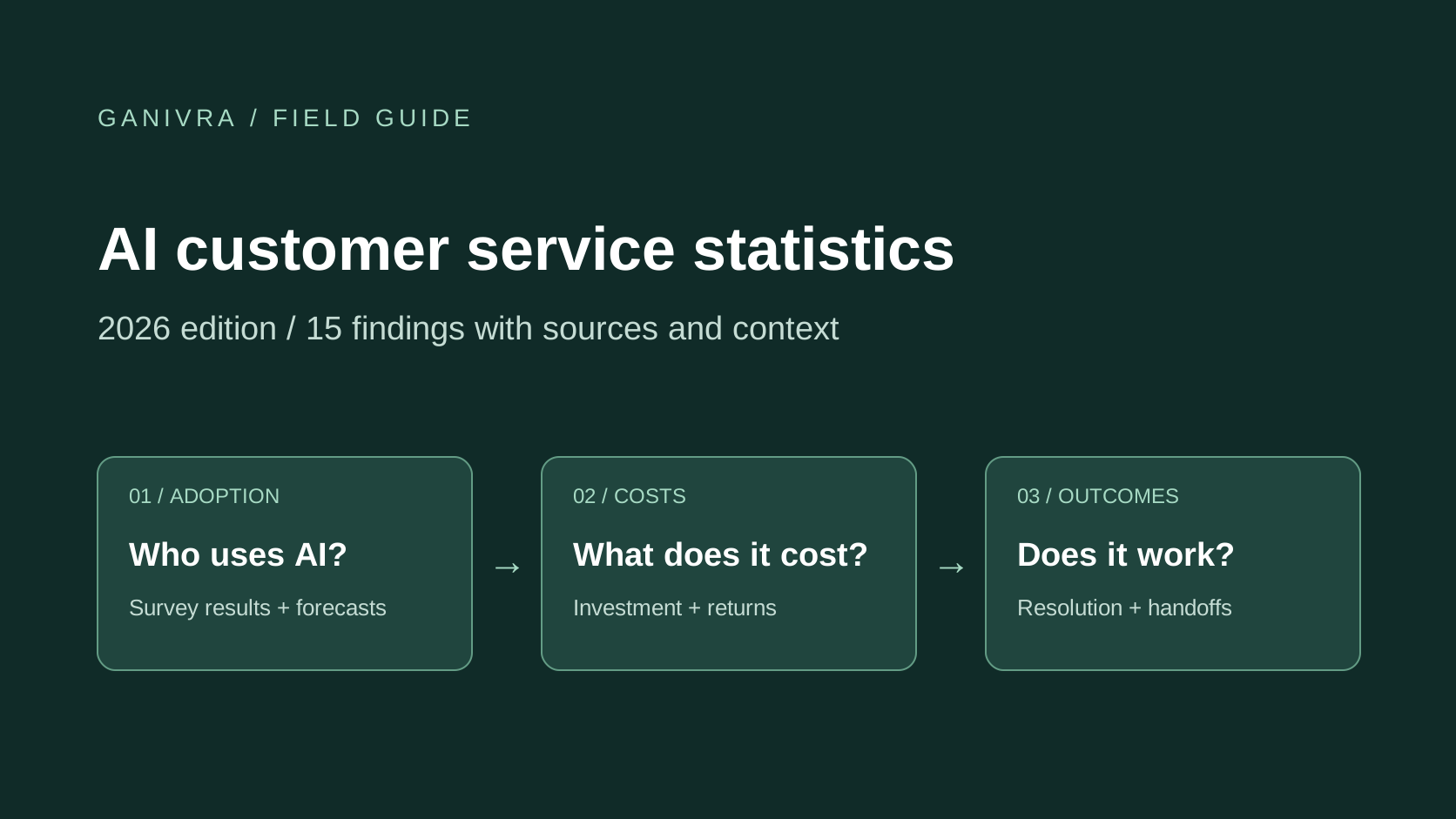
AI adoption, productivity, and profitability are different measurements. Use industry research to frame an evaluation, then measure successful resolutions, repeat contact, human escalation, and complete delivery costs in your own service. A forecast or another company’s saving is not a promised return.
How to read these AI customer service statistics
Ganivra reviewed this collection on September 24, 2026. Sources include original research summaries, company disclosures, and survey publishers. This is an editorial selection, not a systematic review or a representative industry dataset.
The year in the title identifies the edition. Some evidence is historical, and some describes future expectations. Multiple entries can come from the same study; they are not independent replications. Survey publishers and companies may have a commercial interest in AI adoption.
| Evidence type | What it tells you | What it does not prove |
|---|---|---|
| Field research | An observed effect in a studied setting | The same effect in every organization |
| Survey response | Respondents’ estimates, experiences, or preferences | An audited global adoption or profit rate |
| Company disclosure | A company’s reported operational result | A typical result or independently isolated causal effect |
| Forecast | An expectation about a future period | A result already achieved |
Each entry links directly to its source. The “What to measure” suggestions are Ganivra’s interpretation. Keep assisted human work, automated handling, and verified autonomous resolution distinct.
AI customer service adoption statistics
1. Service teams estimated AI handled 30% of cases in 2025
Survey estimate · 2025
Salesforce reports this estimate from a survey of 6,500 service professionals and decision makers, conducted April–June 2025. Read the original source.
Interpret carefully: Self-reported handling is not independently verified end-to-end resolution.
What to measure: Separate AI-touched cases from cases resolved without human help.
2. Those teams projected 50% of cases would be handled by AI in 2027
Respondent forecast · target year 2027
The same Salesforce survey projects a larger AI share by 2027. Read the original source.
Interpret carefully: This is an expectation, not an observed 2026 adoption rate.
What to measure: Compare actual completion rates with your rollout plan.
3. Cisco respondents expected 68% of technology-partner interactions to use agentic AI by 2028
Respondent forecast · published May 2025
Cisco surveyed 7,950 business and technical decision-makers across 30 countries about interactions with technology vendors. Read the original source.
Interpret carefully: The scope includes technology-partner customer experience, not all consumer support.
What to measure: Define your channel and customer population before borrowing a benchmark.
4. Customers were approximately 3× more likely to use third-party GenAI than company chatbots
Customer survey · February–March 2026
Gartner surveyed 3,566 B2B and B2C customers and reported this difference in service interactions. Read the original source.
Interpret carefully: Tool use does not establish successful resolution.
What to measure: Track where journeys begin and whether a contact completes the original task.
AI-assisted customer support productivity
5. An earlier field study found nearly 14% higher worker productivity
Research summary · June 2023
NBER’s summary of Generative AI at Work describes a rise in issues resolved per hour when support workers used an AI assistant. Read the original source.
Interpret carefully: This studies assisted human work in one setting, not autonomous agents or 2026 industry performance.
What to measure: Measure resolved issues per staffed hour, alongside quality and repeat contacts.
6. Gains reached 35% for the least experienced and lowest-skilled workers in that summary
Research subgroup · June 2023
The same NBER digest reports larger gains for these workers and limited or slightly negative effects for the most experienced or able. Read the original source.
Interpret carefully: This follows the figures in the cited 2023 digest; paper revisions may report different estimates.
What to measure: Segment outcomes by worker experience instead of applying one uplift to every team.
AI customer service cost and financial-return statistics
7. Klarna reported approximately $39 million in AI-assistant cost savings in 2024
Company-reported result · 2024
Klarna’s 2025 SEC prospectus attributes this cost saving to its AI assistant. Read the original source.
Interpret carefully: A company-reported saving is neither an industry average nor a complete ROI percentage.
What to measure: Reconcile avoided costs with implementation, operating, review, and escalation expenses.
8. Service leaders allocated a median 12% of their 2025 budgets to AI
Leadership survey · January–April 2026
Gartner reports this service-function finding from a broader survey of 1,303 senior leaders. Read the original source.
Interpret carefully: The full sample spans industries and functions; it is not 1,303 service leaders.
What to measure: Track AI investment against the support budget and realized outcomes.
9. Only 24% of service and support leaders demonstrated positive financial returns across AI use cases
Leadership survey · reported July 2026
Gartner reports this result alongside its AI investment findings. Read the original source.
Interpret carefully: The remaining share should not automatically be described as failed deployments or confirmed losses.
What to measure: Document the baseline, total costs, benefits, and evaluation window before declaring ROI.
Resolution, repeat contact, and human-handoff statistics
10. Klarna reported its assistant handled 69% of service chats
Company-reported usage · 12 months ending June 2025
Klarna’s prospectus bases this share on its service chat logs. Read the original source.
Interpret carefully: Handled chats are not necessarily independently verified durable resolutions.
What to measure: Track resolved intents, escalations, and reopened issues separately.
11. Klarna reported a 25% drop in repeat inquiries after launch
Company-reported comparison · December 2023–January 2024
The prospectus reports this change across the launch period. Read the original source.
Interpret carefully: A short before-and-after comparison does not isolate every possible cause.
What to measure: Compare repeat contact for matched issue types over a defined observation window.
12. 87% of surveyed customers said access to a human was essential
Customer survey · February–March 2026
Gartner reports this preference when companies use GenAI, based on 3,566 B2B and B2C customers. Read the original source.
Interpret carefully: A preference measure is not an observed escalation rate.
What to measure: Measure successful handoffs, wait time, and resolution after transfer.
13. 50% said company use of GenAI made their interactions easier
Customer survey · February–March 2026
The same Gartner survey captures perceived ease of interaction. Read the original source.
Interpret carefully: Perceived ease does not establish accuracy, savings, or customer retention.
What to measure: Pair customer effort with completion and correction rates.
14. 58% of GenAI-using customers had used it to complete a task
Customer survey · reported August 2026
Gartner reports task delegation among customers who use GenAI. Read the original source.
Interpret carefully: The denominator is GenAI users, not all surveyed customers; tasks are broader than company chatbot sessions.
What to measure: Verify the downstream action actually completed rather than counting the conversation alone.
15. 89% of Cisco respondents emphasized combining human connection with AI efficiency
Decision-maker survey · May 2025
Cisco reports this view in its technology-partner customer experience research. Read the original source.
Interpret carefully: This B2B-oriented population differs from general consumer service surveys.
What to measure: Include human-assisted paths in both quality measurement and cost analysis.
Turn customer service statistics into your own ROI calculation
For a broader view beyond support, read AI Agent Statistics: Adoption, Costs, and Business Value in 2026.
The findings above use different denominators and time windows. Do not combine them into an average ROI or assume that faster handling produces an equal percentage reduction in payroll. Capacity saved becomes a financial benefit only when it changes costs, output, or another measurable business result.
Net benefit = realized financial benefits − incremental AI program costs
ROI (%) = net benefit ÷ incremental AI program costs × 100
Define costs and benefits consistently with finance. Include implementation, model and tool usage, infrastructure, review, training, and additional escalation work where applicable. Avoid counting the same labor saving as both a benefit and a reduction in cost. If the cost denominator is zero, ROI is undefined.
Illustrative example: a support team verifies $12,000 of avoided external service costs during a quarter and incurs $8,000 in incremental AI program costs for that period. Net benefit is $4,000 and ROI is 50%. These are invented inputs to demonstrate the formula, not a research finding. Estimated hours saved without a realized benefit should be reported separately.
The measurements to put beside ROI
- Cost per verified resolution: include failed attempts and escalation costs in the same cohort.
- Repeat contact: check whether the same issue returns within a defined window.
- Human handoff: track successful connection and resolution, not just transfer initiation.
- Customer experience: assess effort, satisfaction, complaints, and correction rates.
- Customer and workflow cost: identify where expensive usage is concentrated.
See AI customer support economics for outcome-based measurement and voice AI human-handoff economics for transferred work. If you sell a support product, evaluate its own gross margin separately from the ROI your customers achieve.
Ganivra links model and MCP usage to customers, features, workflows, and executions. Use that attribution for the AI-cost portion of your analysis, then combine it with support operations and finance records. The AI metering guide explains the measurement model.
Frequently asked questions
What percentage of customer service is handled by AI?
There is no single verified global rate in this collection. Salesforce's 2025 survey reports a 30% estimate for cases handled by AI, while other sources measure different populations, channels, and definitions. Keep those denominators separate.
What is the average ROI of AI customer service?
These sources do not establish a comparable industry-wide average. Reported savings, productivity changes, and the share of leaders showing positive returns measure different things. Calculate ROI using your own baseline and full incremental costs.
Are all these statistics measured in 2026?
No. This is a research collection reviewed in September 2026. It includes dated historical studies, company disclosures, current surveys, and future forecasts. Each entry labels its evidence type and time period.
Does AI containment mean a customer issue was resolved?
Not necessarily. A conversation can end without a human handoff while the issue remains unresolved. Verify the outcome and track repeat contact, corrections, and reopened cases.
Measure your own service economics
Industry statistics cannot tell you what your customers cost.
Connect one support workflow to Ganivra and inspect its model and tool costs. Start a 14-day trial with no credit card required.