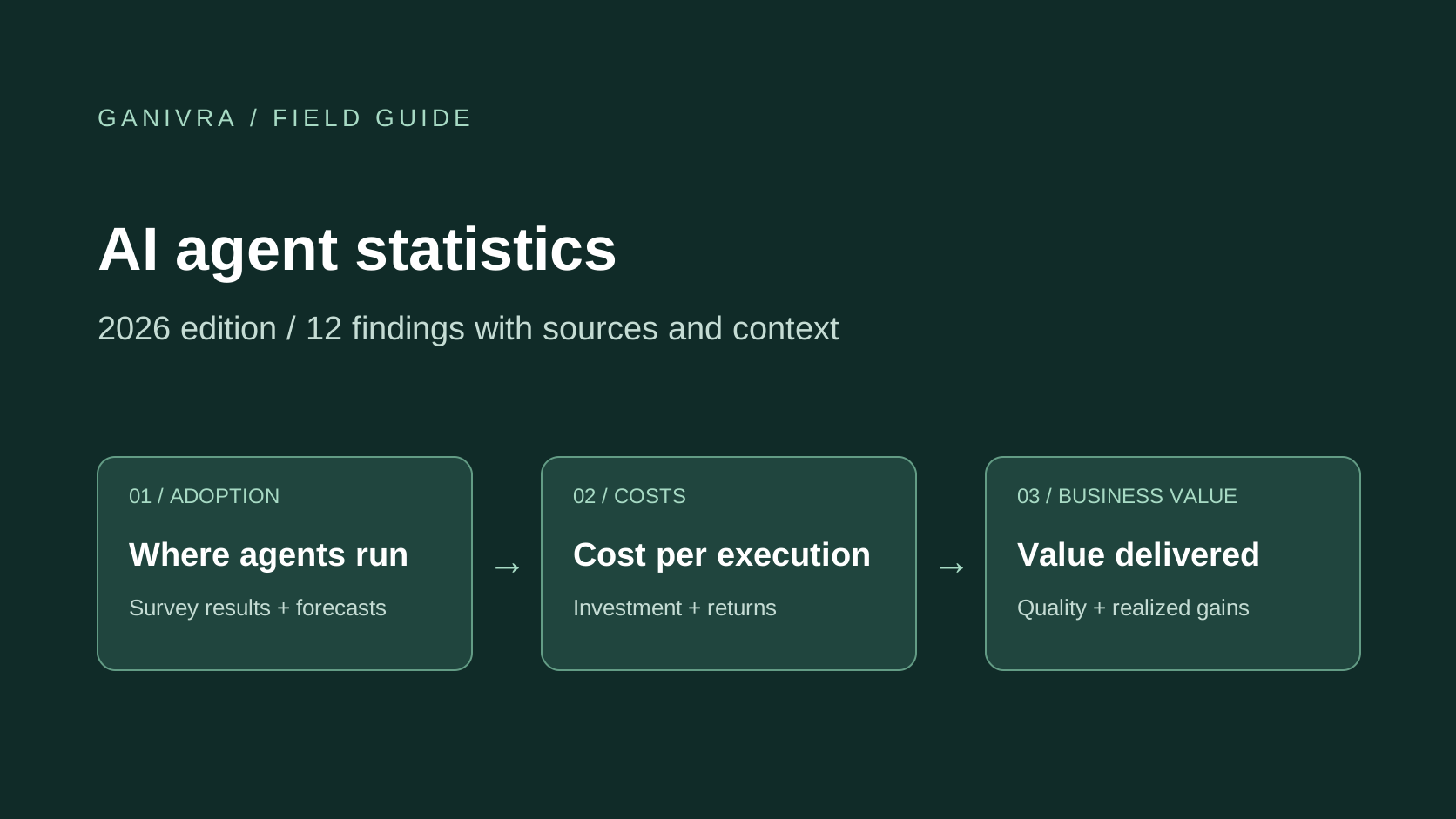
Adoption is not proof of profitability, and benchmark performance is not ROI. Use AI agent statistics to frame a test, then measure complete execution costs and verified outcomes. Keep general AI findings separate from agent-specific evidence, and treat forecasts as expectations rather than achieved results.
How to interpret these AI agent statistics
Ganivra reviewed this editorial collection on September 24, 2026. It links to original survey publishers and vendor engineering reports. It is not a systematic review, a market-size estimate, or a representative census of deployed agents.
McKinsey’s 2026 survey collected 1,719 responses across 97 nations during May 4–June 8. PwC’s cited survey covers 300 senior executives in May 2025. Findings from these different samples should not be treated as a time series. Several entries share a source and are not independent confirmations.
For this guide, an agent selects and performs steps toward a task using models and tools; a multi-agent system coordinates multiple such workers. Individual sources may use broader or narrower definitions. The year in the title identifies this edition, not the observation date of every statistic.
| Evidence | Useful for | Key limitation |
|---|---|---|
| Survey responses | Understanding reported adoption and perceived benefits | Not an audit of deployment depth or financial results |
| Vendor observations and evaluations | Understanding one architecture and workload | Not a universal production benchmark |
| Analyst forecasts | Considering possible future demand and risk | Not a measured current outcome |
Publishers may have commercial interests in AI adoption. The measurement suggestions below are Ganivra’s interpretation, not findings attributed to the cited research.
AI agent adoption and scaling statistics
1. 40% of large-organization respondents reported scaling agents
Survey · May–June 2026
McKinsey reports this for organizations above $1 billion in annual revenue, versus 22% among smaller organizations. Read the original source.
Interpret carefully: Scaling in one or more functions differs from enterprise-wide deployment.
What to measure: Separate pilots, production workflows, and organization-wide rollout.
2. 32% reported avoiding a software purchase because of coding agents
Survey · May–June 2026
McKinsey respondents said their organizations built at least one product or feature internally instead. Read the original source.
Interpret carefully: Avoiding a purchase does not prove lower total ownership cost.
What to measure: Include engineering, maintenance, inference, and incident costs in build-versus-buy analysis.
3. 79% of surveyed executives said their companies were adopting agents
Executive survey · May 2025
PwC surveyed 300 senior executives; this is their reported adoption share. Read the original source.
Interpret carefully: Adoption includes different levels of maturity and is not a global production rate.
What to measure: Define what an active agent workflow means before comparing adoption figures.
AI agent token usage and operating costs
4. About one in five respondents said operating costs constrained AI use
Survey · May–June 2026
McKinsey reports constraints from AI operating costs, including tokens. Read the original source.
Interpret carefully: This finding covers AI broadly, not agents alone.
What to measure: Identify which workloads are being limited and their cost per completed outcome.
5. Agents used about 4× the tokens of chats in Anthropic’s data
Vendor engineering observation · June 2025
Anthropic reported this ratio while describing its research system. Read the original source.
Interpret carefully: This is a workload-specific observation, not a universal cost multiplier.
What to measure: Measure actual token categories and supplier rates for your own executions.
6. Multi-agent systems used about 15× the tokens of chats in the same account
Vendor engineering observation · June 2025
Anthropic reported higher token consumption for multi-agent work relative to chat. Read the original source.
Interpret carefully: The comparison is to chats, not to single-agent runs; token ratios are not dollar ratios.
What to measure: Track subagent work, tools, retries, and duplicate effort under one execution.
Reported business value and performance
7. 66% of agent adopters reported increased productivity
Executive survey · May 2025
PwC reports this among respondents adopting agents. Read the original source.
Interpret carefully: This is the share reporting a benefit, not a 66% productivity improvement.
What to measure: Compare verified output per paid hour with a matched baseline.
8. 57% of agent adopters reported cost savings
Executive survey · May 2025
PwC also reports savings among its adopting respondents. Read the original source.
Interpret carefully: The statistic does not quantify savings or establish audited net ROI.
What to measure: Reconcile realized savings with implementation and ongoing delivery costs.
9. A multi-agent configuration improved an internal research evaluation by 90.2%
Vendor evaluation · June 2025
Anthropic compared Opus 4 with Sonnet 4 subagents against single-agent Opus 4. Read the original source.
Interpret carefully: An internal evaluation gain is not business ROI or a guaranteed production result.
What to measure: Evaluate quality, latency, and cost together on representative customer tasks.
10. 37% attributed a positive enterprise EBIT impact to AI
Survey · May–June 2026
McKinsey reports this across AI use generally. Read the original source.
Interpret carefully: It does not isolate agent contribution. EBIT means earnings before interest and taxes.
What to measure: Distinguish workflow-level gains from company-wide financial results.
Agentic AI forecasts and investment risk
11. Gartner predicts over 40% of agentic AI projects will be cancelled by 2027
Analyst forecast · June 2025
Gartner cites rising costs, unclear value, and inadequate risk controls in this forecast. Read the original source.
Interpret carefully: This is not a measured 2026 failure rate.
What to measure: Set cost and outcome thresholds for continuing, redesigning, or stopping a pilot.
12. Gartner predicts agentic AI in 33% of enterprise software applications by 2028
Analyst forecast · June 2025
The forecast compares that share with less than 1% in 2024. Read the original source.
Interpret carefully: An application containing agentic features need not deliver autonomous or profitable workflows.
What to measure: Measure actual usage and outcomes of embedded features.
Measure the economics of your own AI agents
For the broader spending and visibility context, explore AI Cost Management Statistics: Spending, Visibility, and Unit Economics.
The practical decision is whether a workflow produces enough useful value for its full cost. A larger agent system can be worthwhile for difficult research and wasteful for a simple lookup. Compare architectures on representative tasks at a stated quality threshold.
Cost per verified outcome = total relevant execution costs ÷ verified outcomes
Include failed attempts, retries, model calls, paid tools, orchestration infrastructure, and human review where relevant. Keep a clear distinction between the costs captured in telemetry and the additional delivery costs in finance records. If there are no verified outcomes, report the spend and failure count instead of dividing by zero.
A worked comparison: better success can still cost more per result
Suppose two configurations each attempt 1,000 comparable tasks. These figures are illustrative, not research results. The example counts model and tool costs only.
| Measure | Configuration A | Configuration B |
|---|---|---|
| Verified outcomes | 800 | 900 |
| Model and tool costs across all attempts | $160 | $270 |
| Success rate | 80% | 90% |
| Model and tool cost per verified outcome | $0.20 | $0.30 |
Configuration B completes 100 more tasks but costs $110 more, or $1.10 in additional measured spend per additional outcome in this batch. Whether that is worthwhile depends on the value and quality of the additional results and any change in other costs. Neither success rate nor token count answers the question alone.
Connect execution data to product decisions
- Attribute costs: preserve customer, feature, workflow, and execution identifiers across models and tools.
- Track the expensive tail: inspect high-cost runs and the loops or failures behind them.
- Verify outcomes: check the resulting state or deliverable rather than relying only on a successful API response.
- Compare cohorts: separate task complexity, model versions, customer plans, and prompt changes.
- Connect to revenue: compare selling prices with complete delivery costs before expanding allowances.
Ganivra records model and MCP consumption with customer and workflow context. Use the AI metering guide to define the event model and the MCP cost tracking guide to connect agent steps. Outcome verification, human-review costs, and revenue records complete the business analysis.
For deeper applications, explore agentic workflow economics, AI customer service statistics, and AI subscription profitability. If consumption rises under fixed pricing, growing usage can reduce profit even while task performance improves.
Frequently asked questions about AI agent statistics
What percentage of companies use AI agents?
There is no single comparable global rate in these sources. PwC's 2025 executive survey reports adoption, while McKinsey's 2026 survey distinguishes scaling by organization size and scope. Compare definitions and populations before comparing percentages.
Do AI agents cost 15 times more than chatbots?
Not as a universal rule. Anthropic reported about 15 times the token consumption for multi-agent systems versus chats in its June 2025 engineering account. Dollar cost also depends on models, token categories, tool fees, and workload design.
Do AI agents have proven business value?
Some surveyed adopters report productivity gains and cost savings, and vendor evaluations show performance gains in specific tasks. These results do not establish a universal ROI. Measure realized benefits against complete costs for your workflow.
Are these statistics all from 2026?
No. This September 2026 edition combines dated 2026 survey findings with earlier executive research, vendor engineering observations, and forecasts. Each entry states its evidence type and period.
Measure your own agent economics
See the model and tool costs behind each agent run.
Connect one workflow to Ganivra and inspect its customer-level AI costs. Start a 14-day trial with no credit card required.