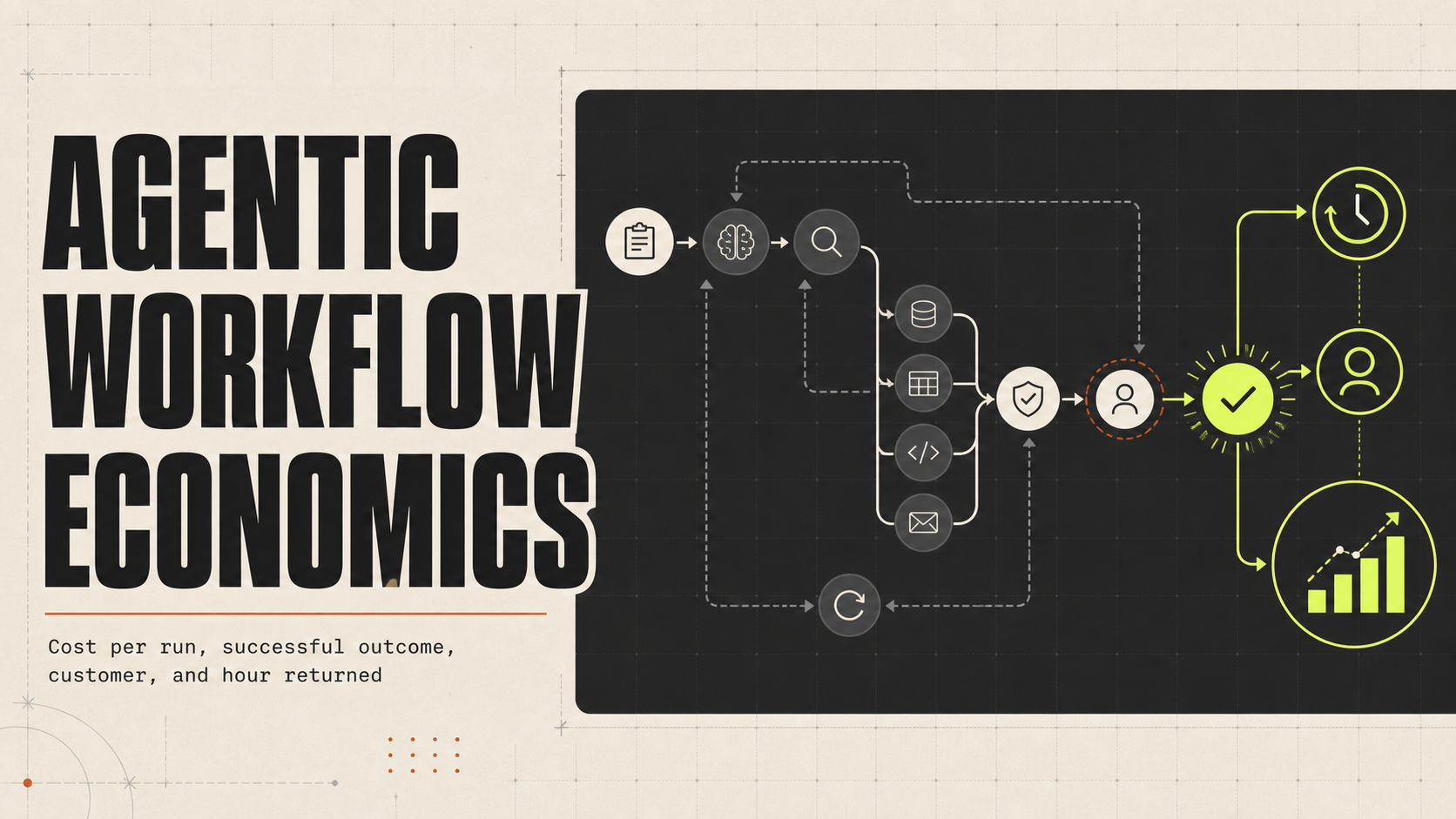
Agentic workflow automation economics measures the cost and value of a completed business outcome. Add orchestration, model, retrieval, tool, retry, sub-agent, human-review, failure, and implementation costs. Divide the loaded total by workflows that meet a defined success standard. Then compare it with baseline labor, error cost, cycle time, customer revenue, and verified hours returned.
What makes workflow automation agentic?
Traditional automation follows predetermined rules. An agentic workflow can interpret context, choose actions, call tools, observe results, and adjust its next step within explicit limits.
The unit is not an agent turn or tool call. It is the complete workflow outcome the business would otherwise pay a person or system to produce.
The distinction matters because flexibility changes the cost curve. A fixed workflow has a known number of steps. An agent can take different paths for two similar inputs: retrieve more context, call another system, retry a failed action, delegate to a sub-agent, or request human approval.
| Approach | Best fit | Economic behavior |
|---|---|---|
| Deterministic workflow | Stable rules, structured data, predictable systems | Known step count and easier cost forecasting |
| RPA | Repeatable interface actions where APIs are unavailable | Low inference cost but maintenance cost when interfaces change |
| Copilot | A person retains control and requests assistance | Model cost plus partially retained human labor |
| Agentic workflow | Variable inputs and bounded judgment across tools | Path-dependent cost, success, and human-intervention variance |
“Agentic” should not be a goal by itself. Use the least complex system that reliably produces the business outcome.
The agentic workflow cost stack
One run can include planning, retrieval, several model calls, paid APIs, retries, validation, and a human approval or exception path.
- 01Trigger and orchestration
Workflow platform, scheduling, queueing, state, durable execution, and event transport.
- 02Planning and reasoning
Model calls for classification, decomposition, routing, decisions, and response generation.
- 03Retrieval and memory
Search, embeddings, vector storage, reranking, state summaries, and context growth.
- 04Tools and enterprise APIs
CRM, ERP, browser, payments, documents, enrichment, email, and paid data services.
- 05Sub-agents and coordination
Delegated work, parallel execution, context transfer, aggregation, and reconciliation.
- 06Validation and retries
Evaluators, policy checks, schema failures, corrected actions, and fallback models.
- 07Human intervention
Approval, exception handling, correction, queue time, and duplicated investigation.
- 08Operations and risk
Implementation, monitoring, audits, incidents, access control, and error loss.
A model call can be inexpensive while the workflow is costly. Paid tools, repeated context, a long-tail retry loop, or ten minutes of specialist review can dominate the run. The complete execution graph—not the provider invoice—is the economic record.
Agentic workflow unit-economics formulas
Calculate attempted-run cost and successful-outcome cost side by side. The gap shows the burden of failures, retries, and rework.
variable_cost_per_run = model + retrieval + tools + orchestration + retry + sub_agent_cost
loaded_cost_per_success = (execution + human_review + rework + allocated_platform_and_ops) ÷ successful_workflows
hours_returned = baseline_human_hours − remaining_review_rework_and_exception_hours
workflow_ROI = (labor_value_returned + avoided_error_loss + incremental_value − program_cost) ÷ program_cost
customer_contribution = attributed_revenue − attributed_workflow_cost − service_cost
Do not count “time saved” before subtracting review and correction time. Do not count avoided errors unless the baseline loss and the automation’s incremental effect can be supported.
Worked example: invoice-exception workflow
The following values are illustrative—not a vendor quote, customer result, or industry benchmark. They show how to move from an automation rate to a workflow P&L.
| Input | Illustrative value | Economic result |
|---|---|---|
| Monthly workflows | 5,000 invoice exceptions | 1,500 baseline human hours at 18 minutes each |
| Baseline labor | $36 loaded hourly cost | $54,000 monthly baseline |
| Straight-through success | 3,750 workflows | 75% require no human intervention |
| Human-assisted completion | 750 × 8 minutes | $3,600 remaining review labor |
| Manual fallback | 500 × 18 minutes | $5,400 remaining exception labor |
| Agentic execution | $3,000 | $0.60 average variable cost per attempted run |
| Platform and operations allocation | $2,000 | Monitoring, knowledge, evaluation, and implementation |
| New monthly workflow cost | $14,000 | $2.80 loaded cost per completed workflow |
| Human hours returned | 1,250 hours | $40,000 net monthly cost reduction before error-value claims |
Useful for engineering, incomplete for operations and finance.
Includes remaining review, fallbacks, platform, and operations.
The largest lever may not be token optimization. Moving the assisted cohort to straight-through success, shortening review, or preventing a high-cost tool retry can return more capacity.
Agentic workflow economics by industry
The measurement contract can stay consistent while each industry defines a different successful outcome and error cost.
| Function or industry | Useful workflow outcome | Costs hidden by run counts |
|---|---|---|
| Finance operations | Invoice exception resolved, reconciliation completed, or close task accepted | Specialist review, ERP actions, duplicate payment risk, and audit work |
| Insurance | Claim intake completed, evidence classified, or case safely routed | Document processing, policy checks, adjuster time, and error severity |
| Sales and marketing operations | Account researched, lead qualified, campaign prepared, or CRM updated | Paid enrichment, duplicate records, approval time, and attribution errors |
| IT operations | Incident triaged, runbook step completed, or service restored | Tool fan-out, on-call intervention, downtime, and unsafe remediation |
| Supply chain and logistics | Order exception resolved, shipment rerouted, or supplier case completed | Carrier APIs, delay cost, inventory impact, and cross-party communication |
| B2B SaaS and back office | Account provisioned, renewal packet prepared, or customer operation completed | Customer tier, tool access, bespoke policy, and contract margin |
For a COO, the decision is throughput, control, and capacity. For finance, it is loaded cost and error exposure. For product and engineering, it is execution reliability and root cause. For an agentic automation startup, it is cost-to-serve and gross margin by customer.
Agentic workflow metrics worth tracking
| Metric | What it reveals | Decision it supports |
|---|---|---|
| Attempted, completed, accepted, and failed | The workflow outcome funnel | Eligibility, scope, and reliability |
| Straight-through and assisted success | How much work is genuinely autonomous | Review design and capacity planning |
| Model, retrieval, tool, and sub-agent calls | Execution complexity and fan-out | Architecture and routing |
| Retry, fallback, and rework rate | Waste and fragile workflow stages | Prompt, schema, tool, and policy fixes |
| Cost per run and successful workflow | Infrastructure versus outcome economics | Budgeting, pricing, and optimization |
| Human review and exception time | Remaining labor and bottlenecks | Approval policy and staffing |
| Error loss and cycle time | Business impact beyond execution cost | Risk boundaries and rollout scope |
| Cost and contribution by customer | Who creates or erodes margin | Contracts, limits, and expansion |
| Unpriced usage coverage | How much cost remains unknown | Catalog and reconciliation work |
A machine-readable agentic workflow event
Use one execution ID across model and tool steps, and keep workflow, customer, prompt, autonomy, review, and outcome metadata explicit:
{
  "event_id": "evt_workflow_3197",
  "execution_id": "wf_invoice_6c42",
  "step_id": "step_validation_08",
  "parent_step_id": "step_tool_07",
  "provider": "openai",
  "model": "workflow-model",
  "operation": "validate_exception_resolution",
  "input_tokens": 2680,
  "output_tokens": 244,
  "cached_input_tokens": 1700,
  "latency_ms": 926,
  "status": "success",
  "environment": "production",
  "provider_reported_cost_usd": 0.0342,
  "attributes": {
    "application": "finance-ops",
    "workflow": "invoice_exception_resolution",
    "feature": "agentic_workflow",
    "customer_id": "acct_1042",
    "conversation_id": "wf_invoice_6c42",
    "prompt_id": "invoice-validator",
    "prompt_version": "v21",
    "autonomy_level": "human_on_exception",
    "workflow_outcome": "accepted",
    "human_review_required": false,
    "attempt_number": 1
  }
}
Send separate events for retrieval, MCP tools, paid APIs, sub-agents, evaluators, and retries with the same execution_id. Cost telemetry does not need documents, prompts, responses, tool arguments, credentials, or personal data.
How to measure agentic workflow automation ROI
Instrument one bounded, high-volume workflow before expanding autonomy. A measurable outcome and reliable baseline matter more than a sophisticated agent graph.
- 01Define the business outcome
Specify what successful completion means, how it is verified, and the cost of a wrong or incomplete result.
- 02Measure the current baseline
Capture human time, software, rework, error loss, cycle time, and throughput for the same workflow cohort.
- 03Create one workflow execution ID
Pass a stable identifier through planning, model, retrieval, tool, sub-agent, retry, and approval steps.
- 04Capture variable and human cost
Record usage, provider-reported or catalog cost, latency, status, retry, review time, and exception handling.
- 05Attach customer and commercial context
Add customer, plan, workflow, prompt and policy version, application, and revenue allocation at the source.
- 06Monitor outcomes and economics together
Alert on cost per success, failure loss, human intervention, hours returned, customer margin, and unpriced usage.
Ganivra’s integration guide shows how to capture model and MCP tool events through one contract, attach customer and workflow context, and join every execution step. The full trace explains why two runs of the same workflow can have different cost and margin.
When not to use an AI agent
An agent is an economic liability when its flexibility does not create incremental value. Prefer a deterministic workflow when inputs are structured, actions are known, exceptions are rare, and rules can be maintained reliably.
- The success condition is ambiguous: if you cannot verify the outcome, you cannot manage reliability or ROI.
- The action is difficult to reverse: use policy gates or human approval where an incorrect action creates unacceptable harm.
- Required data or tools are unreliable: an agent cannot compensate economically for broken system foundations.
- Workflow volume is too low: implementation and operational cost may never be repaid.
- A rules engine already works: adding probabilistic reasoning can increase cost and variance without improving the outcome.
The better architecture is often hybrid: deterministic rails for known steps, agentic reasoning for bounded ambiguity, and risk-based human review for high-impact actions.
For customer-service workflows, continue with the AI customer support economics guide. For voice automation, see Voice AI unit economics. For tool-heavy agents, read the MCP cost tracking guide.
Agentic workflow automation FAQ
What is agentic workflow automation?
Agentic workflow automation is business-process automation in which an AI system can interpret a goal, choose among permitted actions, use models and tools, observe results, and retry, escalate, or stop within defined controls. The workflow should still have explicit success, budget, risk, and approval boundaries.
How is agentic automation different from RPA or traditional workflow automation?
Traditional automation and RPA follow predetermined rules and paths. Agentic automation adds judgment for variable inputs, ambiguous cases, and dynamic action selection. Deterministic automation is usually preferable when the process is stable and rules can be expressed reliably; use agents where interpretation and adaptation create enough value to justify the added variance and cost.
How do you calculate agentic workflow ROI?
Measure the baseline labor, software, rework, error loss, and cycle time for the same business outcome. Subtract the loaded cost of the agentic program, remaining human review, rework, and failures. Divide the net benefit by the agentic program cost, and keep cost savings separate from estimated revenue or risk benefits.
How much does an AI agent workflow cost per run?
There is no universal rate. Cost per run includes orchestration, planning and model calls, retrieval and memory, tool or API fees, sub-agents, validation, retries, infrastructure, and human intervention. Report both average cost per attempted run and loaded cost per successful workflow.
Why can the same AI agent workflow have very different costs?
Agentic paths can vary with input complexity, planning depth, context growth, tool fan-out, model routing, retries, sub-agent delegation, validation, and exception handling. Use step and execution identifiers to explain the distribution rather than relying only on an average.
How should human-in-the-loop cost be measured?
Track which workflow stage requested intervention, queue time, review time, correction or rework time, loaded reviewer cost, and whether the workflow succeeded afterward. Blanket review of every output may preserve quality while eliminating much of the capacity benefit, so measure hours returned after review—not before.
Which processes are good candidates for agentic workflow automation?
Good candidates have meaningful volume, variable but interpretable inputs, access to reliable systems, a verifiable outcome, tolerable or controllable error cost, and enough labor, delay, or revenue value to justify implementation. Examples include invoice exceptions, document intake, account research, incident triage, order exceptions, and CRM operations.
When should a company not use an AI agent?
Avoid an agent when deterministic rules solve the process reliably, the business outcome cannot be verified, required tools or data are unreliable, volume is too low to repay implementation, or an incorrect autonomous action could create unacceptable harm. Use narrower assistance or mandatory approval for high-risk steps.
Are multi-agent workflows more expensive?
Usually they add model calls, context transfer, coordination, validation, and failure paths. That cost can be worthwhile when specialization materially improves success or parallel work reduces cycle time. Compare the complete multi-agent workflow against a simpler single-agent or deterministic baseline using the same outcome standard.
How do I compare LangGraph, CrewAI, n8n, Zapier Agents, and custom agent costs?
Normalize each option into the same ledger: fixed platform cost, model and retrieval usage, tool fees, infrastructure, retries, human review, operations, and successful outcomes. Framework pricing and hosting choices are inputs; cost per successful workflow and engineering burden make the comparison economically meaningful.
How do agentic automation startups track gross margin by customer?
Attach a stable customer ID, contract or revenue allocation, workflow, prompt and policy version, tool, outcome, retry, and review state to every execution. Attribute variable and allocated costs to that customer, then calculate contribution and gross margin by workflow and account.
Does AI workflow cost tracking require prompts or tool arguments?
No. Unit economics can usually be measured with metadata: execution and step IDs, provider, model, token or time usage, tool identity, direct cost, latency, status, retry, customer, workflow, prompt version, approval state, and outcome. Keep sensitive business content and credentials out of cost telemetry.
What is a good success rate for an agentic workflow?
There is no universal target because the process, eligibility rules, error cost, and success definition differ. Measure straight-through success, assisted success, failure, rework, and business loss by comparable workflow cohort. The acceptable rate is the one that meets the required quality and risk threshold while producing positive economics.
How can teams reduce agentic workflow cost without reducing reliability?
Target frequent avoidable waste: unnecessary planning turns, oversized context, duplicate retrieval, excessive tool fan-out, repeated failed actions, overused premium models, and blanket human review. Test changes against successful outcomes, rework, latency, error loss, and customer impact—not token cost alone.
Make every workflow economically legible
See cost per successful outcome, customer margin, and human time returned.
Ganivra connects model, MCP tool, retry, prompt, workflow, and customer costs to the business outcome each agentic execution produced.