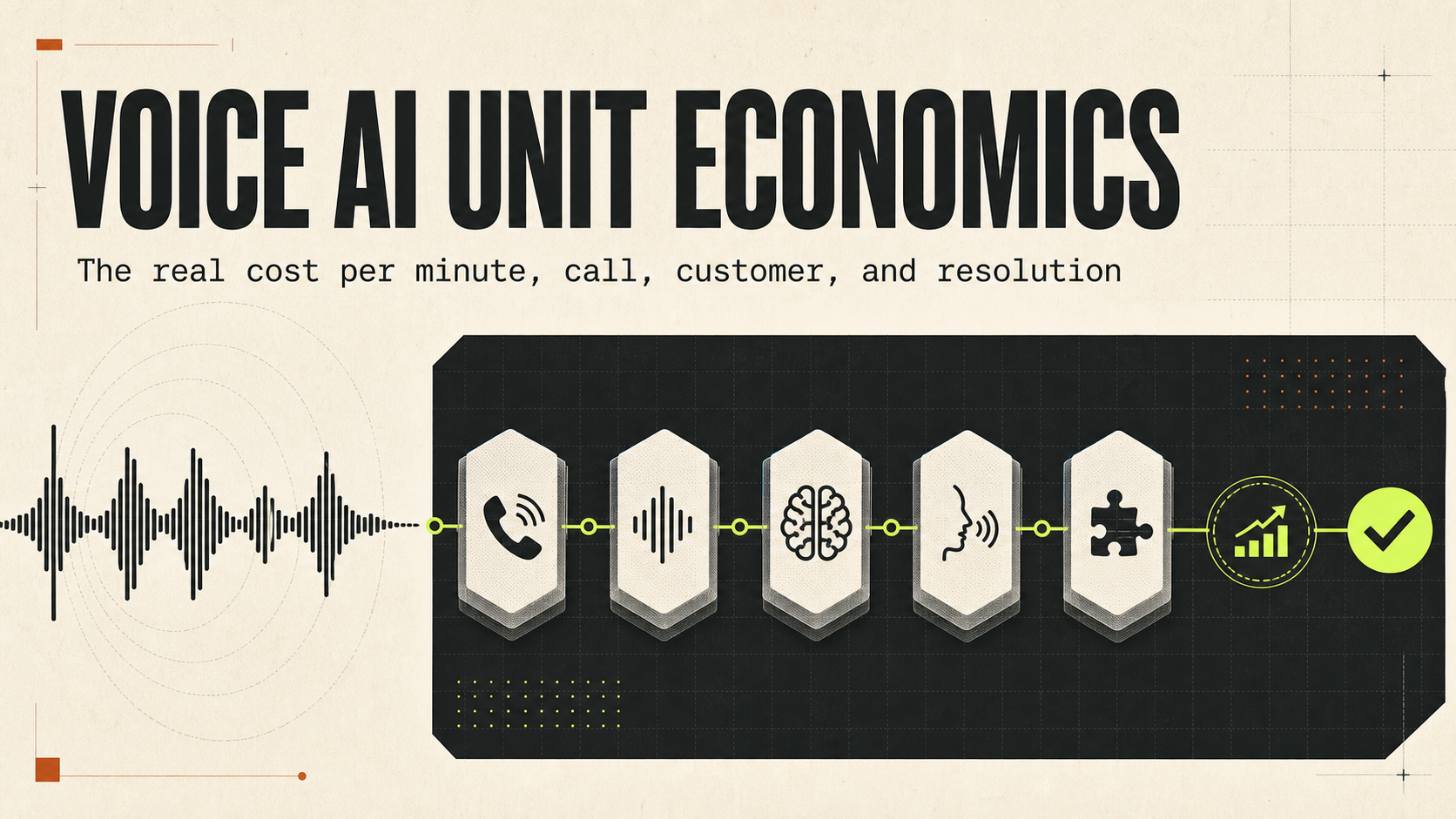
Voice AI unit economics measures what each useful outcome costs and earns. Add telephony, orchestration, speech recognition, model reasoning, speech synthesis, tools, retries, fallbacks, human handoffs, and allocated operations cost. Attribute the total to a call, successful resolution, and customer; then compare it with revenue. Cost per minute is an input. Cost per resolved call and gross margin per customer are the decisions.
Why “cost per minute” is only the beginning
Founders evaluating voice AI pricing often start with a simple query: How much does an AI voice agent cost per minute? That number is useful for normalization, but it does not say whether the product works economically.
A four-minute call that resolves a support issue can be more valuable than a two-minute call that fails and causes a repeat contact. A cheap model that misunderstands an address, retries a tool, and escalates to a person can cost more than a stronger model that completes the workflow once.
Measure the unit your customer buys: a resolved case, booked appointment, qualified lead, collected payment, or completed workflow.
This moves the conversation from an infrastructure bill to AI unit economics: what did the outcome cost, which customer caused it, and did the revenue leave enough contribution to build a durable company?
The complete voice AI cost stack
An all-in voice agent cost is a chain, not a single vendor line item. The exact architecture varies, but a production ledger usually needs these seven layers.
- 01Telephony
Inbound or outbound carrier minutes, phone numbers, recording, transfer, and regional rates.
- 02Orchestration
The voice-agent platform, session runtime, concurrency, and routing layer.
- 03Speech recognition
Streaming transcription, language detection, and specialized vocabulary.
- 04Model reasoning
Realtime or text-model tokens, cached context, routing, and safety checks.
- 05Speech synthesis
Voice generation, premium voices, languages, and audio output duration.
- 06Tools and retrieval
CRM, scheduling, search, payments, knowledge retrieval, and other paid APIs.
- 07Failure and operations
Retries, fallbacks, human handoffs, repeat calls, quality review, and support.
Published rates can help with planning, but your observed cost depends on call length, silence, model turns, cache behavior, tool fan-out, failure rate, geography, and negotiated contracts. A production ledger should use versioned catalog rates or provider-reported cost and mark unknown usage as unpriced—not zero.
Voice AI unit-economics formulas
Use a small set of formulas consistently. Write the scope beside every metric so finance and engineering calculate the same thing.
voice_stack_cost_per_minute = telephony + orchestration + STT + LLM + TTS + allocated_tool_cost
loaded_cost_per_resolution = (AI_stack_cost + handoff_cost + QA_and_ops_cost) ÷ successful_resolutions
customer_gross_margin = (customer_revenue − attributed_cost_to_serve) ÷ customer_revenue
Also track unpriced_usage ÷ total_usage. A margin number built on missing rates is an estimate with false precision.
Worked example: the cheap minute that hides an expensive outcome
The following numbers are illustrative—not a vendor quote or market benchmark. They show why the denominator changes the story.
| Input | Illustrative value | Calculation |
|---|---|---|
| Connected calls | 10,000 per month | 40,000 connected minutes at 4 minutes each |
| Blended voice stack | $0.12 per minute | $4,800 AI stack cost |
| Autonomous resolutions | 70% | 7,000 successful AI resolutions |
| Human handoffs | 3,000 × 3 minutes × $0.45 | $4,050 loaded handoff cost |
| QA and operations | $600 | Allocated monthly cost |
| Total cost-to-serve | $9,450 | $1.35 per AI-resolved call |
| Customer revenue | $18,000 | 47.5% gross margin |
Counts $4,800 of voice infrastructure against $18,000 revenue.
Adds handoffs and operations required to deliver the outcome.
The product may still be attractive. But now the team can see the real levers: containment, handoff duration, call length, price, and the cost of failed automation—not merely the model rate.
Why voice AI margin must be measured by customer
A blended average can make an unhealthy account disappear. One customer may use a premium voice in three languages, send long calls, trigger five CRM actions, and negotiate a low fixed price. Another may run short, predictable appointment confirmations on a usage-based plan. They are not the same economic product.
Customer-level attribution reveals which accounts, workflows, languages, prompt versions, and commercial terms create or erode contribution. That supports specific decisions: adjust price, introduce a fair-use limit, route simple turns to a cheaper model, improve a high-retry tool, or redesign the workflow.
If you cannot connect a call to a customer and revenue model, you can optimize infrastructure spend but you cannot manage customer profitability.
Ganivra is built for this connection: model and tool consumption is attributed to the customer, feature, workflow, execution, and revenue context that caused it. The resulting view turns a cost graph into a pricing and product decision.
Voice AI metrics worth tracking
| Metric | What it answers | Decision it supports |
|---|---|---|
| Attempted, connected, completed, resolved | Where calls fail in the funnel | Routing, carrier, workflow, or UX fixes |
| Connected minutes | The billable duration base | Silence, latency, and call-length control |
| Containment and repeat contact | Whether automation truly solved the issue | Quality versus deflection trade-offs |
| Human handoff rate and duration | Residual labor required | Automation scope and staffing |
| Cost per minute, call, and resolution | Input, execution, and outcome economics | Architecture, pricing, and packaging |
| Cost and margin by customer | Who creates contribution | Contracts, limits, and expansion |
| Cost by prompt or model version | Whether a release changed economics | Roll back, route, or optimize |
| Unpriced usage coverage | How much spend is economically unknown | Catalog and reconciliation work |
A machine-readable voice AI cost event
Join each model or tool step under the call execution, while keeping customer and outcome metadata explicit. A Ganivra event can look like this:
{
  "event_id": "evt_voice_0182",
  "execution_id": "call_7f31",
  "step_id": "step_model_03",
  "provider": "openai",
  "model": "realtime-model",
  "operation": "voice_response",
  "input_tokens": 1840,
  "output_tokens": 226,
  "cached_input_tokens": 960,
  "latency_ms": 612,
  "status": "success",
  "environment": "production",
  "provider_reported_cost_usd": 0.0314,
  "attributes": {
    "application": "voice-platform",
    "workflow": "inbound_support_call",
    "feature": "voice_agent",
    "customer_id": "acct_1042",
    "conversation_id": "call_7f31",
    "prompt_id": "support-router",
    "prompt_version": "v18",
    "channel": "voice",
    "call_outcome": "resolved",
    "connected_seconds": 247,
    "handoff_required": false
  }
}
Send separate events for other paid steps, using the same execution_id. Keep transcripts, recordings, tool arguments, responses, credentials, and personal data out of cost telemetry. Stable IDs and operational metadata are enough for unit economics.
How to measure voice AI unit economics
Start with one production workflow and one outcome definition. The implementation is small when the event contract is shared across the stack.
- 01Define the economic outcome
Choose the unit the buyer values: a resolved support call, booked appointment, qualified lead, collected payment, or completed workflow.
- 02Create one call execution ID
Pass a stable identifier through telephony, speech, model, tool, and handoff steps so the complete cost can be joined.
- 03Capture every variable cost
Record provider, model, tokens or seconds, direct cost, latency, retry, and outcome for each execution step.
- 04Attach customer and product context
Add customer, plan, workflow, language, prompt version, and revenue allocation at the source.
- 05Calculate loaded outcome cost
Include failed attempts, repeat calls, human escalation, and allocated QA or operations cost in the denominator you use.
- 06Set margin and regression alerts
Alert on changes in cost per outcome, resolution rate, unpriced coverage, or customer gross margin.
Ganivra’s integration guide shows how to send model and MCP events through one API, attach customer and workflow context, and connect steps under an execution. The same contract works for voice model calls, CRM tools, retrieval, and other downstream actions. Preserve channel direction and its funnel using the inbound versus outbound Voice AI economics guide.
What to optimize after you can see the ledger
Do not begin with the most expensive call. Begin with expensive behavior that is frequent, avoidable, and material to margin.
- Dead air and latency: reduce time billed without advancing the conversation.
- Oversized context: retrieve less, summarize state, and use cached input deliberately.
- Model routing: reserve premium reasoning for turns where it improves the outcome.
- Tool fan-out: remove duplicate or speculative CRM, search, and validation calls.
- Retries and fallbacks: fix brittle schemas, timeouts, and prompts that repeat work.
- Slow handoffs: transfer earlier and carry structured context into the human queue.
- Underpriced customers: align contracts with actual call length, complexity, and service level.
Evaluate every change against resolution, conversion, repeat contact, latency, and customer experience. A lower bill with a worse outcome is not an efficiency gain.
For tool-heavy voice workflows, continue with the complete guide to MCP cost tracking.
Voice AI unit economics FAQ
How much does a voice AI agent cost per minute?
The all-in cost per connected minute is the sum of telephony, orchestration, speech-to-text, model reasoning, text-to-speech, and allocated tool or retrieval costs. There is no universal rate: architecture, model and voice choices, geography, concurrency, silence handling, and vendor contracts change the result. Measure the blended stack in your own production traffic.
How do you calculate the true cost of an AI voice agent?
Join every paid step under a call or execution ID, sum the voice stack cost, add retries, fallbacks, quality assurance, and human handoff cost, then divide by the business outcome you sell. Cost per successful resolution, booking, or qualified lead is usually more useful than cost per minute alone.
What is cost per resolved call?
Cost per resolved call is total cost-to-serve divided by calls successfully completed to the defined standard. A loaded calculation includes the AI stack, failed attempts, repeat contacts, human handoffs, and allocated quality or operations cost—not only the minutes used by calls that succeeded.
How should I compare voice AI with a human call center?
Compare like-for-like outcomes. Include the AI stack, supervision, QA, handoffs, repeat calls, and failure cost; compare that with loaded agent labor, telephony, software, management, occupancy, and the same quality threshold. Also compare availability, latency, conversion, and customer experience rather than treating cost as the only result.
Why can advertised voice AI pricing differ from all-in cost?
A headline platform or model rate may cover only one layer. Production calls can also incur carrier minutes, transcription, speech generation, model tokens, retrieval, paid tools, recording, concurrency, retries, and human escalation. Normalize every component into one call-level ledger before comparing vendors.
How do voice AI startups track gross margin by customer?
Attach a stable customer ID and plan or revenue allocation to every call execution. Attribute telephony, model, speech, tool, retry, and handoff cost to that customer, then calculate contribution profit and gross margin. Customer-level views expose long-call, high-retry, or underpriced accounts hidden by blended averages.
What is a good gross margin for a voice AI product?
There is no single correct benchmark because service level, human involvement, growth stage, and pricing model differ. Define a target that supports your operating model, calculate it consistently, and watch the trend by customer and use case. The useful question is whether the next successful outcome creates enough contribution to fund the business.
Does voice AI cost tracking require call recordings or transcripts?
No. Unit economics can usually be measured with metadata: call and execution IDs, customer, workflow, duration, providers, models, usage, cost, latency, outcome, retries, and handoff state. Avoid storing call content in cost telemetry unless a separate requirement and appropriate controls justify it.
Which metrics should a voice AI startup track?
Track attempted, connected, completed, and resolved calls; connected minutes; containment and repeat-contact rates; human handoffs; all-in cost per minute, call, and successful outcome; latency and quality indicators; cost and gross margin by customer, workflow, language, and model version; and the share of usage that remains unpriced.
How can a team reduce voice AI cost without hurting quality?
Start with expensive behavior that is frequent and avoidable: dead air billed as active time, oversized context, unnecessary model turns, duplicate tool calls, retries, slow handoffs, and premium models used for simple steps. Test changes against resolution, latency, conversion, repeat contact, and customer satisfaction—not cost alone.
Make each call economically legible
See cost per outcome and margin per customer—not just another usage total.
Ganivra connects voice model and tool consumption to calls, workflows, customers, and revenue so product, engineering, and finance can act on the same economics.