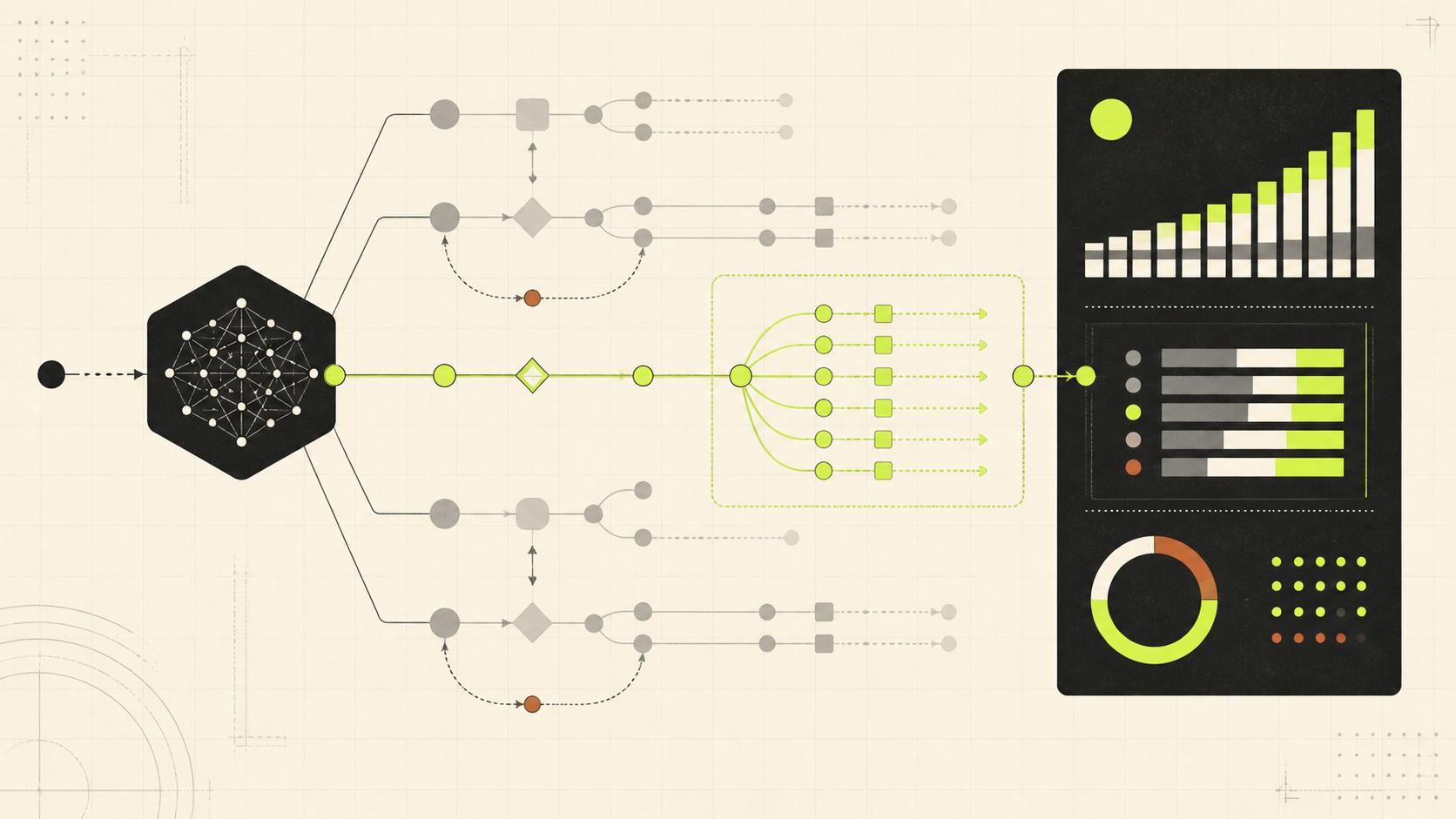
MCP cost tracking is execution-level cost attribution for AI agents. It links an MCP server and tool to its direct fee, downstream model calls, token usage, retries, latency, outcome, customer, feature, and workflow. With revenue metadata, the same trace can show cost-to-serve and gross margin.
What is MCP cost tracking?
New to usage measurement? Start with our AI metering guide for token tracking, customer attribution, and the relationship between usage and billing.
MCP cost tracking is the practice of measuring the complete economic impact of Model Context Protocol activity. The unit of analysis is not an isolated API request. It is an execution: the connected chain of model and tool steps required to produce one useful outcome.
A tool can have a direct price of zero and still create meaningful cost. A retrieval call may lead an agent to read a larger context, invoke a stronger model, validate the answer, or retry a failed step. Counting only the tool fee hides that downstream spend.
Attribute cost to the action that caused it, then connect that action to the customer and product outcome it served.
This is the difference between ordinary request monitoring and AI unit economics. Monitoring tells you that a tool was called. Unit economics tells you whether the resulting workflow created or destroyed margin.
Why provider bills are not enough for AI agents
Model-provider dashboards are useful for finance reconciliation, but they answer an infrastructure question: how much did the account spend? Product teams need a different set of answers:
- Which customer or tenant generated the cost?
- Which feature, workflow, and prompt version caused it?
- Which MCP tool triggered downstream model calls?
- Was extra spend caused by useful work, fan-out, or retries?
- Did the execution remain profitable after cost-to-serve?
Those dimensions live in your application, not on a provider invoice. They must be attached when the execution happens and joined through stable identifiers.
Accurate total, limited product context.
Customer, feature, tool, retry, and margin context.
The MCP cost measurement model
A useful measurement model has three layers: the event, the execution, and the economic entity. Keeping them separate makes the data flexible enough for engineering, product, and finance.
- 01Capture each step
Record model calls and MCP tool calls as events with timestamps, latency, outcome, and cost.
- 02Join the execution
Use one
execution_idacross the full agent run and parent-child step IDs when causality matters. - 03Attribute the outcome
Attach customer, feature, workflow, application, and prompt identifiers from your own product context.
- 04Add the economics
Compare attributed cost with revenue, credits, or plan allocation to calculate contribution and gross margin.
A machine-readable MCP cost event
Use explicit fields instead of packing important dimensions into labels. A compact event might look like this:
{
  "event_type": "mcp",
  "execution_id": "exec_72f1",
  "step_id": "step_02",
  "parent_step_id": "step_01",
  "mcp_server": "support-tools",
  "mcp_tool": "retrieve_policy",
  "customer_id": "acct_1042",
  "feature": "support_copilot",
  "workflow": "ticket_resolution",
  "latency_ms": 284,
  "outcome": "success",
  "cost_usd": 0.004
}
Keep tool content out of cost telemetry unless you have a separate, justified need for it. Arguments and results are usually unnecessary for spend attribution and can contain sensitive customer data.
Which MCP cost metrics should you track?
Start with metrics that lead to a decision. More telemetry is not automatically more useful.
| Metric | What it reveals | Typical decision |
|---|---|---|
| Direct tool cost | Paid API or infrastructure fee for the MCP step | Renegotiate, cache, or replace a provider |
| Linked model cost | Model spend caused after the tool call | Reduce context, fan-out, or model tier |
| Cost per execution | Complete cost of one user-visible outcome | Set a budget or routing threshold |
| Retry rate | Waste caused by failures or weak validation | Fix schemas, timeouts, or fallback logic |
| Cost by customer | Tenant-level cost-to-serve | Change price, limits, or support strategy |
| Gross margin | Revenue left after attributed AI cost | Invest, optimize, repackage, or retire |
Latency and outcome belong beside cost. A cheaper tool that fails twice can be more expensive—and worse for users—than a higher-priced tool that succeeds once.
How to implement MCP cost tracking
The goal is a durable attribution layer, not a second observability stack. Instrument one production workflow first, validate the economics, and then expand.
1. Define one useful execution
Choose a boundary that corresponds to a user or business outcome: resolve a ticket, research an account, produce a report, or complete an order. Generate the execution_id at that boundary and pass it through every model and tool step.
2. Capture model and MCP events through one contract
A shared event contract prevents separate datasets from drifting. Model events should include provider, model, input and output tokens, latency, and cost. MCP events should include server, tool, outcome, latency, direct cost, and an optional parent_step_id. See Ganivra’s MCP and model integration guide for a complete contract.
3. Attach product context at the source
Your application already knows the customer, feature, workflow, application, and prompt version. Add those stable identifiers before the event leaves the service. Avoid trying to reconstruct them later from logs or free-form strings.
4. Price known usage and preserve unknowns
Use versioned catalog prices, contract rates, or provider-reported cost. If a rate is unknown, keep it explicitly unpriced rather than silently treating it as zero. False zeroes make margin look healthier than it is.
5. Validate with an expensive execution
Open a real trace and ask whether the sum of its steps matches the execution total. Confirm that retries, cached tokens, tool fees, and downstream model calls appear once. Then verify that customer and feature totals reconcile upward.
6. Create decision thresholds
Examples include maximum cost per successful execution, retry-rate alerts, customer margin floors, or a prompt-version regression threshold. A metric becomes operational when it has an owner and a response.
From MCP observability to AI unit economics
Cost visibility becomes more valuable when it connects to revenue. For a usage-based product, revenue may be attached directly to a transaction. For a subscription product, allocate plan revenue across customers, workflows, or successful executions using a consistent rule.
contribution_profit = attributed_revenue − AI_cost
gross_margin = contribution_profit ÷ attributed_revenue
The resulting view supports concrete product decisions. A high-cost feature with strong retention and margin may deserve more investment. A popular workflow with negative contribution may need a smaller context window, a different model route, fewer tool calls, usage limits, or a pricing change.
Do not optimize every expensive execution. Optimize expensive behavior that is frequent, avoidable, and economically important.
Common MCP cost tracking mistakes
Counting only model tokens
This misses paid tools, retrieval infrastructure, and the causal relationship between a tool call and later model spend.
Treating every tool call as independent
Agent steps form a graph. Without execution and parent-step identifiers, fan-out and retry costs become invisible.
Using personal data as attribution metadata
Prefer stable tenant or account IDs over emails, names, prompts, tool arguments, or results. Cost analytics rarely needs raw content.
Setting unknown prices to zero
Zero is a real economic claim. Mark unknown cost as unpriced, then resolve it through a catalog, contract, or provider-reported amount.
Building dashboards without decisions
Every view should answer a question: where is margin eroding, what caused it, and what action should the team take?
Frequently asked questions
What is MCP cost tracking?
MCP cost tracking measures the direct cost and downstream AI spend associated with each Model Context Protocol server and tool call. It connects tool activity, model calls, retries, latency, and outcomes under one execution so teams can calculate the complete cost-to-serve.
Why is model-provider billing not enough for AI agents?
Provider bills aggregate token and model charges but usually do not identify the customer, feature, workflow, MCP tool, retry, or revenue event responsible for the spend. Agent unit economics require those dimensions to be joined at execution level.
Which metrics should teams track for MCP tools?
Track call count, direct tool cost, linked model cost, tokens, latency, outcome, retries, customer, feature, workflow, and execution ID. Add revenue or plan allocation when you need gross margin and contribution profit.
Should MCP observability store tool arguments and results?
Cost and operational analysis usually needs metadata rather than tool content. Stable identifiers, timestamps, outcome, latency, cost, and parent-child relationships provide useful economics while reducing sensitive-data exposure.
See the economics behind every execution
Connect model and MCP consumption to revenue and margin.
Ganivra gives product and engineering teams one view of customer cost-to-serve, tool-triggered spend, prompt regressions, and AI gross margin.