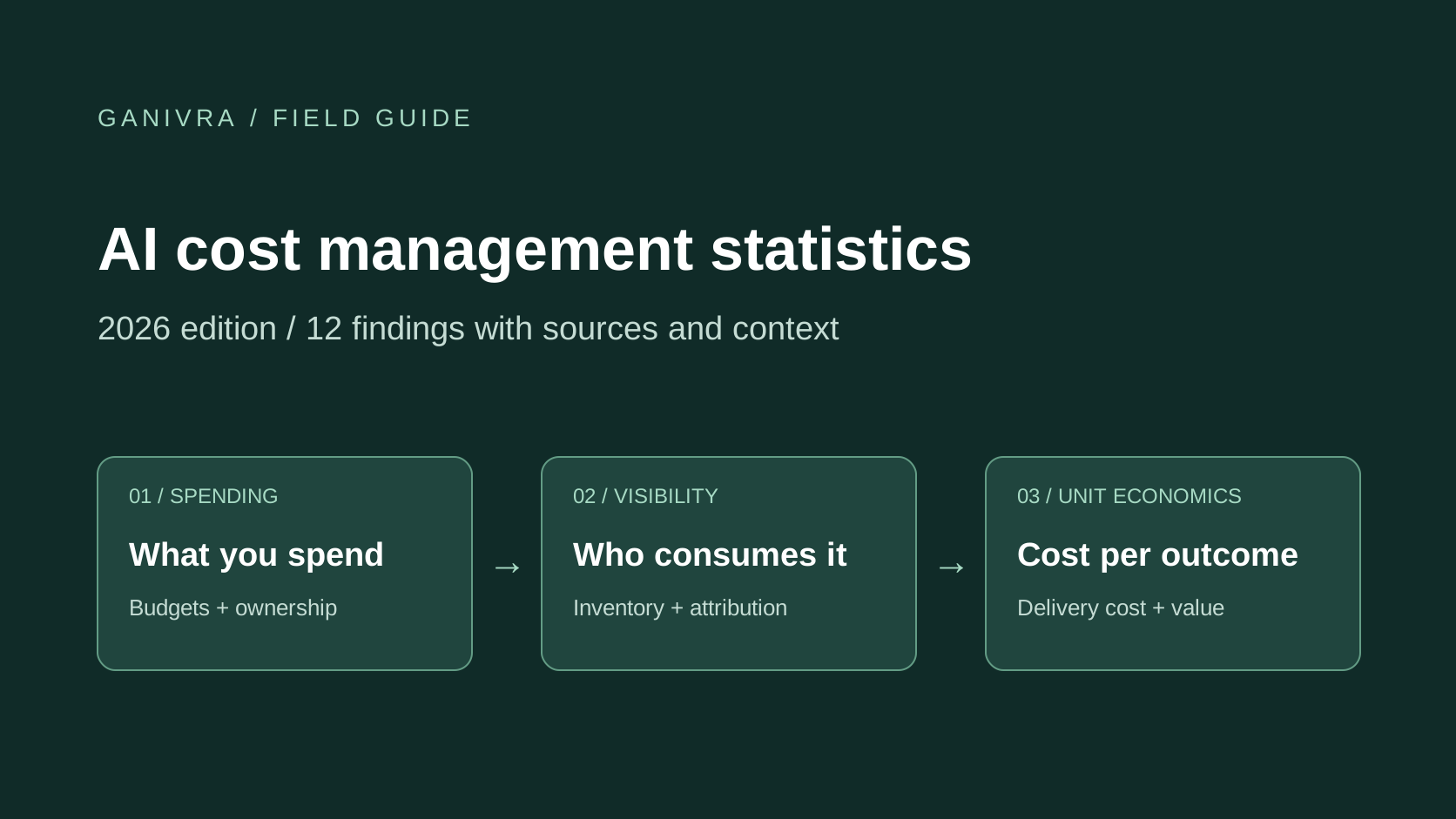
AI cost management connects spending to ownership, consumption, and business outcomes. These surveys indicate growing responsibility for AI costs and gaps in visibility. They do not establish a universal waste rate or a guaranteed return from optimization.
Sources and definitions behind the statistics
Ganivra reviewed this editorial collection on September 24, 2026. The original publishers are the FinOps Foundation, Flexera, and McKinsey. Their survey populations differ, so the findings should not be combined into a global average.
The State of FinOps report lists 1,192 respondents overall, with smaller question-specific samples. Flexera’s cloud report covers 753 cloud decision-makers and users; its IT asset management findings come from a separate report. McKinsey’s 2026 survey covers 1,719 respondents in 97 nations. Where a linked summary does not provide an item-level sample or fieldwork date, we do not invent one.
Several entries share a source and are not independent confirmation. Publishers may have commercial interests in AI or cost-management services. Findings are survey responses or publisher summaries rather than audits of every respondent’s spending. “What to measure” is Ganivra’s interpretation.
| Term | Meaning in this guide |
|---|---|
| AI spend | The AI-related expense scope defined by each source |
| Visibility | Inventory, consumption, or attribution coverage; these are distinct levels |
| Waste | Reported avoidable spending, not automatically a recoverable saving |
| Unit economics | Costs and value associated with a defined customer or business unit |
AI spending and cost-management responsibility
1. 98% of FinOps respondents reported managing AI spend
FinOps practitioner survey · 2026
The FinOps Foundation reports near-universal AI spend responsibility in its respondent population. Read the original source.
Interpret carefully: This describes surveyed practitioners, not 98% of all businesses.
What to measure: Assign an owner to each AI spending category.
2. 28% reported allocating over 10% of their ICT budget to AI
Organization survey · May–June 2026
McKinsey reports this share for enterprise-wide information and communication technology budgets. Read the original source.
Interpret carefully: Budget share is not an absolute spending amount or a return measure.
What to measure: Compare actual AI expenditure with an explicitly defined budget scope.
3. 60% expected to increase AI investment over the following year
Respondent expectation · 2026 survey
McKinsey reports plans for higher investment after its 2026 survey. Read the original source.
Interpret carefully: Intentions are not realized spending growth.
What to measure: Separate committed costs from proposed investments in forecasts.
4. About one in five said operating costs constrained AI use
Organization survey · May–June 2026
McKinsey identifies operating costs, including tokens, as a reported constraint. Read the original source.
Interpret carefully: The finding spans AI technologies, not only LLM APIs.
What to measure: Identify the workloads being limited and their cost per completed result.
AI visibility and waste statistics
5. Only 31% reported accurate visibility into AI software
IT asset management survey · reported June 2026
Flexera’s State of ITAM announcement reports this visibility finding. Read the original source.
Interpret carefully: Visibility into software is broader than token-level cost attribution.
What to measure: Reconcile purchased AI products, actual consumption, and accountable owners.
6. 59% said wasted AI spending had increased year over year
IT asset management survey · reported June 2026
Flexera reports the share of respondents seeing an increase in waste. Read the original source.
Interpret carefully: This does not mean 59% of AI spending is wasted.
What to measure: Identify specific unused capacity, duplicate tools, or avoidable execution costs.
7. Estimated wasted IaaS and PaaS cloud spending was 29%
Cloud survey estimate · 2026
Flexera reports this estimate in its State of the Cloud research. Read the original source.
Interpret carefully: It is a broad cloud estimate, not an AI-only waste rate or an audited loss.
What to measure: Separate infrastructure waste from model usage and software-license waste.
8. 90% of FinOps respondents managed SaaS or planned to
FinOps practitioner survey · 2026
The FinOps Foundation combines current SaaS responsibility with plans for the next year. Read the original source.
Interpret carefully: The total mixes present activity and future intent.
What to measure: Include AI embedded in SaaS in your inventory without double-counting supplier charges.
Unit economics and business-value measurement
9. 49% reported using unit economics to assess cloud progress
Cloud survey · 2026
Flexera reports adoption of this measurement approach, compared with 40% in its prior report. Read the original source.
Interpret carefully: This covers cloud measurement generally and does not establish measurement quality.
What to measure: Choose a business unit such as a completed report or resolved issue.
10. 37% reported positive enterprise EBIT impact from AI
Organization survey · May–June 2026
McKinsey reports financial impact across AI use overall. Read the original source.
Interpret carefully: The share is not an ROI percentage; EBIT means earnings before interest and taxes.
What to measure: Connect operating improvements to financial records instead of assuming savings.
11. 28% were beginning to include labor costs or planned to
FinOps practitioner survey · 2026
The FinOps Foundation reports growing scope beyond technology invoices. Read the original source.
Interpret carefully: The figure combines emerging practice and plans.
What to measure: Add applicable review and delivery labor when calculating complete cost-to-serve.
12. AI cost management ranked as the most-needed skillset
FinOps practitioner priorities · 2026
The FinOps Foundation identifies AI cost management as the top skill development need. Read the original source.
Interpret carefully: This is a relative priority, not a quantified shortage across the entire workforce.
What to measure: Build ownership for usage normalization, pricing, attribution, and reconciliation.
From AI cost visibility to unit economics
A purchasing inventory answers which tools you pay for. A provider dashboard answers how much an account consumed. Customer and execution attribution answers which product activity caused that spend. A useful cost-management workflow connects these views while preserving their different scopes.
1. Define coverage before trusting the total
List production models, tools, AI subscriptions, and serving infrastructure. Identify which costs are directly measured, estimated, allocated, or missing. Keep unknown rates explicitly unpriced. Do not count an included service fee again as a separate expense.
2. Attach customer and workflow context
Use stable customer, feature, workflow, and execution identifiers on model and tool events. Reconcile attributed plus unattributed costs to the provider or finance total for the same period. See our AI metering guide for event measurement and MCP cost tracking guide for agent steps.
3. Choose a verified business unit
Track completed reports, resolved issues, or another outcome the customer values. Include the costs of failed attempts and retries in that cohort. A completed API request is not necessarily a completed customer task.
Cost per verified outcome = relevant delivery costs ÷ verified outcomes
4. Evaluate savings alongside the result
The following numbers are illustrative, not survey findings. Suppose a workflow’s measured cost drops after optimization, but its completion rate also falls.
| Measure | Before | After |
|---|---|---|
| Attempted tasks | 1,000 | 1,000 |
| Model and tool spend | $200 | $160 |
| Verified outcomes | 800 | 500 |
| Measured cost per outcome | $0.25 | $0.32 |
Spend fell 20%, but measured cost per successful outcome rose 28%. That does not automatically settle the decision: quality, review work, latency, and other delivery costs matter too. It does show why a smaller invoice is an incomplete success metric.
5. Bring in revenue and the remaining delivery costs
For a sold AI product, combine the measured AI portion with hosting, support, review, and other applicable delivery costs. Compare the total with recognized revenue. The AI SaaS gross margin guide provides the complete calculation, and the subscription profitability guide tests allowances and discounts.
Ganivra provides model and MCP cost attribution by customer, feature, workflow, and execution. That helps investigate the consumption behind costs. It does not replace your software inventory, finance records, outcome verification, or billing and enforcement systems.
For related research, read AI agent statistics and AI customer service statistics. Keep those adoption and performance measures separate from your own realized financial results.
Frequently asked questions about AI cost management statistics
How much AI spending is wasted?
These sources do not establish one comparable global AI waste rate. Flexera's finding that 59% of respondents saw increased wasted AI spending is a share of respondents, not a share of dollars. Its 29% cloud waste estimate covers IaaS and PaaS more broadly.
What is AI cost visibility?
It can mean knowing which AI software is purchased, seeing provider usage, or attributing costs to customers and workflows. State which level you measure; an inventory is not the same as execution-level attribution.
What should an AI unit economics dashboard measure?
Track cost by customer, feature, workflow, and verified outcome. Include failed attempts and retries in the relevant cohort, and combine AI telemetry with other delivery costs and revenue when evaluating margin.
Does managing AI spend mean reducing all AI usage?
No. Cost management supports decisions about value. A higher-cost workflow may be worthwhile if it produces sufficiently better outcomes. Compare quality, complete delivery costs, and realized benefits.
Put AI spending in context
See which customers and workflows generate your AI costs.
Connect one workflow to Ganivra and inspect its model and tool consumption. Start a 14-day trial with no credit card required.