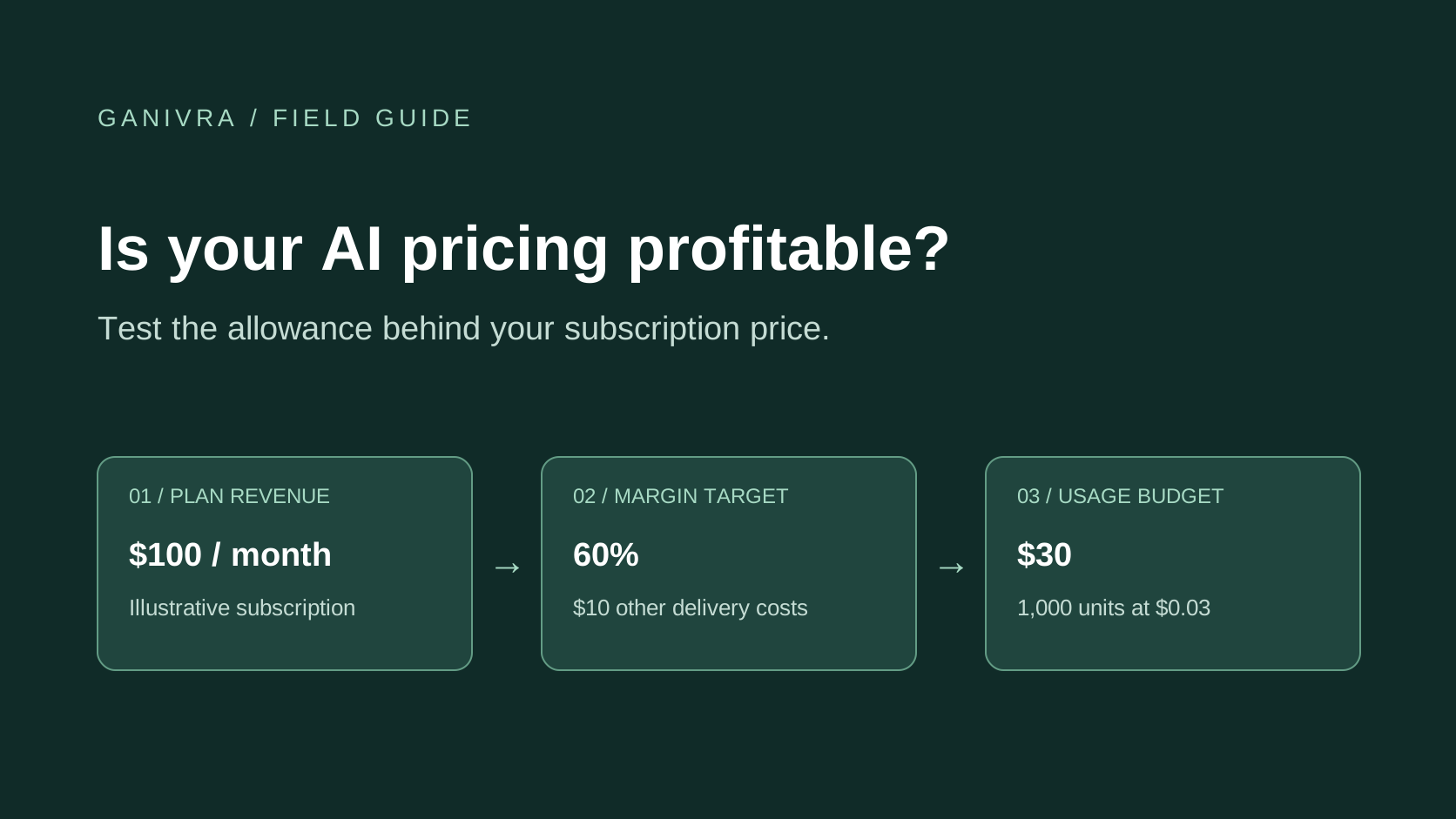
Your AI subscription supports positive gross profit when customer revenue exceeds the full cost of delivering the plan. To assess whether the price is sustainable, test heavy users, full allowance consumption, discounts, and more expensive workflows against a chosen margin target. Model API cost alone is an incomplete delivery-cost measure.
The AI subscription profitability test
Start with the same customer, plan, and time period on both sides of the calculation. Use recognized subscription and overage revenue after applicable discounts and adjustments. Add model costs, paid tools, production infrastructure, support, human review, and other costs classified as delivery costs under your accounting policy.
Gross profit = revenue − attributed and allocated delivery costs
Gross margin = gross profit ÷ revenue
Customer-level margins are estimates when they depend on shared-cost allocation. Keep the method consistent and reconcile them to product totals. The AI SaaS gross margin guide explains the cost scope in detail.
Passing this test does not establish company profitability. Gross profit must still support operating expenses such as product development, sales, and administration. A plan can have positive gross profit and still be insufficient for the business you are building.
Calculate how much AI usage your plan can include
A useful starting model separates per-customer delivery costs from variable costs per usage unit. Choose a unit customers understand—such as a completed report—and include the resource costs of unsuccessful attempts in its measured cost.
Variable usage budget = R × (1 − m) − F
Maximum whole-unit allowance = floor((R × (1 − m) − F) ÷ c)
- R: revenue for the plan period after applicable discounts.
- m: your target gross margin as a decimal.
- F: other delivery costs per customer for that period, assumed fixed in this model.
- c: variable delivery cost per unit, including applicable model, tool, and other incremental costs.
Assume a $100 monthly plan, a 60% gross margin target, $10 of other delivery costs, and $0.03 variable cost per completed report. The total delivery-cost budget is $40. After the $10 fixed component, $30 remains for reports: $30 ÷ $0.03 = 1,000 reports.
This is a cost-based ceiling under the stated assumptions, not a recommended market price or a safe guarantee. It leaves no buffer for uncertainty. Willingness to pay, value delivered, competition, and customer experience also influence the plan.
The formula assumes positive unit cost and a target between zero and one. If the usage budget is negative, the plan already misses the target before serving a report. If costs vary by task or jump with capacity, model those scenarios directly instead of relying on one average.
Stress-test typical users, heavy users, and discounts
Keep the $100 plan and $10 of other delivery costs. The examples below use illustrative costs and assume any usage beyond the included allowance is permitted without an extra charge, solely to show the exposure.
| Scenario | Revenue | Reports × unit cost | Total delivery cost | Gross margin |
|---|---|---|---|---|
| Light usage | $100 | 200 × $0.03 | $16 | 84% |
| Full allowance | $100 | 1,000 × $0.03 | $40 | 60% |
| Heavy usage without overages | $100 | 2,000 × $0.03 | $70 | 30% |
| More expensive workload | $100 | 1,000 × $0.06 | $70 | 30% |
| 20% discount, full allowance | $80 | 1,000 × $0.03 | $40 | 50% |
The plan reaches the chosen 60% target at full allowance only under the original assumptions. Doubling unit cost cuts margin to 30%. A 20% discount reduces the target-preserving allowance to floor(($80 × 0.40 − $10) ÷ $0.03) = 733 reports.
For annual plans, compare the revenue recognized over the service period with the matching costs. A large upfront payment improves collection timing but does not remove future usage obligations. Replay the full allowance under the discounted price, including any rollover policy.
Without overages, the original model reaches zero gross profit at ($100 − $10) ÷ $0.03 = 3,000 reports. The break-even limit is very different from the 1,000-report allowance that preserves the target margin.
Watch how these scenarios develop over time. Growing AI usage can reduce profit even when retention and engagement initially look healthy.
Do your overage prices cover additional work?
A base fee plus overages can make additional consumption generate additional revenue. Stripe’s usage-based pricing documentation describes fixed-fee-plus-overage plans alongside other billing models. The billing mechanism does not determine whether your rates cover costs.
Overage margin = (unit selling price − incremental unit cost) ÷ unit selling price
Required unit price for target m = incremental unit cost ÷ (1 − m)
At $0.03 incremental cost and a 60% target, the minimum calculated selling price is $0.075 per report. Suppose you charge $0.08. An extra 500 reports generates $40 revenue and $15 additional cost.
Combined with the full $100 base plan, total revenue becomes $140 and delivery cost becomes $55. Gross profit is $85 and gross margin is approximately 60.7%, under the same assumptions. If extra usage requires more support or new capacity, include those incremental costs too.
Overages do not fix an underpriced base allowance. Evaluate both pieces independently, and show customers the rate and exhaustion behavior before charging them.
Choose what your AI subscription includes
| Plan structure | What to validate |
|---|---|
| Fixed allowance | Full consumption, reset timing, rollover, and what happens when usage runs out |
| Credits | Conversion rules for each feature and the most expensive mix of actions the balance permits |
| Seats plus usage | Whether team size actually predicts consumption and whether automation can bypass that relationship |
| Unlimited usage | The cost exposure under the actual published policy, including concurrency and automated workloads |
| Base subscription plus overages | Base-plan economics, incremental cost, and clear customer approval or billing terms |
Credits make different actions comparable only if their conversion reflects a deliberate pricing policy. One credit for a short answer and one for a research agent can create very different delivery costs. For the choice of billing unit, see AI Usage-Based Billing: Tokens, Credits, or Outcomes?.
Do not assume fair-use language makes unlimited usage predictable. Specify any limits or premium-feature exclusions clearly, then evaluate what your application actually permits. Real-time controls need enforcement logic that accounts for concurrent requests and work already in progress.
Audit your existing AI subscription plans
- 01Gather realized revenue
Separate list price from actual customer revenue. Include discounts, credits, and the relevant billing period.
- 02Measure complete delivery costs
Attribute model and tool events to customers and executions. Add other applicable delivery costs and flag missing prices or allocations.
- 03Inspect the distribution
Review typical, high-percentile, and full-allowance usage within each plan. Identify whether losses concentrate in a customer segment or feature.
- 04Replay proposed changes
Test new allowances, selling rates, model routes, and credit conversions against representative historical workloads. Treat behavior changes after repricing as uncertain.
- 05Choose and verify a change
Reduce avoidable work, adjust a future plan, or offer a suitable upgrade. Respect existing contracts and communicate changes clearly. Measure customer response and realized margin afterward.
Keep a short record of the assumptions behind each plan: unit definition, target margin, cost scope, expected usage, discount, overage rate, and review date. That makes the next model or pricing change easier to evaluate.
Measure customer AI costs before changing subscription prices
Ganivra connects model and MCP consumption to customers, features, workflows, and executions. That attribution helps you see which customers and actions generate the AI costs behind a subscription.
Use the AI metering guide to define the measurement model, then follow the integration guide to instrument one workflow. Bring recognized revenue and other delivery costs from finance records to complete the pricing analysis.
Ganivra provides the AI cost context. Customer invoicing, prepaid credit balances, and enforcement of subscription allowances require separate billing and application logic.
Frequently asked questions about AI subscription profitability
How do I know whether my AI subscription price is profitable?
Compare recognized customer revenue with the complete cost of delivering the plan over the same period. Test typical usage, heavy usage, and full allowance consumption. Positive gross profit still needs to cover operating expenses before the business is profitable.
How do I calculate an included AI usage allowance?
Under a simplified linear cost model, subtract other delivery costs from revenue multiplied by one minus the target gross margin, then divide by variable delivery cost per usage unit. Stress-test the result because unit costs and customer behavior can change.
Should an AI subscription offer unlimited usage?
Only after evaluating the exposure under the actual published policy. A profitable average customer does not bound the cost of heavy usage. Define any limits, expensive feature restrictions, or fair-use terms clearly.
Does charging for overages guarantee a profitable plan?
No. The included allowance can still be underpriced, and overage rates may fail to cover retries, tools, human review, or other incremental delivery costs. Evaluate the base allowance and overage units separately.
How do annual discounts affect AI subscription margins?
Discounts reduce effective revenue while the same usage allowance can continue to incur the same costs. Test the discounted revenue against expected usage and avoid comparing the full upfront payment with only one month of delivery costs.
Test the costs behind your plans
See what each subscriber consumes in AI usage.
Connect one workflow to Ganivra and inspect customer-level model and tool costs. Start a 14-day trial with no credit card required.