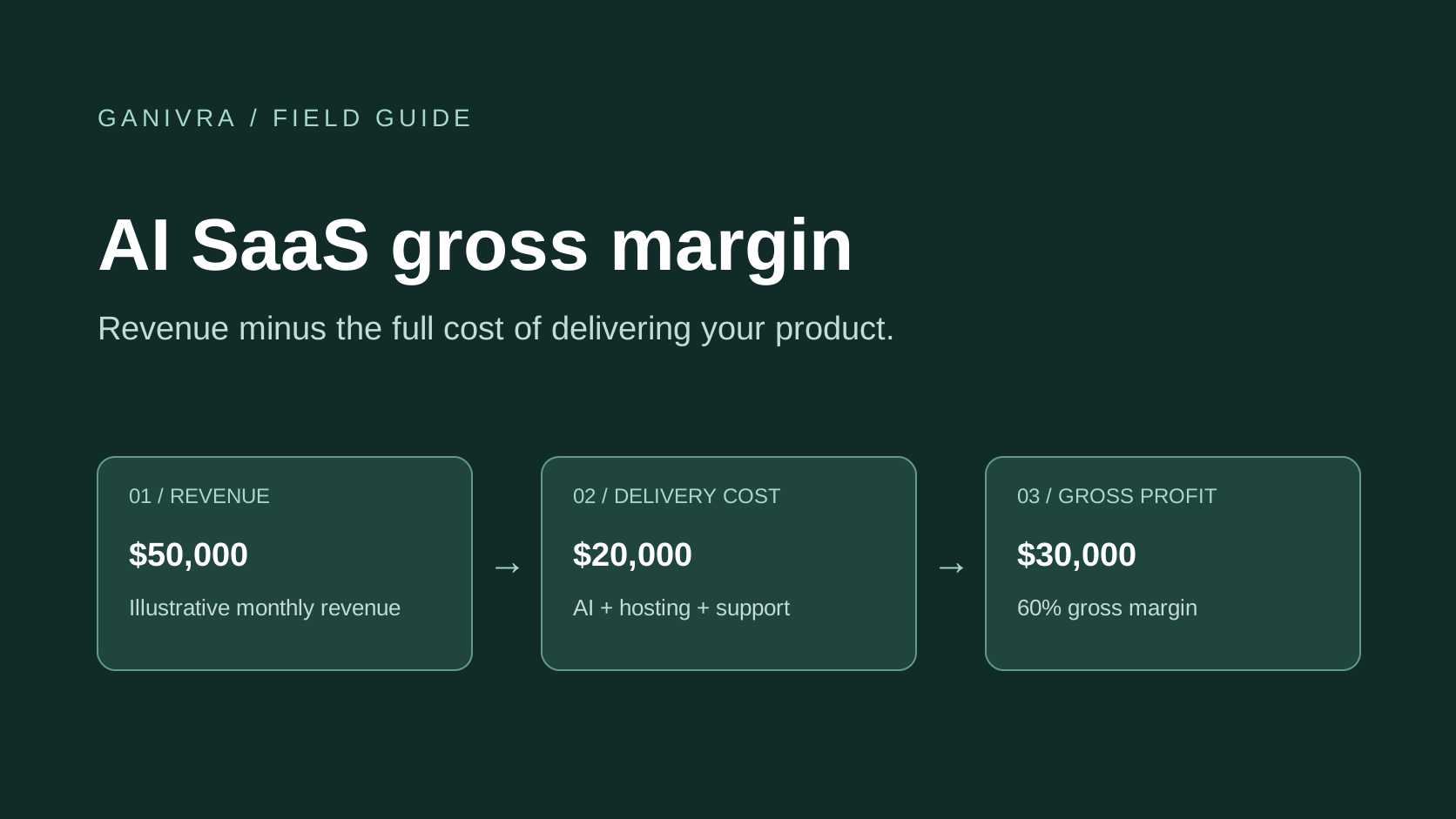
AI SaaS gross margin = (revenue − cost of revenue) ÷ revenue × 100. Match revenue and delivery costs to the same period. Include production inference, paid tools, hosting, and other costs classified as cost of revenue under your accounting policy. Subtracting only your LLM bill produces an incomplete margin measure.
The AI SaaS gross margin formula
Gross profit = recognized revenue − cost of revenue
Gross margin (%) = gross profit ÷ recognized revenue × 100
Gross profit is a currency amount. Gross margin is that amount expressed as a percentage of revenue. For example, $30,000 of gross profit on $50,000 of revenue is a 60% gross margin.
Use recognized revenue for the period, with applicable adjustments, rather than cash receipts, bookings, or annual recurring revenue. A $12,000 annual subscription collected upfront might contribute $1,000 to each month when the service is delivered evenly and that treatment matches the contract’s revenue recognition.
Gross margin is also different from markup: $30,000 of gross profit on $20,000 of delivery cost represents 150% markup, but still 60% gross margin. If revenue is zero, do not divide by zero or report a 0% margin; show the costs and gross loss separately.
What belongs in AI SaaS cost of revenue?
Classify costs by the work they support. Production model usage serves customers; experimental model usage may support research. The fact that both appear on one provider invoice does not make them the same expense category.
| Cost category | What to capture | Classification consideration |
|---|---|---|
| Production inference | Input, output, cache, audio, image, and other billed model units | Include resources consumed delivering the service, including charged failures and retries |
| Tools and external data | Paid searches, MCP tool fees, licensed retrieval, and third-party APIs | Separate direct fees from model costs to avoid counting the same spend twice |
| Production infrastructure | Hosting, databases, storage, networking, queues, and serving capacity | Allocate shared costs consistently and retain an explicit unallocated balance |
| Service delivery and support | Customer support, production operations, and human review required to deliver results | Include applicable compensation and overhead; separate selling or expansion activity |
| Other delivery costs | Applicable transaction fees, licenses, depreciation, and amortization | Follow the company’s documented accounting policy and prevent overlap with vendor totals |
Public software company reporting illustrates why hosting and support matter beyond API spend. HashiCorp’s fiscal 2023 annual report describes gross margin effects from support personnel, hosting-related costs, and internal-use software amortization. That is an example of a company’s reporting, not a universal classification rule.
Product R&D, sales, marketing, and general administration typically sit below gross profit as operating expenses. Mixed roles, implementation services, development capitalization, and overhead allocation need a consistent policy agreed with your accounting team. Keep internal operating analyses reconcilable to that policy.
Worked example: calculate monthly AI SaaS gross margin
Assume an AI reporting product recognizes $50,000 of revenue this month. The table uses illustrative figures and assumes all listed costs are classified as cost of revenue for this business.
| Monthly item | Amount |
|---|---|
| Recognized revenue | $50,000 |
| Production model inference, including retries | $8,000 |
| Paid tools and data APIs | $2,000 |
| Hosting, storage, and databases | $3,000 |
| Delivery support and human review | $5,000 |
| Other allocated delivery costs | $2,000 |
| Total cost of revenue | $20,000 |
| Gross profit | $30,000 |
| Gross margin | 60% |
The calculation is ($50,000 − $20,000) ÷ $50,000 × 100 = 60%. Counting only the $8,000 model bill would show 84% remaining after inference, overstating gross margin by 24 percentage points.
What if usage grows while revenue stays flat?
If inference rises to $13,000 and tool fees rise to $3,000, while other delivery costs stay unchanged, cost of revenue becomes $26,000. Gross profit falls to $24,000 and gross margin to 48%. Higher adoption does not automatically improve economics when the price remains fixed. See why growing AI usage can reduce your profit for the underlying cost drivers and metrics to watch.
Does a 60% gross margin mean the business is profitable?
No. If the original scenario also has $35,000 of operating expenses, its $30,000 gross profit leaves a $5,000 operating loss before other applicable items. Gross margin measures delivery economics, not the full company result.
Calculate AI gross margin by customer
Company averages can hide expensive accounts. Start with the customer’s recognized revenue, add directly attributable delivery costs, then allocate shared cost pools using a documented method. Call the result an internal customer margin estimate when it depends on allocations.
(customer revenue − direct delivery costs − allocated delivery costs) ÷ customer revenue × 100
Consider a $50 monthly customer with $8 in model and tool costs and $7 in other assigned delivery costs. The customer contributes $35 of gross profit under those assumptions, a 70% margin. If model and tool usage rises to $28 while the other costs stay at $7, the margin drops to 30%.
Use stable customer identifiers on model and tool events. Allocate shared hosting using a reasonable driver such as measured compute consumption, and support costs using tracked service effort where available. Keep the allocation method consistent enough to distinguish usage changes from accounting changes.
Reconcile customer-level costs plus unallocated costs to the product total. Calculate overall margin from total revenue and total costs; do not take a simple average of customer margin percentages. A $50 account and a $50,000 account should not carry equal weight.
The AI metering guide explains how to attach customer and workflow context to usage. For agent steps, the MCP cost tracking guide covers tools, retries, and linked model work.
Common AI gross margin calculation mistakes
- Using cash collected as monthly revenue. Match service revenue and delivery costs to the same period, especially for annual subscriptions and prepaid credits.
- Dropping failed executions. Unsuccessful work can still incur supplier charges. Include those charges even if you never bill the customer.
- Counting costs twice. A provider-reported total may already contain tool or cache charges. Do not add the same components again.
- Treating unknown cost as zero. Report unpriced usage and incomplete coverage so provisional margins are visibly provisional.
- Ignoring credits and discounts. Reconcile actual costs with contractual adjustments. If temporary promotional credits materially affect the result, show a separate normalized view without rewriting the reported result.
- Comparing mismatched margins. A token-only measure and a fully loaded cost-of-revenue measure cannot support a meaningful benchmark comparison.
Keep denominators aligned for outcome analysis too. Cost per successful report should include costs of failed attempts in the same cohort. It is a useful operational measure, but it is not gross margin until matched to revenue and the complete cost scope.
How to improve AI SaaS gross margin
First identify whether the problem is resource consumption, non-AI delivery cost, or pricing. Then test a change against quality and successful outcomes.
- Reduce avoidable work: investigate retry loops, duplicate retrieval, oversized context, and unnecessary tool calls.
- Route by task: test whether a less expensive model can complete a defined task at the required quality.
- Review service effort: measure human review and customer support costs alongside inference.
- Revisit allowances: compare heavy-user costs with subscription revenue before expanding included usage.
- Evaluate pricing: assess tokens, credits, or outcomes using the same customer workload and full delivery-cost scope.
For the pricing decision, see AI Usage-Based Billing: Tokens, Credits, or Outcomes? A lower cost per attempt is not an improvement if it creates enough additional failures to raise cost per completed result.
There is no universal gross-margin threshold that makes every AI SaaS product healthy. Compare products with similar service intensity and accounting scope, and choose a target that funds your operating model.
A monthly AI gross margin workflow
- 01Close the revenue period
Use the recognized subscription, usage, and service revenue for the period, including applicable adjustments.
- 02Reconcile production consumption
Compare model and tool events with provider usage and invoices. Resolve missing prices, duplicates, late events, and contractual adjustments.
- 03Add the remaining delivery costs
Bring in infrastructure, support, human review, and other classified costs from finance records. Document allocations.
- 04Calculate and explain the change
Compute company and customer views. Separate changes in price, customer mix, usage, supplier rates, and allocation methods.
Ganivra helps with the AI usage and attribution portion: recording model and MCP consumption against customers, features, workflows, and executions. Your finance records supply recognized revenue and the other delivery costs needed for a complete gross-margin calculation.
Start with one production workflow using the integration guide. Verify its cost breakdown, then connect that measurement to the monthly calculation rather than treating the telemetry dashboard as a replacement for your accounts.
Frequently asked questions about AI SaaS gross margin
How do you calculate AI SaaS gross margin?
Subtract cost of revenue from recognized revenue for the same period, divide by that revenue, and multiply by 100. Include the costs of delivering the service under a consistent accounting policy, not only model API charges.
Are LLM API costs part of cost of revenue?
Inference used to deliver the production service is generally a delivery cost. Model usage for product research, internal experiments, or other functions should be classified by its purpose rather than treating every AI invoice as production cost.
Is revenue minus AI cost the same as gross profit?
Only if AI cost includes all costs classified as cost of revenue, which a token-cost dashboard usually does not. Hosting, delivery staff, customer support, and other applicable costs must also be included.
What is a good gross margin for an AI SaaS business?
There is no single target for every AI product. Compare businesses with similar service intensity, revenue mix, and cost classifications. Choose a target that leaves enough gross profit to fund operating expenses and your business goals.
Can gross margin be negative?
Yes. Gross margin is negative when cost of revenue exceeds revenue. If revenue is zero, the percentage is undefined; report the delivery costs and gross loss instead.
Does positive gross margin mean an AI startup is profitable?
No. Gross profit still needs to cover operating expenses such as research and development, sales, marketing, and administration. Net profit also reflects other applicable income and expenses.
Measure the AI costs behind your margin
See what each customer costs in model and tool usage.
Connect one workflow to Ganivra and inspect its attributed AI costs. Start a 14-day trial with no credit card required.