Growing AI usage can reduce profit when delivery costs rise faster than revenue. Fixed subscriptions, longer contexts, additional agent steps, retries, and human review can all widen that gap. Measure cost by customer and completed workflow so you can distinguish valuable adoption from expensive, avoidable work.
Why AI adoption and profit can move in opposite directions
Usage measures activity. Profit measures what remains after costs. A customer who doubles their activity can create more product value while paying the same monthly fee. If serving that activity incurs additional costs, the amount remaining from the subscription shrinks.
Change in gross profit = change in revenue − change in cost of revenue
With fixed revenue, a $10 increase in delivery costs reduces gross profit by $10. Company profit also depends on operating expenses and other items, so a usage dashboard alone cannot determine whether the entire business is profitable.
Both usage volume and workload intensity matter. More tasks increase consumption; more tokens, tools, or attempts per task can increase it again. For a consistent workload cohort, model and tool cost can be analyzed as attempted tasks multiplied by average recorded cost per attempt. Keep fixed infrastructure and other delivery costs separate.
How a $50 AI subscription turns into a loss
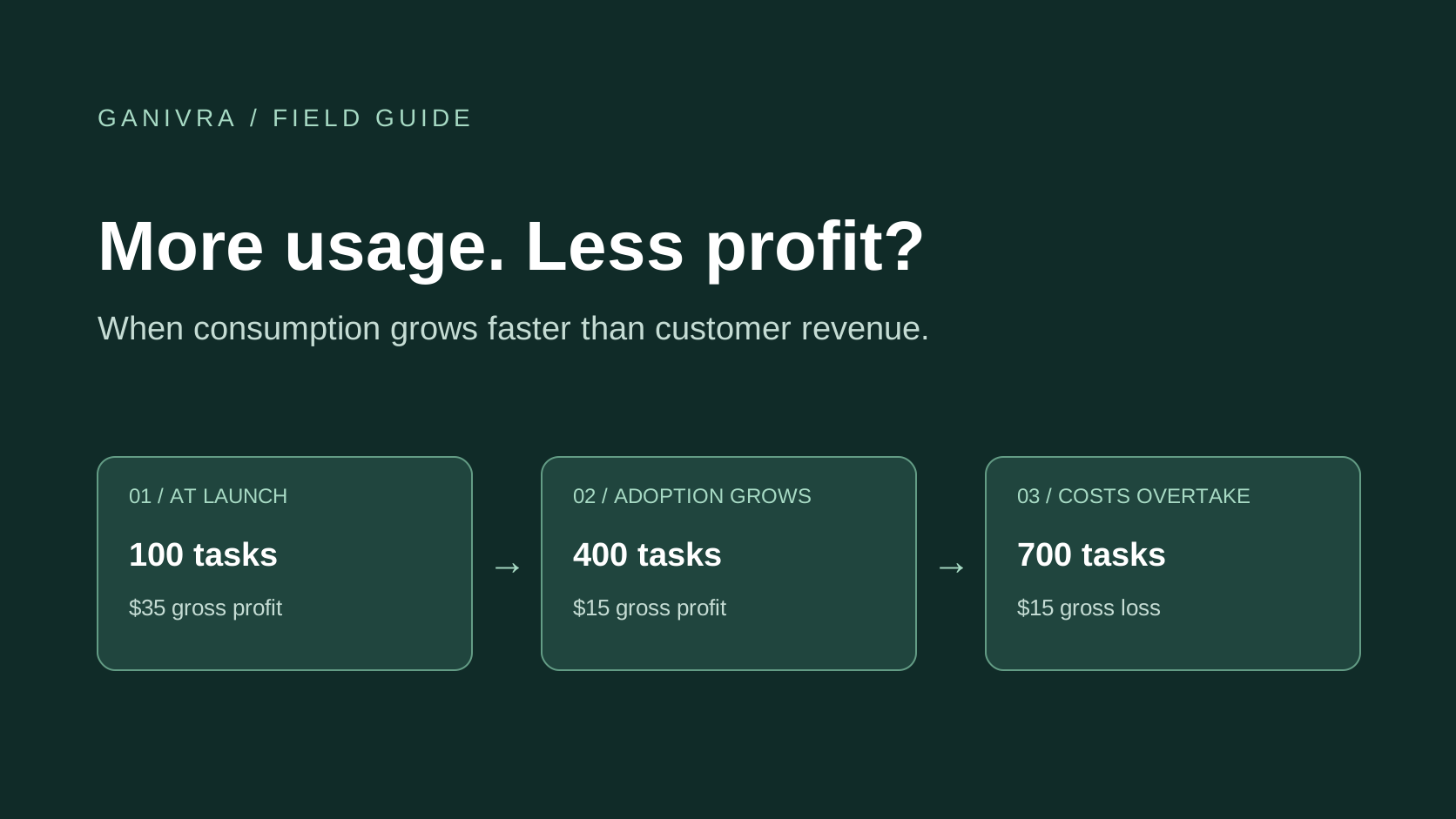
Assume a customer pays $50 per month. The following figures are illustrative, and all listed delivery costs are treated as cost of revenue for this example. Tasks include both successful and unsuccessful attempts.
| Monthly measure | At launch | Adoption grows | Workload expands |
|---|---|---|---|
| Customer revenue | $50 | $50 | $50 |
| Attempted tasks | 100 | 400 | 700 |
| Average model + tool cost per attempt | $0.05 | $0.06 | $0.07 |
| Total model + tool cost | $5 | $24 | $49 |
| Other delivery costs | $10 | $11 | $16 |
| Total delivery costs | $15 | $35 | $65 |
| Gross profit / loss | $35 | $15 | −$15 |
| Gross margin | 70% | 30% | −30% |
The customer now attempts seven times as many tasks. Average model and tool cost per attempt also rises 40%, taking that cost from $5 to $49. More hosting or support work adds further delivery cost. None of those changes automatically changes the subscription revenue.
This is a customer-level illustration, not a prediction about every AI product. For a complete cost classification and calculation method, see How to Calculate AI SaaS Gross Margin.
Five reasons AI delivery costs rise as adoption grows
1. More work fits inside the same subscription
A flat fee can include a large allowance or effectively unlimited usage. Customers expand their activity before moving to a higher plan, leaving the business to absorb the additional resource costs. Evaluate allowances at heavy usage as well as the average.
2. Each task carries more context
Longer conversation history, larger documents, and broader retrieval can increase model input. Tool responses can also add substantial context. Anthropic’s guide to writing tools for agents explains how returning irrelevant records can waste context and recommends evaluating tool efficiency.
3. A feature evolves into a multi-step agent
A single user action may become a sequence of planning, retrieval, generation, and validation calls. The customer still sees one completed task, but your application now pays for several steps. Track the entire execution with the approach in our MCP cost tracking guide.
4. Retries and failures consume paid resources
A timeout, invalid tool result, or failed validation can trigger another attempt. Some failures incur supplier charges even when the customer receives no useful result. An apparently cheap model call may be part of an expensive path to completion.
5. Customer mix and delivery effort change
New accounts may use larger inputs, premium models, or more human review. Support and infrastructure costs can grow alongside inference. An unchanged average request count can conceal a much more expensive mix of work.
Metrics that reveal AI margin erosion
Compare the same customer cohort across equivalent periods. Separate volume growth from changes in task complexity, model selection, and selling price.
| Measure | What to investigate |
|---|---|
| Revenue and delivery cost per customer | Whether consumption grows without corresponding revenue |
| Cost per successful outcome | Whether more attempts are needed to produce useful work |
| Tokens, model calls, and tool calls per execution | Whether each task is becoming more resource-intensive |
| Retry rate and failure cost | How much spend comes from recovery and unsuccessful work |
| High-percentile execution costs | Whether a small group of expensive runs is hidden by the average |
| Cost by workflow and prompt version | Whether a specific product change coincides with rising costs |
Calculate cost per successful outcome using all relevant attempt costs in the cohort, divided by verified completions. Keep quality visible: a cheaper response that needs human correction may be worse economically.
Customer averages also deserve scrutiny. Segment light and heavy users, plans, and workflow types. Reconcile the segments to total spend so unpriced or unattributed usage does not disappear from the analysis.
What to change before cutting useful usage
Trace the cost increase to a cause
Start with a high-cost execution and compare it with a successful baseline. Look for repeated retrieval, unnecessarily large tool results, redundant calls, or a model change. Use AI metering to connect those steps to customer and workflow identifiers.
Test efficiency against completed outcomes
Try narrower retrieval, bounded retries, appropriate caching, or routing simple tasks to a less expensive model. Evaluate changes on representative workloads and compare completion, quality, latency, and total cost. A lower per-call rate is not enough if the number of attempts increases.
Align the allowance with the product’s economics
Use Is Your AI Subscription Pricing Profitable? to calculate an allowance and stress-test heavy users, discounts, and overages.
Define which work the subscription includes and when an upgrade or overage applies. Explain limits and expensive actions before the customer commits to them. A hard cap needs application enforcement that accounts for concurrent and in-flight work; historical analytics cannot enforce it by itself.
Evaluate pricing with actual customer workloads
Replay light, typical, and heavy usage against proposed rates. Include discounted plans, unbilled failures, and non-model delivery costs. Our tokens, credits, or outcomes comparison explains the tradeoffs. Usage-based billing can align revenue with consumption, but it does not guarantee a positive margin.
When growing AI usage is healthy
Higher usage can be desirable when it creates enough incremental revenue, improves use of existing capacity, or contributes to measurable retention and expansion. It can also be a deliberate investment in learning or onboarding.
Keep those reasons explicit. A near-term margin decline justified by future expansion is a hypothesis to measure over time, not revenue you can assume has already arrived. Track the cohort’s later upgrades, renewals, and delivery costs against the original expectation.
Separate a lower margin percentage from lower gross profit dollars. Moving from $100 of revenue and $60 gross profit to $200 of revenue and $100 gross profit lowers gross margin from 60% to 50%, while increasing gross profit by $40. Both measures belong in the decision.
Start with one customer cohort and one workflow
- 01Choose a comparable group
Start with customers on the same plan using the same feature. Compare equivalent time windows.
- 02Measure complete executions
Capture model and MCP events with customer and execution IDs. Preserve retries and unpriced usage for investigation.
- 03Connect usage to economics
Compare attributed AI costs with recognized customer revenue and other delivery costs from your finance records.
- 04Verify one improvement
Choose a frequent, costly behavior to change and check whether cost per successful outcome improves without unacceptable quality loss.
Ganivra provides model and MCP cost attribution by customer, feature, workflow, and execution. It helps locate the AI consumption behind the change; finance records supply the broader revenue and cost picture. Follow the integration guide to instrument your first workflow.
Frequently asked questions about AI usage and profit
Why can growing AI usage reduce profit?
More usage can increase model, tool, hosting, and delivery costs without increasing customer revenue. Under a fixed subscription, gross profit falls when those additional delivery costs are not offset by higher revenue or efficiency gains.
Does higher AI usage always hurt margins?
No. Usage can support expansion revenue, retention, or better utilization of fixed capacity. Assess incremental revenue and cost, then verify whether expected retention or expansion benefits actually materialize.
Why is cost per request not enough?
A user task can trigger multiple model calls, paid tools, and retries. Measure the total cost per completed task, including failed attempts in the same cohort, alongside quality and completion rates.
Does usage-based pricing guarantee profitability?
No. Selling rates, included allowances, discounts, unbilled failures, and supplier costs still determine the economics. Revenue can grow with usage while profit per unit remains negative.
How can I find customers with high AI costs?
Attach stable customer IDs to model and tool events, aggregate their costs for the billing period, and compare those costs with customer revenue and other allocated delivery costs.
Understand the cost of adoption
See which customers and workflows drive your AI spend.
Connect one workflow to Ganivra and inspect its model and tool costs. Start a 14-day trial with no credit card required.