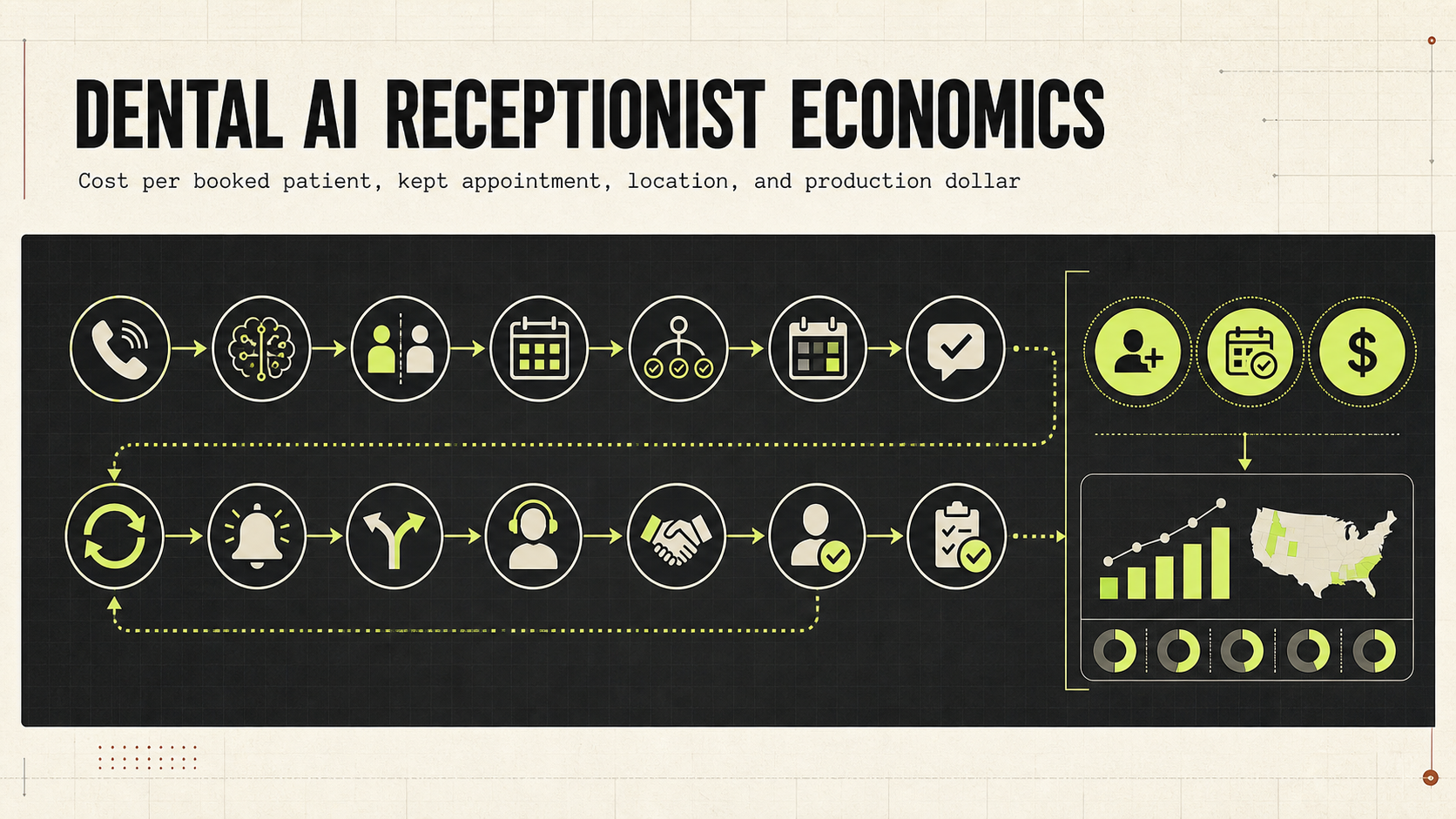
Quick answer
How do you measure dental AI receptionist economics?
Add telephony, speech, models, practice-management and calendar tools, messages, retries, human handoffs, quality review, implementation, privacy controls, and error cleanup. Attribute that loaded cost to eligible calls, valid bookings, kept appointments, practice locations, vendor customers, and attributable production.
The most useful denominator is usually a kept appointment or completed visit under a written standard. Cost per answered call measures activity. Cost per valid booking measures scheduling output. Cost per kept appointment reveals whether the receptionist created a durable operating outcome.
The dental AI receptionist call-to-visit funnel
| Stage | Required evidence | Economic question |
|---|---|---|
| Attempted and connected call | Telephony state and connected duration | How much paid traffic becomes a real conversation? |
| Eligible administrative intent | Supported intent, location, coverage window, and non-spam call | How much demand can the workflow serve? |
| Correctly matched request | New or existing patient route, approved appointment category, provider and location rules | Did the agent create usable intake or staff cleanup? |
| Valid booking | Real slot, correct duration and rule set, successful write-back, and confirmation | What does a booking the front desk can trust cost? |
| Confirmed appointment | Delivered confirmation and any required acknowledgment | Which bookings remain active? |
| Kept appointment | Verified arrival or completed-visit state under the practice definition | How many bookings become delivered visits? |
| Economically closed visit | Completed, canceled, rescheduled, corrected, production, collection, or other terminal state | What value and downside can be attributed? |
Segment the funnel by business hours, overflow, after hours, new versus existing patient, appointment category, recall, confirmation, language, location, and campaign. A blended show rate can hide strong inbound booking and weak outbound recall economics.
A booked patient is not a kept appointment
Voice dashboards often promote answer rate, containment, qualified leads, or calendar events. Those signals matter, but a practice creates value only when a valid scheduling outcome survives cancellation and no-show risk and reaches the chosen visit state.
| Observed event | What it proves | What it does not prove |
|---|---|---|
| Call answered | The phone connected | Eligibility, booking, or staff time returned |
| Call contained | No live transfer occurred | Correct resolution, caller trust, or safety |
| Request captured | Administrative intent exists | A valid slot, patient match, or appointment |
| Appointment created | A calendar or practice-management record exists | Correctness, confirmation, or attendance |
| Appointment confirmed | The confirmation workflow succeeded | Arrival, completed visit, production, or payment |
| Appointment kept | The defined arrival or completion state was reached | Incremental production or profit unless separately verified |
Write the definition first. Include supported intent, required information, appointment and provider rules, system write-back, duplicate prevention, confirmation, cancellation or rebooking window, and the visit state used for the denominator.
The complete dental AI receptionist cost stack
- 01Telephony and routing
Numbers, inbound or outbound minutes, forwarding, transfers, voicemail, messaging, and carrier charges.
- 02Speech and model reasoning
Speech recognition, realtime or language models, speech generation, caching, silence, and interruptions.
- 03Knowledge and scheduling rules
Locations, hours, approved administrative answers, appointment categories, duration, provider, operatory, and escalation rules.
- 04Practice-management and messaging tools
Patient matching, calendar availability, booking, rescheduling, cancellation, confirmation, recall, and write-back.
- 05Human handoffs and operations
Live transfer, front-desk review, clinical or urgent routing, QA, configuration, supervision, and vendor support.
- 06Retries and follow-up
Failed writes, callbacks, repeat callers, confirmation, waitlist fills, rescheduling, and recall attempts.
- 07Errors and cleanup
Wrong appointment category, duplicate record, mismatched location, invalid slot, complaint, cancellation, rework, and service recovery.
- 08Privacy, security, and implementation
Integration, testing, access, agreements, data minimization, encryption, retention, monitoring, incident response, and policy updates.
For a voice AI vendor, attribute these costs to each practice customer. Location count, bilingual traffic, bespoke practice-management integrations, complex provider rules, heavy handoffs, and outbound campaigns can make two equally priced accounts economically different.
Dental AI receptionist unit-economics formulas
cost_per_valid_booking = (voice_stack + tools + handoffs + QA + cleanup + allocated_ops) ÷ valid_bookings
cost_per_kept_appointment = total_receptionist_program_cost ÷ attributed_kept_appointments
recall_reactivation_cost = recall_campaign_cost ÷ incremental_kept_recall_appointments
cost_per_production_dollar = total_receptionist_program_cost ÷ attributable_completed_visit_production
dental_receptionist_ROI = (incremental_visit_contribution + validated_labor_value − program_cost − incremental_error_loss) ÷ program_cost
customer_margin = (customer_revenue − voice_stack − tools − human_ops − compliance_and_integration_allocation) ÷ customer_revenue
Production is not collected revenue, and neither is profit. Use production dollars to understand throughput, but calculate ROI with incremental contribution after the practice's relevant direct delivery costs and a defensible baseline.
Worked example: inbound scheduling and overflow calls
The following values are illustrative—not a benchmark, vendor quote, practice result, fee recommendation, financial projection, or clinical guidance. They show a conservative calculation that credits only incremental kept appointments.
| Input | Illustrative value | Economic result |
|---|---|---|
| Monthly eligible calls | 2,000 calls | The complete measured call population |
| Qualified scheduling and administrative requests | 1,500 calls | Spam and unsupported requests are separated |
| Valid bookings | 620 appointments | Bookings pass the written scheduling standard |
| Kept appointments | 500 appointments | 80.6% illustrative booking-to-kept conversion |
| Voice stack and platform | $2,200 | Telephony, speech, models, and platform consumption |
| Human handoffs and QA | $2,000 | Front desk, supervision, and review |
| Practice-management integration and operations | $1,300 | Scheduling, messaging, monitoring, and allocated support |
| Correction and rescheduling cleanup | $700 | Observed rework and exception cost |
| Total program cost | $6,200 | $10.00 per valid booking and $12.40 per kept appointment |
| Incremental kept appointments versus baseline | 55 appointments | Only the attributable improvement is credited |
| Illustrative contribution per incremental kept visit | $180 | $9,900 incremental contribution after assumed direct delivery costs |
| Incremental error or service-recovery cost | $900 | Observed downside attributed to the cohort |
| Net observable benefit | $2,800 monthly | About 45% illustrative ROI on program cost |
Coverage does not establish correct routing, valid bookings, attendance, or incremental value.
Includes the complete program cost and uses a verified practice outcome.
Test causality by location, call source, coverage window, appointment category, schedule capacity, and season. Marketing changes, staffing, provider availability, holidays, and weather can shift bookings and attendance independently of the receptionist.
Dental receptionist workflows need separate economics
| Workflow | Useful terminal outcome | Cost or risk to measure |
|---|---|---|
| New-patient inbound booking | Correct valid booking that becomes a kept appointment | Patient match, appointment category, provider rules, conversion, no-show, and cleanup |
| Existing-patient scheduling | Correct booking, cancellation, or reschedule written to the system | Identity matching, duplicate records, sequencing, policy exceptions, and staff review |
| Appointment confirmation | Response captured and appointment kept, canceled early, or rescheduled | Delivery, opt-outs, no-show lift, waitlist opportunity, and messages |
| Recall reactivation | Incremental kept recall appointment within the observation window | Consent and purpose, attempts, reach, booking, attendance, opt-outs, and baseline |
| Waitlist fill | Open capacity filled by an eligible patient who keeps the appointment | Contact attempts, timing, patient preference, duplicate outreach, and staff coordination |
| Administrative FAQs | Correct approved answer or successful staff route | Knowledge freshness, financial or insurance boundaries, repetition, and complaint risk |
| Urgent or clinical routing | Correct controlled transfer or emergency pathway under policy | Latency, transfer failure, inappropriate automation, and safety review |
Inbound booking, reminders, recall, and promotional outreach are different products. Give each its own eligibility rule, consent and compliance review, cost pool, denominator, attribution window, and margin view.
How receptionist economics change by dental organization
| Organization | Useful outcome | Costs hidden by averages |
|---|---|---|
| Single-location practice | Kept appointment and front-desk time returned | Low call volume, setup overhead, provider availability, and owner or staff handoffs |
| Specialty practice | Correctly routed consultation or administrative resolution | Referral, appointment type, pre-visit requirements, and higher exception rates |
| Multi-location group | Kept appointment and production by location | Phone lines, calendars, provider rules, transfers, local hours, and data ownership |
| Dental service organization | Standardized outcome and contribution by supported practice | Platform variation, centralized versus local staff, governance, contracts, and rollout cost |
| Dental voice AI vendor | Verified practice outcome at positive customer contribution | Custom prompts, telephony, integrations, human services, compliance support, and usage mix |
Dental AI receptionist metrics worth tracking
| Metric | What it reveals | Decision it supports |
|---|---|---|
| Attempted, connected, eligible, and correctly routed | The true call and intent funnel | Coverage, scope, and denominator design |
| Valid bookings and write-back success | Usable scheduled demand | Rule, prompt, and integration changes |
| Confirmation, cancellation, reschedule, and kept states | Booking durability | Reminder, waitlist, and no-show strategy |
| Completed visit, production, collection, and contribution | Downstream economic outcomes | Attribution and ROI |
| Recall contact, opt-out, booking, and kept conversion | Outbound reactivation performance | Campaign design and compliance review |
| Handoff rate, transfer success, repetition, and staff time | Retained human work and experience friction | Escalation policy and staffing |
| Correction, duplicate, complaint, and service recovery | The cost of wrong outcomes | Quality thresholds and workflow scope |
| Cost per call, booking, kept appointment, and production dollar | Activity versus outcome economics | Architecture, vendor, and pricing comparison |
| Cost and margin by practice location or vendor customer | Who creates or erodes contribution | Commercial plans and rollout |
| Latency, abandonment, tool failure, and unpriced usage | Technical and cost blind spots | Model, voice, provider, and telemetry optimization |
A machine-readable dental receptionist cost event without PHI
Use internal organization, location, workflow, coverage, appointment-category, booking, handoff, and outcome categories instead of names, phone numbers, birth dates, recordings, transcripts, insurance data, treatment information, or clinical content:
{
  "event_id": "evt_dental_voice_7284",
  "execution_id": "call_dental_4fd2",
  "step_id": "step_booking_07",
  "parent_step_id": "step_slot_match_06",
  "provider": "openai",
  "model": "realtime-voice-model",
  "operation": "confirm_dental_booking",
  "input_tokens": 2210,
  "output_tokens": 238,
  "cached_input_tokens": 1290,
  "latency_ms": 574,
  "status": "success",
  "environment": "production",
  "provider_reported_cost_usd": 0.0359,
  "attributes": {
    "application": "dental-ai-receptionist",
    "workflow": "inbound_new_patient_booking",
    "feature": "voice_booking_agent",
    "customer_id": "dental_group_1842",
    "location_id": "practice_location_north",
    "prompt_id": "dental-admin-booking",
    "prompt_version": "v12",
    "coverage_window": "after_hours",
    "intent_category": "appointment_request",
    "appointment_type_category": "new_patient_exam",
    "booking_outcome": "confirmed",
    "human_review_required": false,
    "data_classification": "no_phi_call_cost_metadata"
  }
}
Send separate events for telephony, speech recognition, model turns, speech generation, scheduling tools, practice-management actions, messages, transfers, reviews, retries, and outcomes with the same execution_id. Attach a later kept-appointment or production event without turning the cost ledger into a second patient-record system.
Privacy, patient trust, and outbound-call rules are part of unit cost
This article is an economics and observability framework, not clinical, treatment, emergency, privacy, security, HIPAA, TCPA, telemarketing, financial, or legal advice. Practices and vendors should define permitted administrative conversations, disclosures, recording, urgent routing, scheduling authority, data access, retention, outbound-contact rules, and incident processes with qualified teams.
The ADA Health Policy Institute's 2026 dental AI research identifies appointment efficiency and front-desk adoption as active areas, but adoption does not replace outcome design. For PHI, HHS explains the minimum necessary standard, covered entities and business associates, and the HIPAA Security Rule.
Inbound scheduling, a reminder for an already scheduled appointment, recall reactivation, and a promotional campaign should not be treated as one workflow. The FTC's Telemarketing Sales Rule guidance distinguishes purely informational messages from messages that add solicitation, and the FCC has confirmed that TCPA restrictions on artificial or prerecorded voices encompass AI-generated voice. Determine the rules that apply to each campaign and jurisdiction before launch.
- Bound clinical behavior: keep the agent within approved administrative intake and routing rather than open-ended diagnosis or treatment advice.
- Minimize data: cost measurement rarely needs patient content, recordings, transcripts, or clinical information.
- Make handoffs reliable: distinguish front-desk, financial, clinical, urgent, and emergency pathways.
- Preserve reconstruction: connect actions to workflow, rule, prompt, provider, integration, location, and reviewer versions.
- Price safeguards: agreements, access, security, QA, monitoring, consent and opt-out operations, and incident response belong in loaded cost.
How to implement dental receptionist cost attribution
- 01Define valid booking and kept appointment
Write the exact scheduling, system-of-record, arrival or completion, cancellation, rescheduling, and observation-window rules before measuring automation.
- 02Establish a comparable baseline
Measure the same locations, hours, intent mix, appointment categories, booking rules, capacity, staffing, show rate, staff time, and economics before rollout.
- 03Create one call-to-appointment execution ID
Join telephony, speech, model turns, tools, practice-management actions, confirmation, handoff, appointment, completion, and financial outcome under one durable identifier.
- 04Capture cost and control metadata
Record provider cost, seconds or tokens, latency, workflow, rule and prompt versions, retries, handoffs, booking state, outcome, and data classification without copying PHI into the cost ledger.
- 05Attach location and commercial context
Add the practice or vendor customer, location, phone line, coverage window, appointment category, campaign, plan, and attributable production or contribution at the source.
- 06Monitor funnel economics
Alert on cost per booking and kept appointment, show rate, correction, transfer failure, recall performance, location or customer margin, and unpriced usage.
Ganivra's AI and MCP event model links provider cost, models, tools, retries, prompts, practice customers, locations, workflows, and outcomes without proxying the call or storing its content. Start with the broader voice AI unit economics guide, connect downstream administrative revenue work with the healthcare revenue-cycle guide, or compare another vertical workflow in the HVAC AI receptionist guide.
Dental AI receptionist economics FAQ
What is a dental AI receptionist?
A dental AI receptionist is a voice-enabled system that answers calls, identifies administrative intent, applies approved practice and scheduling rules, books or changes eligible appointments, sends confirmations, and transfers clinical, urgent, financial, or other exceptions to authorized staff.
How much does a dental AI receptionist cost?
There is no universal price. Loaded cost can include telephony, speech recognition, language or realtime models, speech generation, platform fees, practice-management and calendar integrations, messages, human handoffs, quality review, privacy and security controls, implementation, and correction work. Compare loaded cost per valid booking and kept appointment, not subscription price alone.
How do you calculate dental AI receptionist ROI?
Compare a defined call cohort with a credible baseline and observation window. Measure total program cost, valid bookings, kept appointments, completed visits, attributable production, incremental contribution after direct delivery costs, retained staff work, and error or service-recovery cost. Use incremental contribution—not production or revenue alone—in the ROI numerator.
What counts as a booked dental patient?
A valid booking should satisfy the practice's written rules: a real patient request, supported administrative intent, correct location, appointment category and provider constraints, required information, an available slot, successful practice-management or calendar write-back, and confirmation. Spam, duplicates, unsupported requests, tentative holds, and failed write-backs should not count.
What counts as a kept dental appointment?
A kept appointment is a valid booking that reaches the practice's verified arrival or completed-visit state within the chosen observation window. A scheduled, confirmed, or checked-in status should not be treated as kept unless it matches the practice's documented system-of-record definition.
Can a dental AI receptionist schedule, cancel, and reschedule appointments?
It can when the system has reliable access to approved appointment categories, provider and operatory rules, duration, location, availability, cancellation policy, and write-back validation. Complex treatment sequencing, clinical questions, financial exceptions, and ambiguous requests should follow a controlled staff handoff.
How should dental recall reactivation economics be measured?
Track the eligible recall cohort, contact attempts, connections, booked appointments, kept appointments, completed visits, opt-outs, staff handoffs, program cost, and attributable incremental contribution against a comparable baseline. Keep recall outreach separate from inbound scheduling because consent, contact rules, and attribution differ.
How do appointment confirmations and no-show recovery affect ROI?
Measure confirmation delivery and response, cancellations captured early enough to refill, waitlist fills, rescheduled appointments, kept-appointment lift, messaging and voice cost, staff time, and unintended opt-outs or complaints. Do not credit every confirmed or rescheduled appointment as incremental.
Should a dental AI receptionist answer urgent or clinical questions?
The safer model is bounded administrative intake and routing, not diagnosis or treatment advice. The practice should define approved questions, emergency directions, escalation criteria, staff or clinician handoffs, and prohibited actions. Urgent or ambiguous clinical conversations should move to the appropriate human or emergency pathway.
How should human handoffs be measured?
Track the handoff reason, timing, transfer success, destination, staff handling time, final booking or other outcome, and whether the caller had to repeat information. Include retained human cost in the call ledger. A transfer is a successful controlled outcome when policy requires it.
Does a dental AI receptionist need a practice-management integration?
A live integration is valuable when the agent must read availability, apply provider and appointment rules, create or update patient scheduling records, avoid duplicates, and validate write-back. Without it, the agent may only capture a request for staff follow-up, which is a different and less complete outcome.
Does a dental AI receptionist need to comply with HIPAA?
HIPAA applicability depends on the parties, data, and workflow. A dental practice and its vendors should determine covered-entity and business-associate roles, agreements, permitted uses, safeguards, access, retention, and incident processes with qualified privacy, security, and legal teams. Economics telemetry should avoid PHI whenever it is not needed.
Does a dental AI receptionist vendor need a business associate agreement?
That is a fact-specific legal and contracting determination. If a vendor creates, receives, maintains, or transmits protected health information on behalf of a covered entity, the practice and vendor should assess business-associate requirements and downstream subcontractors with qualified counsel and compliance teams before launch.
Can a dental AI receptionist make outbound recall calls?
Technically yes, but outbound artificial-voice calls can raise consent, identification, disclosure, do-not-call, opt-out, timing, recordkeeping, HIPAA, TCPA, state-law, and purpose-of-call questions. A previously scheduled appointment reminder and a campaign promoting services are not necessarily treated the same. Obtain qualified legal review before activation.
How should a DSO or multi-location dental group measure receptionist economics?
Attach organization, practice location, phone line, workflow, coverage window, appointment category, provider-rule set, campaign, plan, and attributable economics to every execution. Then compare cost per valid booking, kept appointment, production dollar, human hour, and customer or location margin so blended performance does not hide weak sites.
Which dental AI receptionist metrics matter most?
Track attempted, connected, eligible, correctly routed, validly booked, confirmed, canceled, rescheduled, kept, completed, and attributable outcomes; recall and waitlist performance; handoff rate and staff time; booking correction; cost per call, booking, kept appointment, location, and production dollar; incremental contribution; customer margin; and unpriced usage.
From voice usage to practice economics
Know what every kept appointment costs.
Connect model, voice, tool, handoff, location, customer, and outcome cost in one execution ledger—without sending patient conversation content.