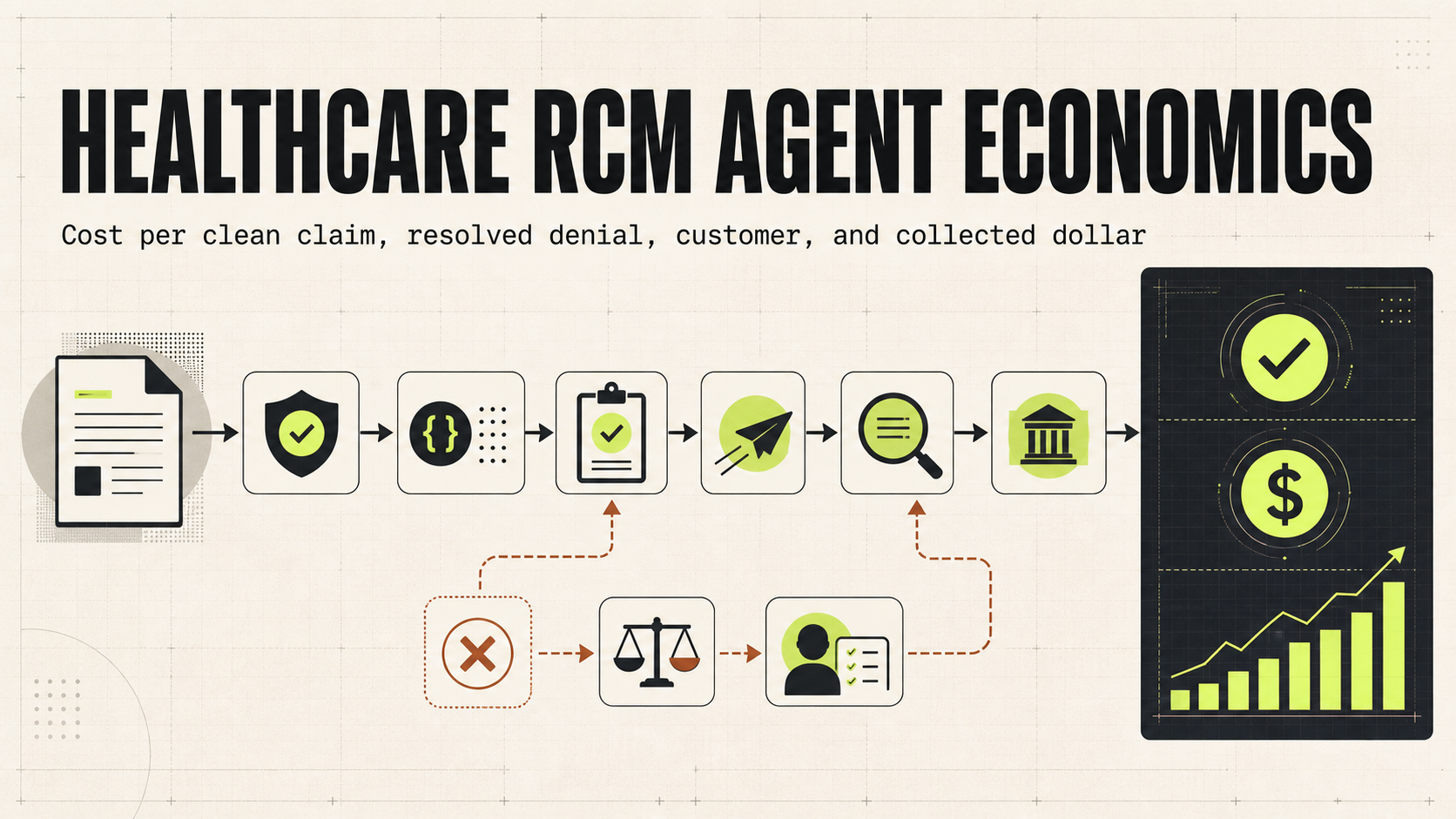
Healthcare revenue-cycle agent economics measures the loaded cost and financial value of verified administrative outcomes. Add platform, model, clearinghouse, payer, EHR or practice-management, tool, human-review, compliance, rework, and implementation costs. Divide by clean claims, resolved denials, correctly posted payments, or incremental dollars collected—then attribute the result to each provider customer.
Where healthcare RCM agents operate
Revenue-cycle agents can support administrative workflows from eligibility and prior authorization through coding assistance, claim submission, status, denial review, appeals, underpayment detection, payment posting, and patient balances.
The unit is not an agent action. It is a verified, compliant revenue-cycle outcome completed under the organization’s billing, coding, privacy, and approval policies.
| Revenue-cycle stage | Agentic workflow | Useful economic unit |
|---|---|---|
| Front end | Eligibility, benefits, registration, prior-authorization preparation | Complete verified response or review-ready request |
| Middle | Charge capture support, coding assistance, claim validation, submission | Accurate claim accepted under the defined first-pass standard |
| Back end | Claim status, denials, appeals, underpayments, payment posting | Actionable status, resolved denial, or correctly reconciled payment |
| Patient financial operations | Estimate, statement, payment-plan, and balance workflows | Accurate completed administrative action under policy |
Healthcare transactions already include structured rails. For example, CMS describes electronic 276/277 claim-status requests and responses, while claims and remittance workflows use the applicable standardized transactions. Agentic reasoning should complement those rails, not invent a parallel source of truth.
Claim activity is not a collected dollar
RCM automation often looks successful at an intermediate step. A claim can pass an internal scrub but fail at the clearinghouse. It can be accepted for processing but later denied. An appeal can be generated but never approved, filed, or paid. Payment can arrive but post incorrectly.
| Activity metric | What it proves | What it does not prove |
|---|---|---|
| Claim reviewed | The agent examined the administrative record | Accuracy, compliant submission, or acceptance |
| Claim submitted | A submission action occurred | Clearinghouse or payer acceptance |
| Claim accepted | The stated receiving-stage check passed | Adjudication or payment |
| Appeal drafted | A draft artifact exists | Approval, timely filing, success, or cash recovery |
| Denial resolved | A defined terminal outcome was verified | Incremental cash unless causality is established |
| Payment posted | A remittance or payment was applied | Correct contract reconciliation without validation |
Write the success definition before calculating ROI. Include the receiving system, required validation, review policy, allowable adjustment or closure states, and the observation window for rework or reversal.
The healthcare RCM agent cost stack
A complete ledger joins AI consumption with clearinghouse and payer steps, EHR or practice-management work, human review, rework, security, and compliance operations.
- 01RCM platform and orchestration
Workflow engine, queues, work lists, durable execution, rules, and service fees.
- 02Model reasoning
Classification, extraction, summarization, drafting, validation, routing, and evaluation calls.
- 03EHR and practice-management work
Integration, record lookup, controlled updates, reconciliation, and exception handling.
- 04Clearinghouse and payer interactions
Eligibility, submission, status, authorization, remittance, portals, and transaction fees.
- 05Human expertise
Coder, biller, clinician, compliance, auditor, and specialist review or correction.
- 06Denials and rework
Corrections, resubmissions, appeals, follow-up, timely-filing risk, and write-offs.
- 07Privacy and security
Access control, audit logging, risk management, contractual safeguards, and incident response.
- 08Implementation and operations
Mapping, testing, monitoring, policy maintenance, payer variation, and change management.
For an RCM AI vendor, these costs must also be attributed to each provider customer. A high-volume account with bespoke payer rules, heavy coder review, and portal exceptions can have very different margin from a standardized practice on the same contract.
Healthcare RCM agent unit-economics formulas
Use separate formulas for prevention, recovery, collections, and vendor margin. Mixing them can count the same dollar twice.
loaded_cost_per_clean_claim = (agent + transactions + review + rework + allocated_ops) ÷ clean_claims
cost_per_resolved_denial = (denial_agent + appeal_channels + human_review + rework) ÷ resolved_denials
cost_to_collect = total_RCM_operating_cost ÷ net_patient_service_revenue_collected
RCM_agent_ROI = (validated_labor_savings + incremental_cash_collected − program_cost − incremental_error_loss) ÷ program_cost
customer_margin = (customer_revenue − execution_cost − human_ops − integration_allocation) ÷ customer_revenue
Report cash acceleration separately from revenue recovery. A lower number of days in A/R can improve working capital timing without changing the total collectible amount.
Worked example: pre-submission claim validation
The following values are illustrative—not a benchmark, vendor quote, customer result, coding standard, or billing recommendation. They show a conservative calculation that does not credit unproven revenue recovery.
| Input | Illustrative value | Economic result |
|---|---|---|
| Monthly claim cohort | 50,000 claims | The same eligible cohort is measured before and after |
| Baseline clean claims | 41,000 | 9,000 claims require preventable correction or rework |
| Post-agent clean claims | 44,000 | 3,000 fewer claims enter the defined rework path |
| Illustrative rework cost | $15 per affected claim | $45,000 observable monthly rework avoided |
| Agent execution and transactions | $12,000 | Model, tools, clearinghouse, and workflow usage |
| Human QA and coding review | $10,000 | Retained specialist labor |
| Platform, security, and operations | $8,000 | Allocated monthly program cost |
| Total agent program cost | $30,000 | $0.68 loaded cost per clean claim |
| Net observable benefit | $15,000 monthly | Before any claim for incremental collections or cash timing |
A throughput number that does not establish accuracy, acceptance, or payment.
Includes execution, transactions, retained review, security, and operations.
The next question is causal: did the agent create the improvement for comparable claims, or did payer mix, coding policy, staffing, or workflow eligibility change? Cohort design and controlled rollout make the ROI defensible.
How RCM agent economics change by provider type
| Provider or operator | Useful outcome | Costs hidden by averages |
|---|---|---|
| Health system | Clean institutional claim, resolved high-value denial, or reconciled remittance | Facility complexity, service lines, interfaces, audit scope, and specialist review |
| Physician group | Accepted professional claim, actionable status, or reduced rework | Specialty mix, payer portals, lean staffing, and practice-management variation |
| Dental service organization | Verified benefits, reviewed claim, or completed attachment workflow | Plan variation, imaging or attachment handling, site differences, and patient balances |
| Laboratory or imaging network | Order or claim exception completed and payment reconciled | Volume, medical-necessity documentation, ordering-provider follow-up, and payer edits |
| Behavioral health organization | Administrative authorization or claim workflow completed under policy | Service authorization, recurring visits, privacy sensitivity, and payer variation |
| RCM technology or services vendor | Verified outcome delivered at positive customer contribution | Implementation, bespoke workflows, manual operations, transaction fees, and contract model |
Healthcare revenue-cycle agent metrics worth tracking
| Metric | What it reveals | Decision it supports |
|---|---|---|
| Eligible, attempted, reviewed, submitted, and accepted | The complete administrative funnel | Scope, workflow, and denominator design |
| Clean claim or first-pass outcome | Preventable correction and rework | Validation, coding review, and payer rules |
| Denial, appeal, and resolved-denial outcomes | Recovery funnel and terminal outcomes | Prioritization, staffing, and root cause |
| Human touches and review time | Retained expertise and bottlenecks | Approval policy and capacity |
| Cost per attempt and verified outcome | Activity versus result economics | Architecture, vendor, and pricing comparison |
| Days in A/R and aging movement | Cash-cycle timing | Follow-up, prioritization, and working capital |
| Cost to collect and incremental cash | Operating efficiency and validated recovery | Investment and workflow expansion |
| Cost and margin by provider customer | Who creates or erodes vendor contribution | Contract, limits, and service design |
| Error, audit, and policy-exception signals | Risk introduced by automation | Review gates, rollback, and compliance response |
| Unpriced usage coverage | How much cost remains unknown | Catalog and reconciliation work |
A machine-readable RCM agent cost event without PHI
Use internal workflow identifiers and operational categories instead of patient, member, encounter, or claim content:
{
  "event_id": "evt_rcm_2719",
  "execution_id": "rcm_wf_7f31",
  "step_id": "step_denial_05",
  "parent_step_id": "step_status_04",
  "provider": "openai",
  "model": "rcm-operations-model",
  "operation": "classify_denial_reason",
  "input_tokens": 1940,
  "output_tokens": 186,
  "cached_input_tokens": 1120,
  "latency_ms": 688,
  "status": "success",
  "environment": "production",
  "provider_reported_cost_usd": 0.0246,
  "attributes": {
    "application": "healthcare-rcm",
    "workflow": "denial_triage",
    "feature": "denial_agent",
    "customer_id": "provider_org_1042",
    "prompt_id": "denial-classifier",
    "prompt_version": "v16",
    "payer_segment": "commercial",
    "claim_stage": "denial_review",
    "denial_category": "administrative_missing_information",
    "workflow_outcome": "appeal_ready_for_review",
    "human_review_required": true,
    "data_classification": "no_phi_cost_metadata"
  }
}
Send separate events for models, retrieval, clearinghouse calls, payer status tools, EHR or practice-management actions, evaluations, and retries with the same execution_id. The cost ledger can explain economics without becoming a second claims or medical-record system.
Privacy, security, and compliance are part of the unit cost
This article is an economics and observability framework, not medical, coding, billing, compliance, or legal advice. Each organization must define permitted automation, required review, documentation, access, and submission controls for its own workflows.
HHS explains that the HIPAA Privacy Rule’s minimum-necessary standard generally calls for reasonable steps to limit PHI use, disclosure, and requests to what is needed for the purpose, subject to stated exceptions. HHS also explains the obligations around covered entities and business associates. Apply the requirements relevant to the actual role and data flow with qualified privacy, security, compliance, and legal teams.
- Keep PHI out of cost telemetry: use provider-organization, workflow, step, policy, and outcome metadata.
- Apply least-privilege access: an agent should have only the systems and actions required for the bounded workflow.
- Version policies and prompts: connect every action to the rule, model, prompt, and approval configuration in effect.
- Preserve auditability: record who or what acted, when, under which control, and with what verified outcome.
- Price required safeguards: security, BA arrangements where applicable, review, audit, monitoring, and incident response are real cost-to-serve.
How to measure healthcare RCM agent economics
Start with one administrative workflow whose outcome can be verified without making broad claims about clinical or reimbursement decisions.
- 01Define one RCM outcome
Choose a clean claim, actionable status, resolved denial, correctly posted payment, or another verified administrative outcome.
- 02Measure a comparable baseline
Capture claim volume, labor, touches, rework, error loss, cycle time, fees, and collections for the same workflow cohort.
- 03Create one RCM execution ID
Join model, clearinghouse, payer, EHR or practice-management, tool, retry, review, and posting steps without using patient identifiers.
- 04Capture cost and controls
Record provider-reported or catalog cost, latency, status, policy version, human review, exception reason, and final outcome.
- 05Attach customer and contract context
Add a stable provider-organization ID, plan or revenue allocation, workflow, payer segment, and service tier at the source.
- 06Monitor economics, compliance, and quality
Alert on cost per outcome, rework, denial patterns, human touches, audit signals, customer margin, and unpriced usage.
Ganivra’s integration guide shows how to send model and MCP tool events through one contract, attach organization and workflow context, and connect steps under an execution. The same approach can measure cost and margin while excluding PHI from the telemetry event.
For the broader execution model, continue with the Agentic Workflow Automation economics guide. For voice-based payer or patient administrative workflows, see Voice AI unit economics.
Healthcare revenue-cycle agent FAQ
What is a healthcare revenue-cycle AI agent?
It is an AI-enabled administrative system that performs or assists bounded RCM steps such as eligibility verification, prior-authorization preparation, coding assistance, claim validation, status follow-up, denial triage, appeal preparation, underpayment review, or payment-posting exceptions under defined controls.
Which revenue-cycle workflows are suitable for AI agents?
Good candidates have meaningful volume, reliable system access, clear administrative rules, a verifiable outcome, and controllable error risk. Common candidates include eligibility, claim-status follow-up, claim scrubbing, work-queue prioritization, denial classification, appeal drafting, payment-posting exceptions, and underpayment research.
How do you calculate ROI for healthcare RCM agents?
Compare the same claim cohort before and after automation. Measure labor, platform, clearinghouse, payer, EHR or practice-management, model, tool, review, rework, security, implementation, and error costs. Add only validated incremental collections or cash-flow effects, then divide net benefit by the RCM agent program cost.
How much does an AI revenue-cycle agent cost per claim?
There is no universal rate. Cost varies by workflow, claim complexity, model and tool use, payer interactions, clearinghouse fees, human review, exception rate, integration burden, and security controls. Report cost per attempted claim, per clean claim, and per collected dollar so an inexpensive action is not mistaken for an inexpensive outcome.
What is a clean claim for ROI measurement?
Use a written organization-specific definition tied to the relevant claim workflow—for example, a complete and accurate claim accepted under the required submission and validation standard without preventable correction. Do not assume that clearinghouse acceptance, payer acceptance, adjudication, and payment are the same event.
What counts as a resolved claim denial?
Define resolution as a verified terminal outcome under policy, such as payment, corrected and accepted resubmission, approved adjustment, or documented closure with the appropriate reason. An appeal drafted or submitted is workflow activity, not automatically a resolved denial.
How should prior-authorization agent economics be measured?
Measure cost per complete and accurate request, response cycle time, touches, missing-information rate, human review, resubmission, and the downstream effect on scheduled services or claims. Keep clinical and coverage decisions under the required human, payer, and regulatory controls; this guide does not provide authorization or clinical guidance.
Should AI medical-coding output require human review?
Review requirements should be set by the provider's coding, compliance, audit, payer, and legal policies and by the risk of the specific workflow. Track coder review time, acceptance, correction, audit findings, and downstream denials so apparent automation does not hide retained labor or compliance exposure.
Can claim-status follow-up be automated?
Electronic claim-status workflows can use the applicable standardized request and response transactions and payer or clearinghouse capabilities. Measure successful actionable status updates, posting accuracy, exceptions, and avoided manual follow-up rather than counting inquiries alone.
How do HIPAA and PHI affect RCM agent cost tracking?
Cost telemetry should be designed to avoid PHI whenever possible and use stable internal workflow and customer identifiers instead. Healthcare organizations and vendors must evaluate applicable privacy, security, minimum-necessary, access, contractual, and retention requirements with their compliance and legal teams.
Does an RCM AI vendor need a business associate agreement?
That depends on the parties' roles and the data the vendor creates, receives, maintains, or transmits. When a vendor is acting as a business associate, HIPAA requires the appropriate written arrangement and safeguards. Organizations should have privacy, security, and legal teams assess the specific data flow.
How is an RCM agent different from RPA?
RPA follows predetermined rules and interface paths. An RCM agent can interpret variable administrative inputs, select permitted actions, and handle bounded exceptions. Use deterministic automation for stable transactions and reserve agentic reasoning for ambiguity that creates enough value to justify added cost and variance.
How can I compare healthcare RCM automation vendors?
Normalize each proposal into cost per verified outcome: clean claim, actionable status, resolved denial, correctly posted remittance, or incremental dollar collected. Include fixed fees, percentage-of-collections charges, integrations, clearinghouse costs, model and tool usage, human services, implementation, security, and overage exposure.
How do healthcare RCM agent startups track margin by customer?
Attach a stable provider-organization ID, contract and revenue allocation, workflow, payer segment, prompt and policy version, model, tool, review state, and outcome to each execution. Attribute variable and allocated operational cost to the customer without placing PHI in the cost event.
Does RCM cost telemetry need medical records or claim content?
No. Unit economics can usually be measured with non-PHI metadata: execution and step IDs, provider organization, workflow, stage, payer segment, model, tokens or time, tool identity, direct cost, latency, status, retry, review state, and outcome. Clinical documentation and claim content should remain in appropriately controlled systems.
Which metrics should an RCM AI team track?
Track eligible, attempted, accepted, clean, denied, appealed, resolved, posted, and collected outcomes; first-pass acceptance; touches and human review; cost per attempted and successful outcome; denial rework; days in A/R; cost to collect; incremental cash; error and audit signals; customer margin; and unpriced usage.
Make every administrative workflow economically legible
See cost per verified RCM outcome and margin per provider customer.
Ganivra connects model and tool consumption to revenue-cycle workflows, organizations, outcomes, and commercial context—without requiring PHI in cost telemetry.