Quick answer
How do you measure freight detention automation economics?
Add ELD, telematics or geofence events, TMS and accounting tools, document processing, models, notifications, retries, human review, disputes, implementation, support, and correction cost. Attribute that loaded cost to eligible stops, identified detention events, supported claims, approved charges, collected dollars, customers, facilities, and loads.
Cost per identified event measures detection. Cost per supported claim measures billing readiness. Cost per collected accessorial dollar measures recovery. The last denominator is usually the most economically defensible.
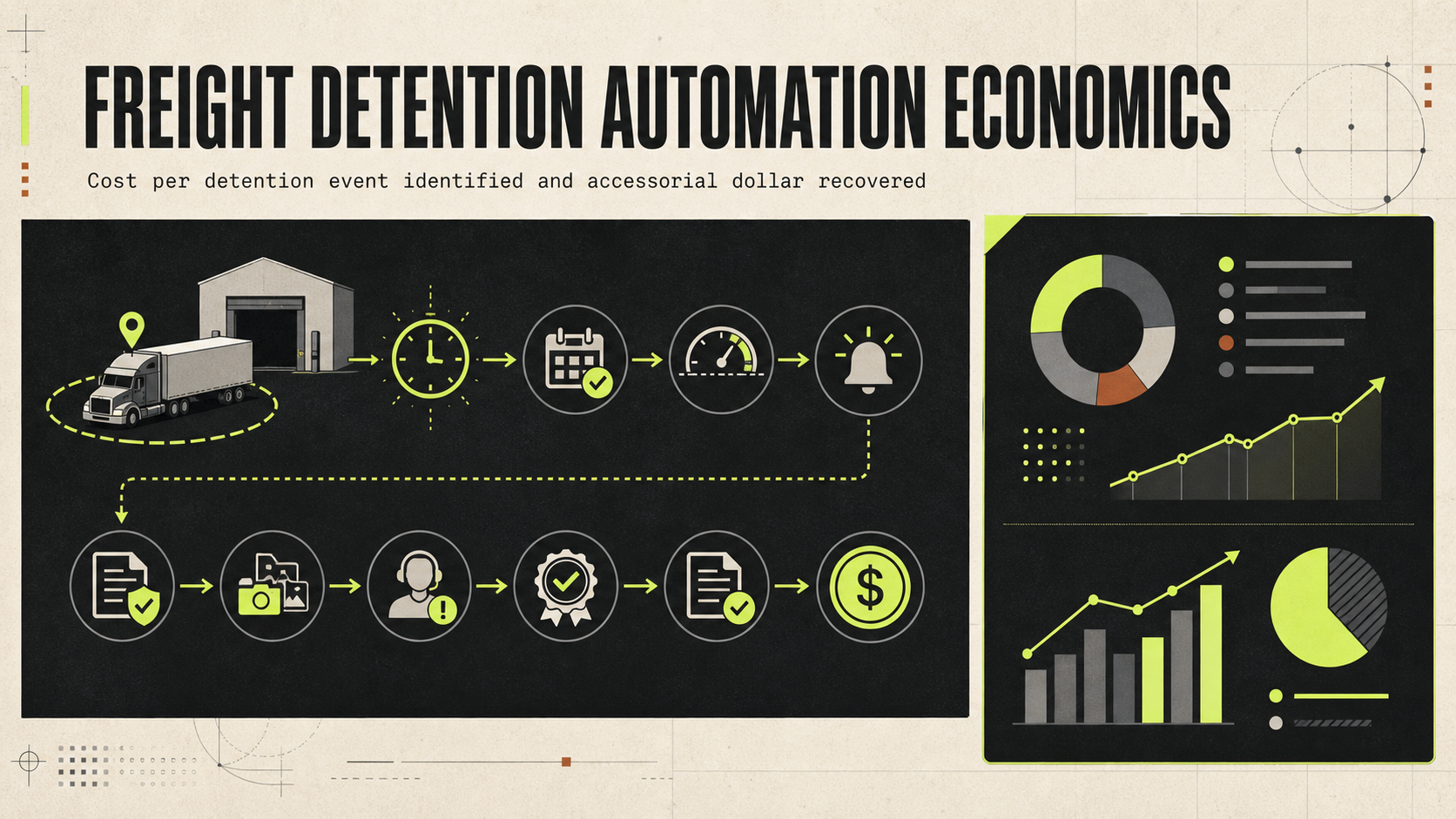
The freight detention stop-to-cash funnel
| Stage | Required evidence | Economic question |
|---|---|---|
| Eligible stop | Valid load, facility, stop type, appointment, customer, and contract route | Which stops should enter monitoring? |
| Arrival and departure observed | Approved geofence, ELD, telematics, check-in, document, or manual source | Is the dwell clock trustworthy? |
| Candidate detention event | Dwell exceeds the configured preliminary threshold | How many stops require rule evaluation? |
| Supported claim | Applicable terms, free time, notice, evidence, exclusions, responsible party, and calculation pass | How many events are ready to submit or bill? |
| Approved accessorial | Authorized counterparty or internal approval under policy | What amount is accepted? |
| Invoiced and undisputed | Charge posted with required packet and dispute state | How much enters accounts receivable cleanly? |
| Collected dollar | Verified payment or settlement within the observation window | What cash was actually recovered? |
Segment the funnel by carrier, broker, shipper, receiver, facility, customer, stop type, mode, lane category, contract rule, responsible party, evidence source, and reviewer. Blended recovery rates can hide weak facilities, incomplete evidence, or customer-specific concessions.
A detention event identified is not an accessorial dollar recovered
Dwell dashboards can produce a large number of alerts. That does not mean each event is contractually payable, sufficiently documented, approved, invoiced, or collected.
| Observed event | What it proves | What it does not prove |
|---|---|---|
| Geofence arrival | A device entered a configured boundary | Appointment, check-in, facility responsibility, or contract applicability |
| Dwell threshold exceeded | The observed stop lasted beyond a configured time | Payable detention or complete evidence |
| Claim generated | A workflow produced a charge packet | Accuracy, approval, invoice acceptance, or payment |
| Charge approved | An authorized party accepted an amount | Invoice delivery, absence of dispute, or cash |
| Charge invoiced | An accounts-receivable item exists | Collection or net recovery after credits |
| Dollar collected | The selected payment state was reached | Incremental value unless compared with a credible baseline |
Preserve every state. Rewriting a candidate directly to “paid” erases the evidence needed to diagnose leakage between detection, approval, billing, and collection.
Detention is an operational, safety, and revenue-recovery problem
FMCSA's detention research describes the effects of excess waiting time on driver earnings, operations, and safety, while noting the difficulty of separating normal loading or unloading from detention. The American Transportation Research Institute reported detention at 39.3% of surveyed stops in its 2023 data.
Current products illustrate the workflow categories. ChargeGuard focuses on timestamps, specific contract terms, and claim generation; Haulia describes automatic clocks, proactive notice, evidence, and billing; and LoadStop connects accessorial detection with document validation and invoicing. Treat product claims as diligence inputs, not proof of your recovery rate.
The complete detention-automation cost stack
- 01Stop and appointment data
TMS records, appointment changes, facility data, manual corrections, synchronization, and data-quality monitoring.
- 02Location and time evidence
ELD, telematics, geofences, mobile check-in, timestamps, messages, documents, and evidence reconciliation.
- 03Contract and rule processing
Customer, broker, carrier, facility, mode, free-time, rate, rounding, notice, exclusion, and submission-window logic.
- 04Models and document tools
Extraction, classification, matching, validation, confidence, prompt and model versions, retries, and fallbacks.
- 05Notifications and workflow actions
Pre-threshold notices, approvals, customer or carrier communication, TMS updates, invoice creation, and accounting sync.
- 06Human review and disputes
Evidence repair, contract interpretation, strategic exceptions, approvals, dispute response, collections, and relationship management.
- 07Errors, credits, and delayed cash
False events, duplicate charges, wrong parties, inaccurate calculations, rejected packets, credits, write-offs, and full-invoice delays.
- 08Implementation and controls
Integration, testing, access, security, retention, audit, monitoring, change control, support, and incident response.
For an automation vendor, attribute the cost to each customer. Event frequency, contract variation, facility data quality, document volume, dispute behavior, custom integrations, and human service can make equally priced accounts economically different.
Freight detention automation unit-economics formulas
cost_per_identified_event = total_detection_and_validation_cost ÷ candidate_detention_events
cost_per_supported_claim = (data + rules + models + tools + review + allocated_ops) ÷ supported_claims
cost_per_recovered_dollar = total_detention_program_cost ÷ collected_accessorial_dollars
documentation_completeness_rate = claims_meeting_evidence_standard ÷ candidate_claims
collection_conversion = collected_non_reversed_claims ÷ supported_claims
detention_automation_ROI = (incremental_collected_accessorials + validated_labor_value − program_cost − incremental_dispute_and_credit_cost) ÷ program_cost
customer_margin = (customer_revenue − data_and_model_cost − tools − human_review − support_and_integration_allocation) ÷ customer_revenue
Use collected dollars, not generated charges, in the most conservative recovery formula. Keep billed, approved, disputed, credited, written-off, and collected amounts visible so teams can choose a less conservative view without losing the underlying funnel.
Worked example: truckload stop-to-cash automation
The following values are illustrative—not a benchmark, customer result, vendor quote, contract interpretation, accounting treatment, legal conclusion, or financial projection. They demonstrate a conservative model that credits only incremental collected accessorials.
| Input | Illustrative value | Economic result |
|---|---|---|
| Eligible monthly stops | 5,000 stops | The complete monitored cohort |
| Candidate detention events | 1,300 events | Preliminary dwell threshold exceeded |
| Supported claims | 1,000 claims | 76.9% pass terms, evidence, notice, and responsible-party rules |
| Approved charges | 780 claims · $78,000 | 78% supported-to-approved conversion |
| Collected within the observation window | $66,300 | 85% of approved dollars collected |
| Data, telematics, and integrations | $3,000 | Stop, appointment, location, TMS, and accounting events |
| Models, documents, rules, and workflow tools | $2,400 | Extraction, validation, notifications, and actions |
| Human review, disputes, and collections | $4,200 | Retained operational work |
| Platform, support, and allocated operations | $2,200 | Monitoring, security, implementation allocation, and support |
| Corrections and credits | $1,200 | Observed error and concession cost |
| Total program cost | $13,000 | $10.00 per candidate, $13.00 per supported claim, $0.20 per collected dollar |
| Incremental collections versus baseline | $42,000 | Existing manual recovery is excluded |
| Validated billing and operations labor value | $3,000 | Only time demonstrably reassigned or avoided |
| Incremental dispute and relationship cost | $2,000 | Downside beyond normal program operations |
| Net observable benefit | $30,000 monthly | About 231% illustrative ROI on program cost |
Detection does not establish contract applicability, evidence, approval, invoice acceptance, or cash.
Uses loaded program cost and the verified payment state.
Test causality by customer, facility, contract version, evidence source, stop type, mode, responsible party, reviewer, and aging bucket. Volume, customer policy, facility behavior, freight mix, and collections performance can change results independently of the automation.
Detention economics change by operator
| Operator | Useful outcome | Costs hidden by averages |
|---|---|---|
| Motor carrier | Documented charge collected and driver or equipment cost recovered | Driver reporting, ELD coverage, broker terms, claim follow-up, and payment timing |
| Freight broker | Correct carrier-pay and shipper-bill outcome with defensible margin | Different buy and sell terms, evidence, approvals, disputes, and relationship concessions |
| Third-party logistics provider | Recovered or avoided accessorial by customer, facility, and mode | Customer contracts, operating partners, modes, systems, and allocation |
| Shipper | Correct charge paid or avoidable dwell reduced | Facility responsibility, appointment data, dispute review, and operational improvement |
| Detention-automation vendor | Verified customer outcome at positive contribution | Data events, documents, integrations, custom rules, human services, support, and recovery-based pricing |
Design detention automation around evidence and exceptions
| Workflow design | Best use | Cost or risk to measure |
|---|---|---|
| Alert-only | Surface possible events for staff | Alert fatigue, review time, missed submission windows, and low follow-through |
| Draft-and-review | Assemble calculation and packet for approval | Evidence repair, reviewer throughput, false positives, and queue age |
| Straight-through billing | High-confidence, contract-standard events | Duplicate or wrong-party charges, credits, disputes, and relationship damage |
| Proactive prevention | Notify before free time expires and escalate dwell risk | Notification delivery, operational response, avoided-event attribution, and message cost |
| Recovery and collection | Track approved charges through payment | Invoice disputes, cash delay, follow-up work, concessions, and write-offs |
| Hybrid confidence routing | Automate routine events and review exceptions | Threshold calibration, reviewer consistency, and retained staffing |
The most profitable design is rarely “automate every event.” It is usually straight-through processing for evidence-complete, low-risk claims plus fast review for ambiguous or strategically sensitive cases.
Freight detention automation metrics worth tracking
| Metric | What it reveals | Decision it supports |
|---|---|---|
| Eligible stops, observed arrivals and complete departures | Monitoring coverage and source quality | Data integrations and denominator design |
| Candidate events and dwell-band distribution | Detection volume without assuming payability | Threshold and facility analysis |
| Terms match, evidence completeness, and notice success | Claim readiness | Contract data, document, and messaging work |
| Supported, approved, disputed, credited, and collected | The full recovery funnel | Workflow scope and ROI |
| Dollars generated, approved, invoiced, aged, and collected | Where financial leakage occurs | Billing and collections operations |
| Straight-through rate, review time, and dispute effort | Retained human work | Confidence thresholds and staffing |
| Cost per event, supported claim, approved charge, and recovered dollar | Activity versus outcome economics | Architecture, vendor, and pricing comparison |
| Recovery and margin by customer, facility, rule, and workflow | Who creates or erodes contribution | Contracting, rollout, and commercial plans |
| Latency, retries, tool failure, and unpriced usage | Technical and cost blind spots | Provider, model, and telemetry optimization |
A machine-readable detention cost event without shipment or invoice content
Use internal customer, facility, workflow, stop-type, mode, contract-rule, dwell-band, evidence, review, and claim-state categories instead of shipment descriptions, precise coordinates, driver or consignee data, rate confirmations, BOLs, PODs, invoice content, or messages:
{
  "event_id": "evt_detention_7284",
  "execution_id": "stop_detention_4fd2",
  "step_id": "step_claim_validation_08",
  "parent_step_id": "step_evidence_07",
  "provider": "openai",
  "model": "document-reasoning-model",
  "operation": "validate_detention_claim",
  "input_tokens": 1940,
  "output_tokens": 214,
  "cached_input_tokens": 1120,
  "latency_ms": 548,
  "status": "success",
  "environment": "production",
  "provider_reported_cost_usd": 0.0294,
  "attributes": {
    "application": "freight-detention-automation",
    "workflow": "truckload_stop_to_cash",
    "feature": "accessorial_recovery",
    "customer_id": "broker_org_1842",
    "facility_id": "facility_group_42",
    "stop_type": "delivery",
    "mode": "truckload",
    "contract_rule_id": "detention_rule_17",
    "contract_rule_version": "v6",
    "pricing_version": "recovery_plan_v3",
    "dwell_band": "threshold_plus_60_to_120",
    "evidence_completeness": "complete",
    "claim_state": "supported_pending_approval",
    "human_review_required": false,
    "data_classification": "no_shipment_document_or_invoice_content"
  }
}
Send separate events for stop data, location evidence, contract lookup, document processing, notice, review, charge creation, invoice, dispute, credit, and payment with the same execution_id. Preserve original events and post reversals rather than mutating the ledger.
Commercial rules, evidence, and relationships are part of unit cost
This article is an economics and observability framework, not transportation, safety, contract, legal, regulatory, tax, accounting, billing, collections, or financial advice. Parties should determine applicable agreements, tariffs, regulations, evidence, notices, authorization, recordkeeping, dispute, privacy, security, and accounting treatment with qualified teams.
- Use governing terms: do not replace customer-, broker-, carrier-, facility-, or mode-specific rules with a universal threshold.
- Preserve source reliability: record whether an event came from ELD, geofence, check-in, document, message, or manual correction.
- Separate parties and amounts: carrier-pay, broker-margin, shipper-bill, credit, and collection can differ.
- Route ambiguity: conflicting timestamps, unclear responsibility, missing notice, and strategic exceptions need authorized review.
- Minimize telemetry: cost measurement rarely needs shipment, driver, consignee, document, coordinate, invoice, or message content.
- Price controls: evidence QA, approval, disputes, collections, security, audit, and change management belong in loaded cost.
How to implement detention cost attribution
- 01Define the recovered-dollar outcome
Write the exact event, evidence, contractual, approval, invoice, dispute, credit, payment, and observation-window states before measuring automation.
- 02Establish a comparable baseline
Measure the same customers, facilities, modes, stop types, terms, volumes, event frequency, documentation, approval, collection, review time, and write-offs before rollout.
- 03Create one stop-to-cash execution ID
Join appointment, geofence or ELD, check-in, dwell, notice, contract, evidence, review, charge, invoice, dispute, credit, and payment steps under one durable identifier.
- 04Capture cost and control metadata
Record provider cost, documents, tools, latency, rule and model versions, evidence completeness, retries, review, claim state, and outcome without copying shipment or invoice content into the cost ledger.
- 05Attach customer and commercial context
Add the carrier, broker, 3PL, or shipper customer; facility category; stop type; contract rule; plan; pricing version; and revenue or recovery allocation at the source.
- 06Monitor recovery economics
Alert on cost per identified event, supported claim, approved charge, recovered dollar, dispute, customer margin, collection delay, and unpriced usage.
Ganivra's AI and MCP event model links provider cost, documents, tools, retries, rules, customers, facilities, workflows, and outcomes without proxying operations or storing their content. Use the broader freight back-office economics guide for load-to-cash context, the agentic workflow guide for review and retry economics, and the Voice AI pricing guide when check calls or phone evidence enter the workflow.
Freight detention automation economics FAQ
What is freight detention automation?
Freight detention automation is a controlled workflow that detects extended dwell at a pickup or delivery facility, applies the governing free-time and rate terms, assembles required evidence, notifies the appropriate parties, creates or validates an accessorial charge, routes exceptions for review, and tracks the charge through approval, invoice, dispute, credit, and collection.
What is driver detention time?
FMCSA describes detention as extra time commercial motor vehicle operators wait at shipping or receiving facilities because of delays beyond normal loading or unloading. Commercial payment definitions vary by contract, customer, facility, mode, and workflow, so a dwell threshold alone does not prove a payable event.
How does automated detention tracking work?
A workflow combines appointment, arrival and departure evidence from approved sources; computes dwell and contractual free time; validates load, facility, party, notice, evidence, and rate rules; creates a candidate charge; and routes it to billing or review. Later events record approval, dispute, invoice, payment, reversal, and collection.
How do you calculate freight detention automation ROI?
Compare a defined stop cohort with a credible baseline. Measure loaded program cost, candidate events, supported claims, approved and invoiced charges, dollars collected within the observation window, human review, dispute cost, credits, relationship concessions, and validated labor returned. Credit only incremental collections and avoided cost.
What counts as an identified detention event?
An identified event is a stop whose validated dwell and preliminary rules exceed a configured threshold. It is a candidate, not necessarily a payable charge. The workflow should still verify appointment and facility events, applicable free time, responsible party, exclusions, notice, evidence, and contract terms.
What counts as a supported detention claim?
A supported claim satisfies the organization's written standard for governing terms, validated arrival and departure or equivalent evidence, required notices, reason or exception codes, charge calculation, documentation, submission window, and responsible bill-to party. Missing or conflicting evidence should trigger review rather than automatic billing.
What counts as an accessorial dollar recovered?
Use a verified cash or settlement state from the accounting or payment system within a defined observation window. An identified event, generated invoice, submitted claim, customer approval, or accounts-receivable balance is not yet a recovered dollar.
What data is needed to automate detention charges?
Common inputs include the load and stop, facility, appointment window, arrival and departure evidence, source reliability, governing customer or broker terms, free time, rate and rounding, notice requirements, exclusions, documents, responsible party, invoice state, disputes, credits, and payment. Exact requirements depend on the commercial agreement.
Can ELD or geofence data prove detention?
ELD, telematics, or geofence events can provide valuable arrival and departure evidence, but commercial acceptance depends on the agreement and counterparty. Data quality, geofence boundaries, device state, yard movement, appointment changes, manual corrections, and required signed documents can affect whether the evidence is sufficient.
What is the difference between detention and demurrage?
In trucking, detention generally concerns a driver's or equipment's excess waiting time at a shipper or receiver. In ocean and intermodal contexts, detention and demurrage commonly refer to distinct container and terminal timing concepts with different tariffs, free periods, clocks, responsible parties, and evidence. Do not reuse one workflow's rules for the other.
Should every detention event be invoiced automatically?
Not necessarily. High-confidence, low-risk events may qualify for straight-through billing under policy. Conflicting timestamps, missing notices, disputed responsibility, strategic-customer exceptions, unclear terms, high-value claims, or unusual facilities should route to authorized review.
How should detention disputes and credits be measured?
Track dispute reason, evidence gap, reviewer time, resolution, amount approved, amount credited, days to resolution, payment delay, and whether the event affected the full freight invoice. Preserve the original charge event and post a separate reversal or credit rather than rewriting history.
Can detention automation recover lumper, layover, and TONU charges?
The same event-and-evidence architecture can support lumper, layover, truck ordered not used, driver assist, extra stop, redelivery, and other accessorials, but each needs its own trigger, governing terms, documents, responsible party, approval path, and collection definition.
How should brokers and carriers measure detention differently?
A carrier may focus on earned charge, driver or equipment cost, claim submission, approval, and payment. A broker may need separate carrier-pay and shipper-bill rules, evidence, margin, disputes, and cash timing. The amount charged to a shipper and paid to a carrier should not be assumed identical.
How do detention-automation vendors measure customer margin?
Attribute data ingestion, geofence or telematics events, models, documents, TMS and accounting tools, notifications, human review, disputes, support, and implementation allocation to each carrier, broker, 3PL, or shipper customer. Compare that cost with subscription, usage, or recovered-dollar revenue by customer and workflow.
Which freight detention automation metrics matter most?
Track eligible stops, dwell candidates, identified events, supported claims, notices, approved charges, invoiced dollars, disputes, credits, collected dollars, collection time, documentation completeness, straight-through and review rates, cost per event and recovered dollar, incremental recovery, customer margin, and unpriced usage.
From dwell alerts to recovered revenue
Know what every collected accessorial dollar costs.
Connect data, model, document, tool, review, customer, facility, claim, and collection economics in one execution ledger—without sending shipment or invoice content.