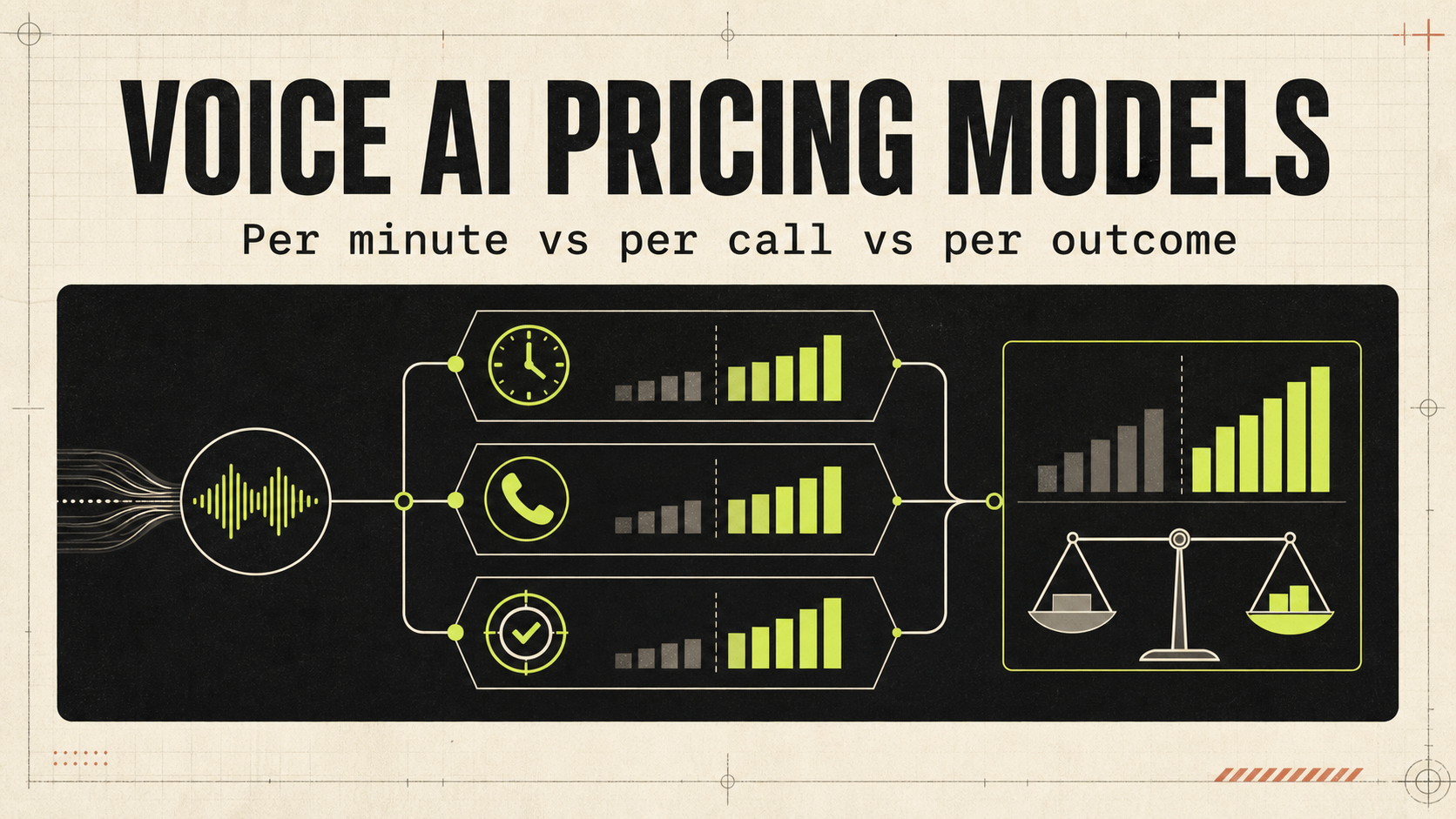
Quick answer
Should Voice AI be priced per minute, per call, or per outcome?
Choose the unit that is closest to value while remaining objective and auditable. Per-minute pricing is transparent for infrastructure-like consumption. Per-call pricing creates duration predictability. Per-outcome pricing aligns the invoice with a verified business result.
No model removes cost; it reallocates risk. Buyers should compare effective cost per successful outcome. Vendors should compare revenue with the full cost to produce that outcome, including failed calls, retries, tools, human work, support, and customer-specific complexity.
Voice AI pricing models compared
| Model | Buyer pays for | Risk held by buyer | Risk held by vendor |
|---|---|---|---|
| Per minute | Billable connected duration | Long calls, failed conversations, weak conversion, silence, retries | Unit-cost changes not passed through and any service commitments |
| Per call | Each call meeting the billable definition | Spam or low-quality calls that count, weak outcomes, repeat calls | Long-call tail and variable compute inside a fixed call fee |
| Per outcome | Each accepted, verified result | Definition gaming, attribution disputes, minimums, low-quality accepted results | Failed attempts, long calls, retries, low conversion, reversals |
| Subscription plus allowance | Access plus included units and overage | Unused allowance, tier cliffs, forecast error, overage | Heavy users inside generous allowances |
| Hybrid | Platform or minimum plus a usage or outcome unit | More contract complexity | Less extreme downside if assumptions move |
A pricing unit is not an outcome definition. “Per call” means little until the contract defines a real call. “Per outcome” is only aligned when the result is valuable, verified, attributable, reversible when necessary, and resistant to duplicate billing.
The billing definition matters more than the headline rate
| Term | Questions the contract must answer | Common economic failure |
|---|---|---|
| Billable minute | Connected or agent-active time? Per-second or rounded? Silence? Hold? Transfer? | Short calls round up or transferred duration keeps accruing |
| Billable call | Does it require speech, eligibility, a duration threshold, or a human conversation? | Spam, voicemail, hang-ups, tests, and repeat attempts consume quota |
| Qualified lead | Which rubric fields, evidence, CRM state, and duplicate window apply? | Contact capture is sold as qualification |
| Booked appointment | Valid slot, write-back, confirmation, cancellation and no-show treatment? | Calendar events are billed even when invalid or immediately canceled |
| Resolution | Eligible issue, no handoff, customer confirmation, reopen or repeat-contact window? | Containment is counted as a durable resolution |
| Warm transfer | Connection to whom, minimum duration, context delivered, acceptance by representative? | A ring or failed transfer is billed as a completed handoff |
Include an auditable disposition hierarchy. Attempted, connected, human conversation, eligible, qualified, completed, verified, reversed, disputed, and credited should be separate states—not one mutable “success” label.
How current Voice AI vendors package pricing
Public prices change, so treat the following as model examples observed on August 30, 2026—not quotes or recommendations. Retell AI publishes usage-based per-minute ranges and component add-ons. Vapi's documentation describes a voice pipeline whose cost depends on transcriber, model, voice, platform, and telephony components.
Smith.ai's AI Receptionist pricing uses monthly call allowances and per-real-call rates, with specific spam-call treatment. Goodcall uses a distinct unit—unique customers served—rather than minutes, calls, or tokens. Nedzo publishes outcome-based plans where a resolved conversation, completed workflow, or qualified lead can be the billable unit.
The lesson is not that one vendor or unit is universally better. It is that “Voice AI pricing” can refer to infrastructure consumption, a managed receptionist service, a unique customer, or a business result. Normalize scope, support, quality, and outcome evidence before comparing rates.
Costs the pricing unit can hide
- 01Platform and orchestration
Agent runtime, workflow engine, routing, observability, environments, and platform minimums.
- 02Speech and model stack
Recognition, language or realtime model, generation, prompt and context growth, caching, silence, and model tiers.
- 03Telephony and deliverability
Numbers, inbound and outbound rates, geography, carriers, SIP, connection attempts, branded calling, and messages.
- 04Tools and integrations
CRM, calendar, helpdesk, payments, data lookups, automation platforms, API fees, retries, and write-back validation.
- 05Human services
Live transfers, receptionist or specialist handling, QA, prompt operations, implementation, support, and account management.
- 06Quality, privacy, and controls
Recording, transcription, redaction, retention, security, evaluation, guardrails, monitoring, and incident response.
- 07Commercial mechanics
Monthly minimums, included units, unused allowance, overages, concurrency, volume tiers, term, credits, and termination.
- 08Failure and correction
Spam, voicemail, wrong numbers, invalid outcomes, repeat contacts, disputes, credits, refunds, complaints, and service recovery.
Voice AI pricing and break-even formulas
effective_cost_per_minute = (fixed_fees + variable_voice_cost + tools + human_ops + allocated_implementation) ÷ production_connected_minutes
effective_cost_per_call = total_monthly_program_cost ÷ billable_calls
effective_cost_per_outcome = total_monthly_program_cost ÷ verified_non_reversed_outcomes
break_even_minutes_per_call = per_call_price ÷ per_minute_price
minute_model_cost_per_outcome = (average_billable_minutes_per_call × per_minute_price) ÷ eligible_call_outcome_rate
customer_margin = (customer_revenue − attributed_voice_stack − tools − human_ops − support − credits) ÷ customer_revenue
Normalize fixed fees before using break-even equations. If two plans include different services or quality commitments, arithmetic alone does not make them comparable.
Worked example: the cheapest model changes with call behavior
The following values are illustrative—not vendor quotes, benchmarks, purchasing advice, or a financial projection. All three offers are assumed to cover the same workflow, service level, tools, and quality standard.
| Input | Illustrative value | Why it matters |
|---|---|---|
| Billable calls | 4,000 monthly | Spam and non-billable attempts already removed |
| Verified outcomes | 1,000 monthly | 25% outcome conversion |
| Shared monthly platform and operations fee | $300 | Added to each comparison |
| Per-minute proposal | $0.18 per minute | Buyer holds duration and conversion risk |
| Per-call proposal | $0.75 per billable call | Vendor holds duration risk after 4.17 minutes |
| Per-outcome proposal | $4.25 per verified outcome | Vendor holds failed-call execution risk |
| Scenario | Per minute | Per call | Per outcome |
|---|---|---|---|
| 3-minute average call | $2,460 total · $2.46/outcome | $3,300 total · $3.30/outcome | $4,550 total · $4.55/outcome |
| 6-minute average call | $4,620 total · $4.62/outcome | $3,300 total · $3.30/outcome | $4,550 total · $4.55/outcome |
| 6-minute calls, conversion falls to 15% | $4,620 total · $7.70/outcome | $3,300 total · $5.50/outcome | $2,850 total · $4.75/outcome |
At short duration and strong conversion, the minute plan wins. When calls lengthen, the call plan wins. When conversion deteriorates, outcome pricing protects the buyer while the vendor absorbs more failed-call cost. That protection is why a rational outcome fee often carries a premium over the happy-path cost of raw minutes.
Which pricing model fits which Voice AI scenario?
| Scenario | Natural starting model | Metric that can break the model |
|---|---|---|
| Short informational inbound calls | Per minute or per call | Repeat contacts and low durable resolution |
| Receptionist and call answering | Per real call or hybrid allowance | Spam definition, long intake, human escalation, repeat callers |
| Appointment booking | Per call during pilot; per valid booking when verified | Invalid slots, cancellations, no-shows, attribution |
| Outbound lead qualification | Per minute or connect during pilot; per qualified lead at maturity | List quality, consent, connection, rubric gaming, duplicates |
| Tier-1 customer support | Per minute initially; per durable resolution with reopen window | Containment mislabeled as resolution |
| Collections or payment recovery | Outcome or hybrid | Attribution, reversals, payment failure, regulatory constraints |
| Complex regulated workflows | Hybrid platform plus usage and service fees | Human review, controls, integration, and liability scope |
| Voice AI platform sold to developers | Per minute with transparent components | Provider mix, concurrency, support, and downstream tool cost |
Hybrid pricing is often the practical answer
Pure outcome pricing can expose a vendor to unbounded cost when the customer controls list quality, demand mix, availability, downstream staff, or systems. Pure per-minute pricing can leave the buyer paying for failures the vendor can influence. A hybrid can allocate each risk to the party best able to control it.
- Platform plus minutes: covers availability and support while usage follows consumption.
- Minimum plus outcomes: funds committed capacity and operations while most variable revenue follows results.
- Minutes during pilot, outcomes after calibration: uses observed duration and conversion to price verified results.
- Base outcome plus complexity bands: distinguishes routine results from long or specialist workflows.
- Outcome plus human-service add-on: keeps AI success separate from optional live handling.
Hybrid does not mean opaque. Publish or contract the unit definitions, base fee, allowance, overage, complexity rule, exclusions, and reconciliation method.
Voice AI pricing contract checklist
| Contract area | Terms to define | Evidence to retain |
|---|---|---|
| Meter boundary | Start, stop, rounding, silence, hold, transfer, test traffic | Carrier and platform timestamps |
| Eligibility and disposition | Spam, voicemail, wrong number, hang-up, repeat and unsupported intent | Auditable non-content disposition metadata |
| Outcome acceptance | Fields, system state, verification source, attribution window | CRM, calendar, helpdesk, payment, or workflow event |
| Reversals and disputes | Duplicates, cancellations, reopens, invalid records, credit period | Immutable original event plus reversal or credit event |
| Fees and tiers | Minimum, included units, overage, concurrency, numbers, add-ons, support | Pricing version attached to every billed unit |
| Quality and service | Latency, availability, transfer success, accuracy, support, remedies | Shared service and outcome reports |
| Change control | Model, voice, prompt, provider, workflow, rate, and policy changes | Versioned configuration and effective dates |
This is a unit-economics framework, not legal, procurement, accounting, tax, regulatory, or financial advice. Have qualified teams review the commercial and compliance terms for the relevant workflow and jurisdiction.
Voice AI pricing metrics worth tracking
| Metric | What it reveals | Decision it supports |
|---|---|---|
| Attempts, connections, human conversations, eligible calls | Traffic quality and denominator movement | Billable-call definition and filtering |
| Average, median, P90 and P99 billable duration | Long-call tail hidden by the average | Minute-versus-call break-even |
| Verified, reversed, disputed, and credited outcomes | Outcome durability and billing quality | Outcome definition and reserves |
| Model, voice, telephony, tool, message, and add-on cost | Direct execution cost | Architecture and provider selection |
| Handoff rate, transfer success, and human handling time | Retained service cost | Scope and hybrid pricing |
| Effective price per minute, call, and outcome | Normalized buyer price | Proposal comparison and renewal |
| Cost and revenue by customer, workflow, and pricing version | Vendor contribution and outliers | Guardrails, tiers, and repricing |
| Invoice-to-event reconciliation and unpriced usage | Billing completeness and leakage | Finance close and telemetry fixes |
A machine-readable Voice AI pricing event without call content
Store stable customer, workflow, pricing-version, billing-unit, duration, disposition, verification, cost, and outcome metadata instead of caller content, recordings, transcripts, phone numbers, or tool payloads:
{
  "event_id": "evt_voice_price_7284",
  "execution_id": "call_voice_4fd2",
  "step_id": "step_outcome_09",
  "parent_step_id": "step_tool_08",
  "provider": "openai",
  "model": "realtime-voice-model",
  "operation": "verify_booking_outcome",
  "input_tokens": 2180,
  "output_tokens": 226,
  "cached_input_tokens": 1240,
  "latency_ms": 566,
  "status": "success",
  "environment": "production",
  "provider_reported_cost_usd": 0.0347,
  "attributes": {
    "application": "voice-booking-agent",
    "workflow": "inbound_booking",
    "customer_id": "account_1842",
    "pricing_model": "per_outcome",
    "pricing_version": "voice_outcome_v3",
    "billable_unit": "verified_booking",
    "billable_quantity": 1,
    "billable_outcome": true,
    "connected_seconds": 186,
    "attempt_disposition": "human_conversation",
    "human_handoff_required": false,
    "outcome_verification": "system_writeback_confirmed",
    "data_classification": "no_call_content_pricing_metadata"
  }
}
Use the same execution_id across telephony, speech, model, tool, transfer, verification, reversal, and credit events. That creates a reconstructable ledger for buyer ROI and vendor margin without turning billing telemetry into a conversation archive.
How to compare and operate a Voice AI pricing model
- 01Define the billable unit
Write the exact start, stop, eligibility, success, reversal, dispute, and observation-window rules for a minute, call, or outcome.
- 02Measure the traffic distribution
Capture attempts, connections, duration, intent, spam, voicemail, eligible calls, retries, transfers, outcomes, corrections, and seasonality.
- 03Build the loaded cost stack
Add platform, speech, models, telephony, tools, messaging, concurrency, support, human work, implementation, QA, and error cost.
- 04Normalize every proposal
Convert monthly fees, allowances, overages, minimums, and add-ons into effective cost per connected minute, eligible call, and verified outcome.
- 05Run break-even scenarios
Stress-test short and long calls, weak and strong conversion, peak concurrency, model changes, handoffs, and customer mix.
- 06Instrument contract performance
Reconcile invoice units with execution cost and outcomes, then monitor buyer ROI and vendor margin by customer, workflow, and pricing version.
Ganivra's AI and MCP event model links provider cost, call duration, models, tools, retries, pricing versions, customers, workflows, and outcomes without proxying calls or storing their content. Use the Voice AI unit economics guide to build the cost stack, then see outcome design in the HVAC and dental AI receptionist examples.
Voice AI pricing FAQ
What are the main Voice AI pricing models?
The three most common usage units are connected minute, billable call, and verified outcome. Many commercial plans combine one of these with a monthly platform fee, included allowance, overage rate, implementation fee, concurrency charge, phone-number fee, telephony pass-through, or human-service add-on.
How much does Voice AI cost per minute?
There is no universal rate. The loaded price depends on the platform, speech recognition, language or realtime model, speech generation, telephony geography, silence rules, billing increments, tools, knowledge, QA, recording, redaction, and support. Compare the same configuration and call cohort rather than the headline platform rate alone.
How does per-minute Voice AI pricing work?
The buyer pays for billable connected duration, usually subject to a definition of when metering starts and stops, rounding or per-second proration, silence treatment, transfer behavior, and provider add-ons. It exposes consumption clearly but leaves the buyer with duration, failure, and conversion risk.
How does per-call Voice AI pricing work?
The buyer pays a fixed amount for each call that meets the contract's billable-call definition. The rate may be bundled into a monthly allowance with overages. The critical terms are whether spam, immediate hang-ups, voicemail, transfers, test calls, repeat calls, and abandoned calls count.
How does per-outcome Voice AI pricing work?
The buyer pays when the agent produces a predefined, verifiable result such as a qualified lead, booked appointment, completed workflow, payment, warm transfer, or durable resolution. The contract must define eligibility, acceptance evidence, attribution window, duplicates, reversals, disputes, and outcomes later invalidated.
Which Voice AI pricing model is cheapest?
None is always cheapest. Per minute often wins for short, predictable, high-conversion calls. Per call can win when duration varies but billable-call quality is controlled. Per outcome can win for long or failure-heavy workflows when the outcome is valuable and verifiable. Model your own duration, connection, conversion, handoff, and correction distributions.
How do you calculate effective Voice AI cost per minute?
Add the monthly platform fee, voice-stack charges, telephony, tools, human support, implementation allocation, and other variable costs, then divide by production connected minutes. Keep non-production testing and implementation visible rather than silently spreading them across a misleading denominator.
What counts as a successful Voice AI call?
A successful call should reach the written terminal state for its workflow, not merely connect or avoid a human transfer. Examples include a valid booking written to the calendar, a support issue that remains resolved through a repeat-contact window, or a qualified lead that satisfies an agreed rubric and lands in the CRM.
Who pays for failed calls under each pricing model?
Under per-minute pricing, the buyer usually pays for connected duration even when the workflow fails. Under per-call pricing, the buyer generally pays if the call meets the billable-call definition. Under per-outcome pricing, the vendor usually absorbs direct execution cost when no billable result occurs, although minimum commitments or exclusions may still shift part of that risk back to the buyer.
Should spam, voicemail, and immediate hang-ups be billable?
The contract should state this explicitly. Buyers should model their actual traffic mix and require auditable dispositions. Vendors should distinguish attempts, connections, human conversations, and eligible calls so filtering cost and false-positive risk are visible instead of hidden in one blended rate.
How should human transfers be priced?
Specify whether AI metering stops at transfer, whether the transferred call becomes a second billable unit, whether live-agent handling is included, and whether a warm transfer itself counts as an outcome. Include the retained human time and failed-transfer cost when comparing models.
What hidden Voice AI fees should buyers check?
Check platform minimums, included usage, overages, billing increments, telephony, international rates, phone numbers, concurrency, premium voices and models, knowledge bases, messages, call recording, redaction, QA, analytics, integrations, implementation, support, human handoffs, data retention, and early termination.
Is a monthly Voice AI subscription a separate pricing model?
A subscription is usually the commercial wrapper rather than the usage unit. A plan may include minutes, calls, customers, or outcomes and then charge an overage. Convert the base fee and unused allowance into effective unit prices before comparing it with pay-as-you-go offers.
Is per-outcome pricing good for outbound Voice AI?
It can align incentives when list eligibility, consent, connection, qualification, and the terminal outcome are clearly defined. Attribution is harder when multiple channels, repeated attempts, sales teams, or later human work contribute. Compliance, carrier, and attempt costs still exist even when the buyer is not invoiced for a failed outcome.
How do you calculate Voice AI pricing ROI?
Compare the loaded program cost with incremental contribution, validated labor value, avoided loss, and error cost for a comparable baseline and observation window. Do not treat every handled call, booking, or resolution as incremental, and do not confuse revenue with contribution or profit.
How should a Voice AI vendor choose a pricing model?
Choose a unit customers understand that can be measured consistently while preserving positive contribution across call length, provider mix, failure rate, human support, and customer segments. Pilot first, instrument cost per outcome, set guardrails and exclusions, and monitor gross margin by customer rather than relying on portfolio averages.
From billing units to customer margin
Know what every minute, call, and outcome really costs.
Connect model, voice, tool, handoff, customer, pricing-version, and outcome economics in one execution ledger.