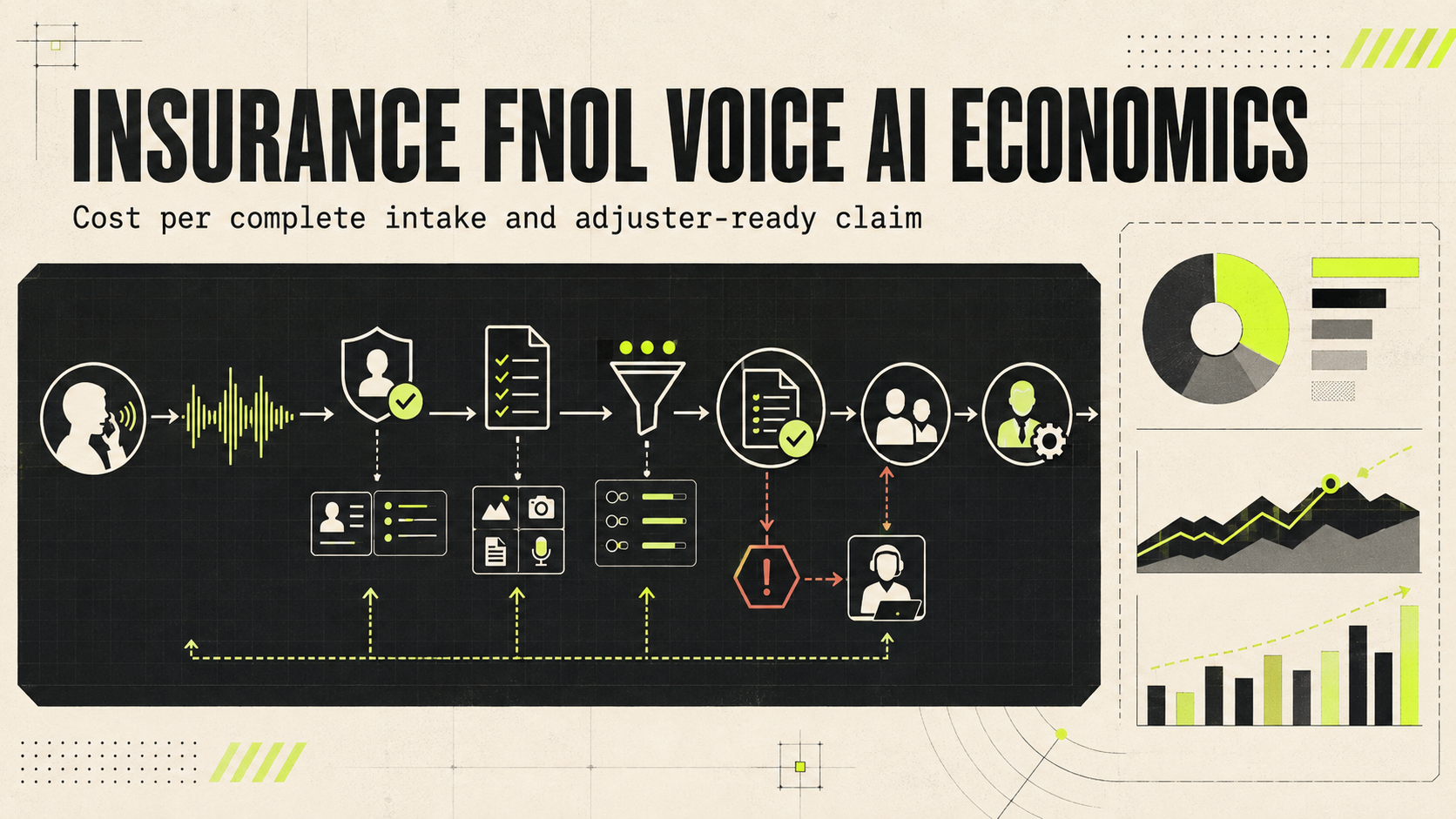
Quick answer
How do you measure Insurance FNOL Voice AI economics?
Add telephony, speech, models, policy and claims-system tools, data services, documents, messaging, human review, implementation, QA, governance, security, corrections, and service recovery. Attribute loaded cost to valid notices, complete FNOLs, claims-system acceptance, correct routing, adjuster-ready intake, and carrier customers.
Keep intake separate from coverage, liability, fraud, reserve, denial, and settlement decisions. The best denominator is an eligible FNOL that remains usable through the carrier's correction and duplicate window.
The loss-call-to-adjuster funnel
| Stage | Required evidence | Economic question |
|---|---|---|
| Connected loss call | Call state, line of business, language, and catastrophe cohort | How much paid traffic reaches intake? |
| Valid notice | Eligible loss report with permitted identity and policy context | How many calls represent addressable claims demand? |
| Complete FNOL | Required fields, notices, evidence references, and duplicate checks | What does usable intake cost? |
| Claim created | Validated claims-system write-back and stable claim link | Did conversation become system state? |
| Correct routing | Applicable authority, severity, catastrophe, specialist, and queue rules | Did the intake reach the right operating path? |
| Adjuster-ready FNOL | Accepted, correctly routed, and usable without material correction | What does a durable handoff cost? |
Segment by carrier, TPA, line, product, loss category, jurisdiction, language, channel, catastrophe, policy-rule version, handoff path, and customer. A business-as-usual auto FNOL should not hide a catastrophe property queue with high concurrency and correction cost.
A claim number is not an adjuster-ready intake
| Observed event | What it proves | What it does not prove |
|---|---|---|
| Call answered | The phone connected | Valid notice or complete intake |
| Claim number issued | A claims record exists | Correct policy, completeness, deduplication, or routing |
| Call contained | No live transfer occurred | Accuracy, claimant experience, or adjuster readiness |
| Queue assigned | A routing state exists | That the route matched the governing rule |
| FNOL complete | The written intake standard passed | Durability until corrections and duplicates are observed |
Define required fields, authority boundaries, claims-system acknowledgement, correct routing, human-review triggers, duplicate treatment, correction window, and the terminal state that qualifies as adjuster-ready.
FNOL is moving from call logging to connected claims intake
Salesforce describes FNOL as the process that starts claims handling and supports submission of required information and documents. Current vendor pages such as Assured and Hi Marley position digital or voice-assisted FNOL around structured intake and connected claims communication. These are workflow descriptions, not independent economic benchmarks.
Buyers still need their own evidence for completeness, correct routing, claimant effort, adjustment rework, catastrophe performance, and cost-to-serve. Ganivra connects model and tool costs to the final claims-system outcome and the carrier customer that caused them.
The complete FNOL Voice AI cost stack
- 01Telephony and speech
Numbers, routing, connected minutes, recognition, models, speech generation, silence, interruption, transfers, and recording where permitted.
- 02Policy and loss context
Identity and policy lookup, line and product rules, required questions, loss categories, coverage-context presentation, and duplicate search.
- 03Claims, data, and document tools
Claim creation, evidence references, geocoding or weather where approved, messaging, write-back validation, acknowledgement, and retries.
- 04Routing and human operations
Severity screens, catastrophe queues, specialists, language, live transfer, adjuster review, supervisor handling, and claimant callbacks.
- 05Corrections and service recovery
Wrong policy or loss, missing fields, duplicates, reclassification, repeated contact, reopened intake, complaints, and cleanup.
- 06Governance and implementation
Connector work, authority design, testing, documentation, fairness review, security, privacy, audit, third-party oversight, monitoring, and incident response.
Insurance FNOL Voice AI unit-economics formulas
cost_per_valid_notice = total_FNOL_program_cost ÷ valid_loss_notices
cost_per_complete_FNOL = total_FNOL_program_cost ÷ complete_FNOLs
cost_per_correct_routing = total_FNOL_program_cost ÷ correctly_routed_FNOLs
cost_per_adjuster_ready_FNOL = total_FNOL_program_cost ÷ adjuster_ready_FNOLs
correction_free_intake_rate = complete_FNOLs_without_material_correction_in_window ÷ complete_FNOLs
FNOL_ROI = (validated_baseline_cost_avoided + verified_adjuster_time_value + observed_rework_savings − program_cost − correction_and_service_recovery) ÷ program_cost
customer_margin = (customer_revenue − voice_stack − claims_and_data_tools − human_ops − governance_and_support) ÷ customer_revenue
Do not credit speculative claim leakage, fraud prevention, severity reduction, or retention in the core case. Keep them separate unless a defensible causal method exists.
Worked example: monthly personal-lines FNOL intake
The figures are illustrative—not a benchmark, carrier result, loss estimate, staffing standard, or vendor quote.
| Input | Illustrative value | Economic result |
|---|---|---|
| Inbound loss-report calls | 8,000 | The full paid call population |
| Valid notices | 6,000 | Spam, status, and unsupported contacts separated |
| Complete FNOLs | 5,100 | Written intake standard passed |
| Correctly routed FNOLs | 4,700 | Applicable routing rule verified |
| Adjuster-ready FNOLs | 4,400 | No material intake correction in the observation window |
| Voice stack and platform | $14,000 | Telephony, speech, models, and platform |
| Claims, policy, data, and messaging tools | $7,500 | Connected intake operations |
| Human handoff and review | $13,500 | Retained claims work |
| QA, governance, and support | $6,000 | Control and customer cost-to-serve |
| Corrections and service recovery | $4,000 | Observed consequence cost |
| Total program cost | $45,000 | $7.50 per valid notice, $8.82 per complete FNOL, $9.57 per correct routing, $10.23 per adjuster-ready FNOL |
| Validated benefits | $59,000 | Baseline intake cost, verified time value, and observed rework savings |
| Net observable benefit | $14,000 | About 31% illustrative ROI |
Answering does not establish valid, complete, correctly routed, or durable intake.
Loaded cost against an observed claims-system outcome.
Catastrophe surge needs its own denominator
Catastrophe windows change call concurrency, repeat contact, duplicate notices, policy lookups, loss mix, data usage, human capacity, and claimant wait time. Report business-as-usual and catastrophe cohorts separately.
catastrophe_cost_per_adjuster_ready_FNOL = catastrophe_voice_data_human_and_support_cost ÷ catastrophe_adjuster_ready_FNOLs
Measure abandonment, fallback, time to accepted claim record, duplicate rate, complete intake, correct catastrophe routing, correction, human minutes, and cost through the full event window. Surge capacity is valuable only if intake remains usable.
How the economics change by insurance operator
| Operator | Useful outcome | Costs hidden by averages |
|---|---|---|
| P&C carrier | Adjuster-ready FNOL by line and claim segment | Product rules, systems, jurisdictions, catastrophe load, and governance |
| TPA | Complete and correctly routed intake by client program | Client variation, service levels, authority, reporting, and human operations |
| MGA or program administrator | Usable intake under carrier and program rules | Delegated authority, handoffs, data exchange, and low-volume products |
| Digital carrier or insurtech | Connected intake with low claimant effort | Connector reliability, fallback, support, and exception handling |
| FNOL Voice AI vendor | Verified carrier outcome at positive margin | Custom rules, claims integrations, surge, compliance, QA, and support |
FNOL Voice AI metrics worth tracking
| Metric | What it reveals | Decision |
|---|---|---|
| Calls, valid notices, complete FNOLs | The intake funnel | Coverage and flow design |
| Claims-system acceptance and duplicate rate | Write-back quality | Connector and retry policy |
| Correct routing and high-consequence errors | Authority and operational risk | Rules, review, and rollout scope |
| Human handoff and correction minutes | Retained claims cost | Automation boundary and staffing |
| Adjuster-ready rate and repeat contact | Durable intake quality and claimant effort | Question design and handoff |
| Cost and margin by carrier customer | Who is profitable to serve | Pricing, limits, and support |
Keep claim content out of the economics plane. A machine-readable event can be useful without exposing claimant, policy, loss, vehicle, medical, document, recording, or transcript data.
{
  "event_id": "evt_fnol_voice_7284",
  "execution_id": "fnol_call_4fd2",
  "step_id": "step_claim_create_08",
  "parent_step_id": "step_intake_validation_07",
  "provider": "openai",
  "model": "realtime-voice-model",
  "operation": "create_adjuster_ready_fnol",
  "input_tokens": 2640,
  "output_tokens": 284,
  "latency_ms": 644,
  "status": "success",
  "environment": "production",
  "provider_reported_cost_usd": 0.0417,
  "attributes": {
    "application": "insurance-fnol-voice-agent",
    "workflow": "inbound_first_notice_of_loss",
    "feature": "claim_intake_and_routing",
    "customer_id": "carrier_org_1842",
    "line_of_business": "personal_auto",
    "product_segment": "standard_auto",
    "loss_category": "collision",
    "catastrophe_cohort": "none",
    "prompt_version": "v12",
    "policy_rule_version": "v6",
    "intake_completeness": "complete",
    "routing_outcome": "adjuster_queue_acknowledged",
    "human_handoff_required": false,
    "data_classification": "no_claimant_policy_or_loss_content"
  }
}
Ganivra's event integration connects every model and claims-tool step to the FNOL execution, outcome, carrier customer, and commercial context.
Governance is part of FNOL unit cost
The NAIC AI topic page describes insurance uses including claims handling and emphasizes insurer responsibility, fairness, accuracy, and human oversight. Its Model Bulletin addresses governance, risk management, documentation, third-party systems, and regulator inquiries. Applicability varies by jurisdiction and adoption.
Use the NIST AI Risk Management Framework to organize governance, mapping, measurement, and management. For outbound AI calls, the FCC's declaratory ruling confirms TCPA artificial- or prerecorded-voice requirements apply. Qualified legal, claims, privacy, security, and compliance teams should define the operating rules.
Price model and prompt testing, authority boundaries, identity controls, audit samples, fairness review, security, data minimization, least-privilege claims tools, human fallback, third-party oversight, incident response, and claimant service recovery. This guide is an economics framework, not claims, coverage, legal, or regulatory advice.
How to measure Insurance FNOL Voice AI economics
- 01Define complete and adjuster-ready FNOL
Write the eligible notice, required fields, claims-system, routing, correction, duplicate, and observation-window standards.
- 02Measure a comparable baseline
Capture calls, notices, completeness, routing, human time, corrections, repeated contact, cost, and loss mix for comparable cohorts.
- 03Create one call-to-adjuster execution ID
Join telephony, speech, policy lookup, claims tools, data, documents, routing, review, correction, and terminal outcomes.
- 04Version rules and controls
Record prompt, model, authority, severity screen, catastrophe, routing, tool, fallback, and review versions.
- 05Attach carrier and commercial context
Add carrier or TPA customer, line of business, product segment, plan, pricing version, and cost or revenue allocation.
- 06Monitor risk-weighted economics
Alert on completeness, routing errors, high-consequence misses, correction, repeat contact, cost per adjuster-ready FNOL, and customer margin.
Start with bounded intake and routing, prove claims-system durability, review errors by consequence, and expand only when correction-adjusted economics hold. Continue with the insurance claims automation economics guide, the Voice AI cost guide, and the Voice AI pricing guide.
Frequently asked questions
Insurance FNOL Voice AI economics FAQ
What is insurance FNOL Voice AI?
Insurance FNOL Voice AI is a voice-enabled system that receives a first notice of loss, captures required information under carrier-approved rules, checks available policy context, creates or updates the claim record, routes the intake, and hands off exceptions. It should remain inside a defined intake authority.
What does FNOL mean in insurance?
FNOL means first notice of loss: the initial report that starts the insurer's claims process. A useful FNOL identifies the correct policy context and captures enough structured loss information for the carrier's next step.
How does automated FNOL work?
The agent receives the loss report, verifies permitted identity and policy context, asks the approved questions, checks completeness and duplicates, captures evidence references, writes to the claims system, applies bounded routing rules, confirms the next step, and escalates uncertainty.
What counts as a complete FNOL?
A complete FNOL satisfies the carrier's written intake standard for the line of business, loss category, policy context, required fields, notices, attachments, duplicate handling, and next-step confirmation. A connected call or partially created claim does not qualify.
What makes an FNOL adjuster-ready?
An adjuster-ready FNOL is complete, correctly linked, accepted by the claims system, routed to the correct queue, and usable without material intake correction. Apply an observation window so reclassification, duplicate merge, and missing-information work remain visible.
What does correctly routed FNOL mean?
Correct routing follows the authority, line-of-business, loss-category, severity-screen, catastrophe, jurisdiction, language, specialist, and human-review rules that applied at the time. A transfer or queue assignment alone does not prove correctness.
Should FNOL Voice AI decide coverage, liability, fraud, or settlement?
FNOL intake should not be treated as authorization for coverage, liability, fraud, reserve, denial, or settlement decisions. Those require separately defined authority, controls, evidence, human oversight, and compliance review.
How much does insurance FNOL Voice AI cost?
Loaded cost includes telephony, speech, models, policy and claims-system tools, data services, documents, messaging, human review, implementation, governance, security, quality assurance, corrections, and service recovery. Compare cost per complete and adjuster-ready FNOL.
How do you calculate FNOL automation ROI?
Compare equivalent call cohorts and loss mix before and after deployment. Credit validated intake cost avoided, observed adjuster or administrative time returned, and verified rework savings; subtract the loaded program, correction, and service-recovery costs. Do not credit speculative leakage, fraud, or severity reduction.
How does Voice AI compare with a human FNOL call center?
Compare the same lines, hours, loss mix, language, catastrophe state, and quality standard. Include wait time, completeness, routing, system write-back, human escalation, correction, claimant effort, surge capacity, QA, and loaded cost.
How should catastrophe-surge FNOL economics be measured?
Separate catastrophe cohorts and concurrency from business-as-usual calls. Track queueing, abandonment, fallback, duplicate notices, staff augmentation, data-service use, completeness, routing, correction, and cost per adjuster-ready FNOL by event window.
Does FNOL Voice AI need a claims-system integration?
Reliable integration is central when the system promises complete automation. It should find the permitted context, prevent duplicates, create or update the claim, verify write-back, route correctly, and preserve an audit trail. Message-taking is a different outcome.
When should FNOL Voice AI hand off to a human?
Use human escalation for injuries or other high-consequence categories under carrier policy, emergencies, uncertainty, identity or policy mismatch, ambiguous coverage context, suspected duplicate or abuse, accessibility needs, caller distress, unsupported language, tool failure, or authority boundaries.
How should repeat callers and duplicate notices be handled?
Use privacy-preserving matching and claims-system checks to link, update, or escalate under written rules. Track duplicate attempts and merge work separately so an apparent high claim-creation rate does not become duplicate inventory.
Can the agent make outbound claim-update calls?
Technically yes, but a requested transactional update and marketing are different workflows. Define consent or another lawful basis, identification, disclosure, permitted content, opt-out where relevant, timing, and records before outbound activation.
Does FNOL cost tracking require claimant calls or claim content?
No. Cost telemetry can use carrier, execution, workflow, line-of-business category, loss category, completeness, routing, control version, cost, review, and outcome metadata without names, policy numbers, addresses, recordings, transcripts, or loss narratives.
How do FNOL vendors measure margin by carrier customer?
Attribute telephony, models, policy and claims connectors, data services, catastrophe capacity, human operations, implementation, custom rules, QA, governance, security, support, and correction cost to each carrier or TPA customer under the actual pricing version.
Which FNOL Voice AI metrics matter most?
Track calls, valid notices, complete FNOLs, claims-system acceptance, correct routing, adjuster-ready rate, duplicate rate, human handoffs, correction, reopen, claimant repeat contact, latency, catastrophe concurrency, cost per outcome, customer margin, and unpriced usage.
Measure the adjuster-ready intake
See which FNOL Voice AI workflows are actually economical.
Connect telephony, models, claims tools, data, human review, corrections, outcomes, and carrier-customer revenue in one cost ledger.