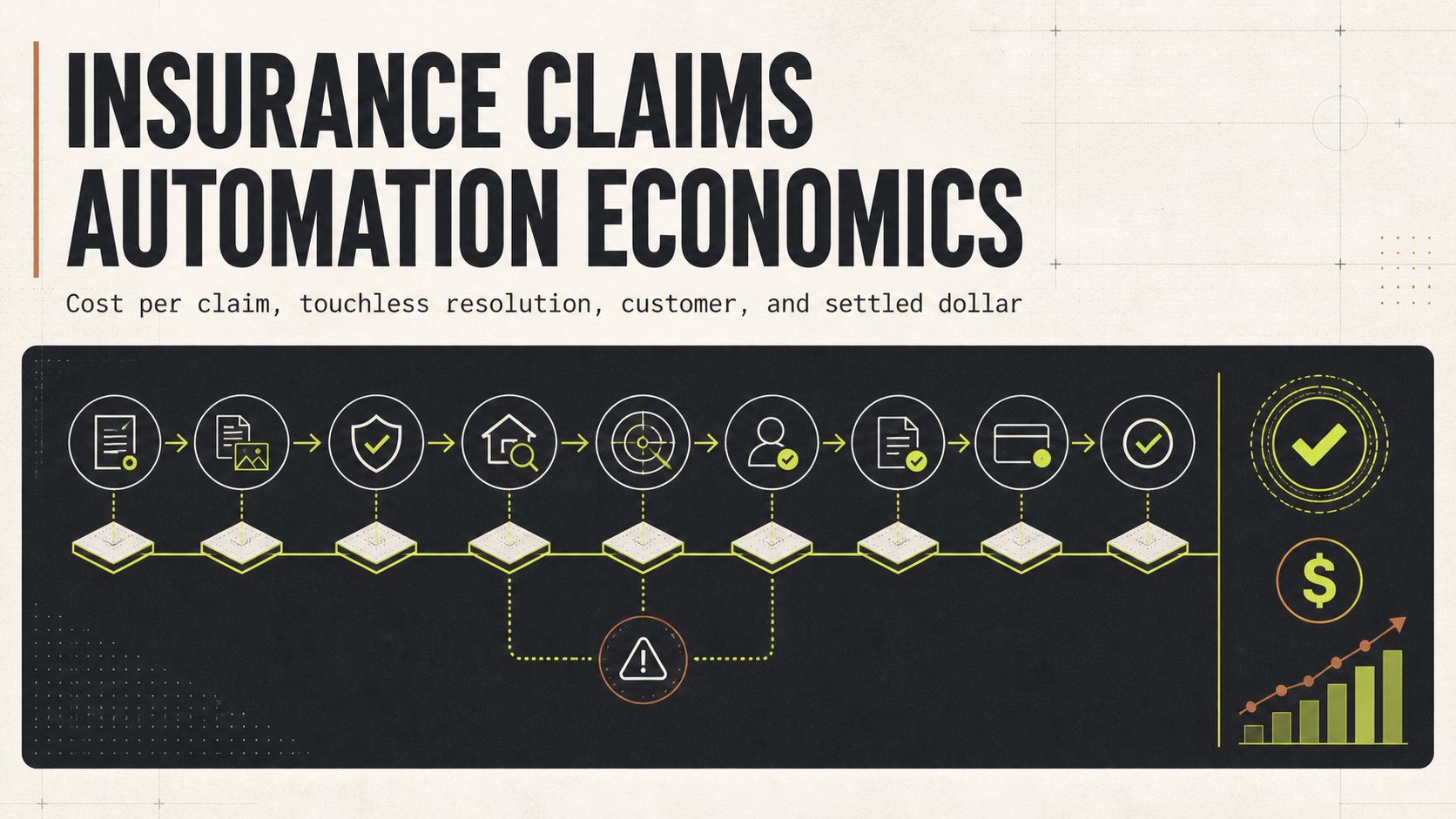
Quick answer
What are the real unit economics of insurance claims automation?
The real unit cost includes workflow software, models, OCR or vision, third-party data, policy and claims-system actions, human review, exceptions, rework, security, governance, and allocated operations. Divide that loaded cost by a verified outcome—not by API calls or files touched.
For carriers, MGAs, and TPAs, useful denominators include a complete FNOL, correctly triaged claim, durable touchless resolution, correctly issued payment, correctly closed claim, or adjuster hour returned. For vendors, add customer revenue and customer-specific delivery cost to expose contribution margin.
What is insurance claims automation?
Insurance claims automation coordinates deterministic rules, document and image processing, predictive models, generative models, data sources, and approved system actions across a claims workflow. The automation may assist an adjuster, complete a bounded administrative step, or move an eligible low-complexity claim through a controlled straight-through path.
The economic question is not whether the system used AI. It is whether the complete workflow produced a correct, timely, durable, and appropriately governed claim outcome at a lower risk-adjusted cost.
Where AI agents operate in the claims lifecycle
| Workflow | Agent work | Useful economic outcome |
|---|---|---|
| FNOL and intake | Capture facts, classify documents, identify missing information, create or enrich the claim | Complete and accurate notice with less claimant and adjuster effort |
| Coverage-data validation | Retrieve policy facts, dates, endorsements, limits, and deductibles for authorized review | Correct data presented under the required authority and review controls |
| Triage and routing | Estimate complexity, identify specialist needs, and assign the correct queue | Correct first assignment with fewer transfers and delays |
| Document and image handling | Extract, classify, summarize, compare, and flag missing or inconsistent evidence | Usable claim file with measured extraction and review accuracy |
| Adjuster assistance | Summarize the file, draft communications, assemble evidence, and recommend next actions | Verified adjuster time returned without hidden correction work |
| Fraud or anomaly referral | Surface signals and route cases under approved policy | Appropriate referral quality, not an automated accusation or denial |
| Settlement and payment | Prepare calculations, authority packages, correspondence, and payment instructions | Accurate, authorized settlement and payment with audit evidence |
| Recovery and closure | Support subrogation, salvage, reconciliation, closure checks, and reopen monitoring | Verified recovery or durable closure under the defined observation window |
Claims activity is not a correct settlement
Claims automation dashboards often celebrate throughput: documents extracted, messages sent, files summarized, claims routed, or payments prepared. Those are useful operational events, but none alone proves that a claim was handled correctly or economically.
| Observed event | What it proves | What it does not prove |
|---|---|---|
| FNOL created | A claim record was opened | Completeness, accuracy, coverage, or correct routing |
| Document extracted | Structured fields were produced | Field accuracy or suitability for a consumer-impacting decision |
| Claim triaged | A queue or path was selected | Correct assignment, severity, liability, or fraud determination |
| Adjuster summary generated | A draft synthesis exists | Factual completeness or adjuster acceptance |
| Settlement recommended | A recommendation was produced | Authority, fairness, legal compliance, or claimant agreement |
| Payment prepared | A payment instruction exists | Approval, accuracy, issuance, delivery, or finality |
| Claim closed | The system recorded a closure state | Durable resolution without reopening, supplement, complaint, or audit issue |
Write the outcome definition before calculating ROI. Include eligibility, required validation, authority level, human-review policy, payment or closure state, and the observation window for reopening, supplementation, or correction.
The insurance claims automation cost stack
A complete ledger joins AI consumption with data, core claims systems, human handling, controls, exceptions, and the cost of inaccurate outcomes.
- 01Claims platform and orchestration
Workflow engine, queues, durable execution, rules, environments, and service fees.
- 02Models and document intelligence
Language, OCR, vision, extraction, classification, summarization, evaluation, and routing calls.
- 03Data and external services
Policy, identity, property, vehicle, weather, repair, fraud, geospatial, and other approved data sources.
- 04Core-system and tool actions
Claims-system reads and writes, communications, document storage, payment rails, and partner APIs.
- 05Human expertise
Adjuster, examiner, specialist, legal, fraud, supervisor, quality, and customer-service review.
- 06Exceptions and rework
Corrections, reassignment, supplements, reopenings, manual recovery, and claimant follow-up.
- 07Risk, security, and governance
Testing, documentation, access controls, monitoring, audit, complaint handling, and incident response.
- 08Implementation and operations
Integration, change management, line and jurisdiction variation, catastrophe capacity, and vendor oversight.
For a claims-automation vendor, attribute these costs to each carrier, MGA, or TPA customer. A customer with bespoke integrations, high document volume, expensive data, catastrophe surges, and heavy adjuster review can have very different margin from a standardized book on the same commercial plan.
Insurance claims automation unit-economics formulas
Keep operating expense, loss or indemnity outcomes, cycle-time value, and vendor margin separate. Combining them can make a fast workflow look profitable while hiding leakage or retained labor.
loaded_cost_per_correct_claim = (automation + data + human_review + rework + allocated_ops) ÷ correctly_completed_claims
cost_per_touchless_resolution = eligible_touchless_program_cost ÷ touchless_claims_without_reopen_or_correction
hours_returned = baseline_adjuster_hours − post_automation_review_rework_and_exception_hours
claims_automation_ROI = (validated_expense_savings + validated_leakage_avoided + measured_service_value − program_cost − incremental_error_loss) ÷ program_cost
customer_margin = (customer_revenue − execution_cost − data_cost − human_ops − integration_allocation) ÷ customer_revenue
Report faster cycle time separately from indemnity or loss savings. A quicker payment can improve claimant experience and operational capacity without proving that claim severity changed.
Worked example: low-complexity personal-auto triage
The following values are illustrative—not a benchmark, vendor quote, customer result, coverage position, settlement recommendation, or legal advice. They demonstrate a conservative calculation that includes retained review and observed error cost.
| Input | Illustrative value | Economic result |
|---|---|---|
| Monthly eligible cohort | 10,000 claims | The same eligibility and complexity rules apply before and after |
| Baseline human touches | 30,000 touches | Three measured touches per eligible claim |
| Post-automation touches | 14,000 touches | 16,000 touches removed after review and rework |
| Illustrative loaded touch cost | $6 per touch | $96,000 observable monthly handling cost avoided |
| Automation, models, data, and tools | $34,000 | Direct workflow consumption |
| Human QA and exception handling | $19,000 | Retained adjuster and specialist labor |
| Governance and allocated operations | $12,000 | Testing, monitoring, integration, and control cost |
| Observed incremental correction cost | $8,000 | Measured rework or error impact attributed to the rollout |
| Net observable benefit | $23,000 monthly | $96,000 less $65,000 program cost and $8,000 correction cost |
A throughput number that does not establish routing accuracy, durable closure, or claimant outcome.
If 9,000 claims meet the written outcome standard, using the $65,000 loaded program cost.
The next question is causal: did automation create the improvement, or did mix, staffing, catastrophe conditions, repair patterns, or operating policy change? Comparable cohorts, staged rollout, audit samples, and explicit observation windows make the result more defensible.
How claims automation economics change by operator
| Operator | Useful outcome | Costs hidden by averages |
|---|---|---|
| Property and casualty carrier | Correctly triaged, paid, recovered, or durably closed claim | Line, severity, jurisdiction, catastrophe surge, data, legal, and adjuster mix |
| Managing general agent | Complete intake and controlled claim workflow under delegated authority | Carrier requirements, authority boundaries, book size, bordereaux, and bespoke integrations |
| Third-party administrator | Service-level outcome delivered at positive account contribution | Client variation, staffing commitments, systems, reporting, and exception handling |
| Digital insurer or insurtech | Durable touchless resolution with strong consumer and control outcomes | Vendor stack, acquisition promises, scale, outlier severity, and manual backstops |
| Life or disability claims operation | Complete administrative workflow with correct specialist routing | Evidence complexity, medical information, beneficiary communication, and long-duration review |
| Claims-automation vendor | Verified customer outcome at positive contribution margin | Implementation, third-party data, manual services, overages, surges, and support obligations |
Insurance claims automation metrics worth tracking
| Metric | What it reveals | Decision it supports |
|---|---|---|
| Eligible, attempted, completed, and touchless | The complete automation funnel | Scope, workflow, and denominator design |
| Correct first assignment and transfer rate | Triage quality | Routing policy, models, and specialist capacity |
| Cycle time by stage and complexity | Where elapsed time accumulates | Queue, data, communication, and review design |
| Adjuster touches and handling time | Retained expertise and bottlenecks | Approval policy and capacity planning |
| Exception, correction, supplement, and reopen rate | Whether completion is durable | Eligibility, validation, and observation windows |
| Leakage and audit signals | Potential economic harm hidden by throughput | Controls, review, and rollout limits |
| Cost per attempt and verified outcome | Activity versus result economics | Architecture, vendor, and pricing comparison |
| Communication, complaint, and escalation signals | Consumer and service impact | Human handoff and communication policy |
| Cost and margin by customer | Who creates or erodes vendor contribution | Contract, limits, and service design |
| Unpriced usage coverage | How much cost remains unknown | Catalog, vendor, and reconciliation work |
A machine-readable claims automation cost event without claim PII
Use internal customer, workflow, complexity, control, and outcome categories instead of claimant, policy, vehicle, property, beneficiary, or loss content:
{
  "event_id": "evt_claims_4381",
  "execution_id": "claim_wf_91ac",
  "step_id": "step_triage_04",
  "parent_step_id": "step_intake_03",
  "provider": "openai",
  "model": "claims-operations-model",
  "operation": "classify_claim_complexity",
  "input_tokens": 2180,
  "output_tokens": 214,
  "cached_input_tokens": 1260,
  "latency_ms": 742,
  "status": "success",
  "environment": "production",
  "provider_reported_cost_usd": 0.0284,
  "attributes": {
    "application": "insurance-claims",
    "workflow": "fnol_and_triage",
    "feature": "claims_triage_agent",
    "customer_id": "carrier_org_2084",
    "prompt_id": "claim-complexity-router",
    "prompt_version": "v11",
    "line_of_business": "personal_auto",
    "claim_complexity_band": "low",
    "workflow_outcome": "adjuster_queue_assigned",
    "authority_level": "recommendation_only",
    "human_review_required": true,
    "data_classification": "no_pii_claim_cost_metadata"
  }
}
Send separate events for models, OCR or vision, data sources, claims-system actions, communications, evaluations, human review, payment steps, and retries with the same execution_id. The cost ledger can explain economics without becoming another claim-file system.
Governance and consumer outcomes are part of the unit cost
This article is an economics and observability framework, not insurance, coverage, claim-handling, settlement, compliance, or legal advice. Requirements vary by jurisdiction, product, operator role, action, and consumer impact. Each organization should define permitted automation, authority, review, documentation, testing, and appeal or escalation controls with qualified teams.
The NAIC’s Model Bulletin on the Use of AI Systems by Insurers describes regulator expectations around governance, risk management, accuracy, and applicable insurance law. The NAIC also publishes an Unfair Claims Settlement Practices Act model. These resources are not a substitute for identifying the law and regulatory guidance that actually applies to a specific jurisdiction and workflow.
The NIST AI Risk Management Framework provides a voluntary framework for managing AI risk. Teams can use its governance structure as one input while building insurance-specific testing, documentation, monitoring, vendor oversight, and human escalation.
- Keep personal claim content out of cost telemetry: use customer, workflow, complexity, policy-version, control, and outcome metadata.
- Bound authority: distinguish recommendations, drafts, approved actions, payments, denials, referrals, and closures.
- Test outcomes: measure accuracy, error patterns, consumer impact, corrections, reopenings, complaints, and audit findings.
- Preserve reconstruction: connect each action to its inputs, model, prompt, data source, rule, reviewer, and version.
- Price safeguards: governance, security, review, audit, complaint handling, vendor oversight, and incident response are real cost-to-serve.
How to measure insurance claims automation economics
Start with one bounded claims workflow whose operational and consumer outcomes can be verified without making broad claims about coverage, liability, fraud, settlement, or severity.
- 01Define one claims outcome
Choose a complete FNOL, correctly triaged claim, durable touchless resolution, adjuster hour returned, correctly issued payment, or another verified outcome.
- 02Measure a comparable baseline
Capture eligible volume, cycle time, touches, adjuster labor, vendor fees, exceptions, rework, leakage, reopenings, and complaints for the same cohort.
- 03Create one claim-workflow execution ID
Join models, documents, images, data sources, policy systems, tools, retries, review, payment, and closure steps without using claimant identifiers.
- 04Capture cost and controls
Record provider-reported or catalog cost, latency, status, authority level, policy version, human review, exception reason, and verified outcome.
- 05Attach customer and contract context
Add a stable carrier, MGA, or TPA ID, revenue allocation, line of business, workflow, complexity band, and service tier at the source.
- 06Monitor economics and consumer outcomes
Alert on cost per correct outcome, leakage, reopenings, cycle time, review load, complaints, audit signals, customer margin, and unpriced usage.
Ganivra’s integration guide shows how to send model and MCP tool events through one contract, attach customer and workflow context, and connect steps under an execution. The same approach can measure claims cost and vendor margin without putting personal claim content in the telemetry event.
For the broader orchestration model, continue with the Agentic Workflow Automation economics guide. For provider-side reimbursement workflows, see Healthcare Revenue-Cycle Agent economics. For phone-based FNOL or status workflows, see Voice AI unit economics.
Insurance claims automation FAQ
What is insurance claims automation?
Insurance claims automation uses rules, workflow software, document intelligence, models, and bounded AI agents to perform or assist claims tasks such as first notice of loss, document intake, coverage-data checks, triage, routing, correspondence drafting, adjuster support, payment preparation, and closure under defined controls.
What is an AI claims agent?
An AI claims agent is an orchestrated system that interprets claim inputs, selects permitted tools or workflow steps, records its reasoning context, and produces an action or recommendation for validation. It should not be treated as an unsupervised replacement for every adjuster, coverage, settlement, fraud, or payment decision.
Which claims workflows are best suited to automation?
Strong candidates have repeatable inputs, clear authority boundaries, accessible systems, measurable outcomes, and manageable exception risk. Common starting points include FNOL intake, document classification, missing-information outreach, low-complexity triage, status communication, work-queue routing, adjuster summaries, and payment reconciliation.
How do you calculate insurance claims automation ROI?
Compare a consistent eligible claim cohort before and after automation. Include software, models, data, integrations, human review, implementation, governance, rework, and error or leakage costs. Credit only validated labor or loss-adjustment savings, avoided leakage, or measurable service value, then divide net benefit by total program cost.
How much does automated claims processing cost per claim?
There is no universal cost. It varies by line of business, claim severity, document and image volume, third-party data, model and tool calls, human review, exceptions, integration burden, catastrophe conditions, and governance. Measure both cost per attempted claim and cost per correctly completed claim.
What is touchless claims processing?
A touchless claim completes the organization’s defined eligible workflow without a manual handling step. The definition should still require the appropriate coverage, accuracy, authority, communication, payment, and closure checks. A claim routed automatically or a payment merely prepared is not necessarily a touchless resolution.
What is straight-through claims processing?
Straight-through processing is the automated movement of an eligible claim through a defined end-to-end path with no manual intervention. Track eligibility, completion, later reopenings, supplemental payments, complaints, and audit results so the rate reflects durable outcomes rather than only initial speed.
How should FNOL automation be measured?
Measure complete and accurate notices, time to create the claim, duplicate rate, missing-information rate, successful routing, claimant effort, human correction, and the downstream effect on cycle time. Counting started forms or chatbot conversations alone overstates value.
How do you measure claims leakage in an automated workflow?
Define leakage categories and compare like-for-like claim cohorts using approved audit methods. Track overpayments, underpayments, missed recoveries, duplicate payments, avoidable expense, reserve or settlement variance, reopenings, and control failures without assuming that every variance was caused by automation.
Should AI-generated claim decisions require human review?
Review policy should depend on the action, authority, jurisdiction, line of business, severity, model evidence, consumer impact, and the insurer’s legal and governance requirements. Higher-risk coverage, liability, fraud, settlement, denial, and payment decisions generally warrant stronger controls and documented escalation paths.
Is claims automation the same as RPA?
No. RPA is useful for deterministic rules and stable interfaces. AI-enabled claims automation can interpret variable documents, images, language, and exceptions, but introduces additional cost and variance. Combine deterministic automation with bounded reasoning where ambiguity creates enough value to justify it.
How can carriers compare claims-automation vendors?
Normalize proposals into loaded cost per verified outcome: complete FNOL, correctly triaged claim, durable touchless resolution, adjuster hour returned, or correctly closed claim. Include implementation, integrations, data fees, model and tool use, human services, exception handling, security, governance, and usage overages.
How do claims-automation startups track margin by customer?
Attach a stable carrier, TPA, or MGA customer ID, contract allocation, line of business, workflow, claim-complexity band, prompt and policy version, model, tool, review state, and outcome to each execution. Attribute variable and allocated operational costs without placing claimant or policy content in the cost event.
Does claims cost telemetry need personal claim data?
Usually not. Unit economics can be measured with operational metadata such as execution and step IDs, customer, workflow, line-of-business category, complexity band, model, token or time usage, tool identity, direct cost, latency, status, retry, review state, and verified outcome.
How should catastrophe claims affect automation benchmarks?
Separate catastrophe and surge cohorts because volume, severity, staffing, data availability, communication load, and vendor cost can change sharply. Track performance and cost by event or operating condition instead of comparing catastrophe periods with ordinary claims as if they were equivalent.
Which insurance claims automation metrics matter most?
Track eligible, attempted, completed, touchless, reopened, supplemented, escalated, paid, and closed claims; cycle time; touches and adjuster time; exception and correction rates; leakage and audit signals; claimant communication; cost per attempted and correct outcome; customer margin; and unpriced usage.
Make every claim workflow economically legible
See cost per verified claim outcome and margin per insurance customer.
Ganivra connects model, tool, and data consumption to claims workflows, customers, outcomes, controls, and commercial context—without requiring personal claim content in cost telemetry.