Quick answer
How do you measure healthcare appointment Voice AI economics?
Add telephony, speech, models, identity and patient matching, provider directory, scheduling, EHR, messaging, referral and eligibility tools, human patient-access work, implementation, quality assurance, privacy, security, corrections, and service recovery. Attribute loaded cost to eligible scheduling intents, valid bookings, kept appointments, completed visits, locations, and provider customers.
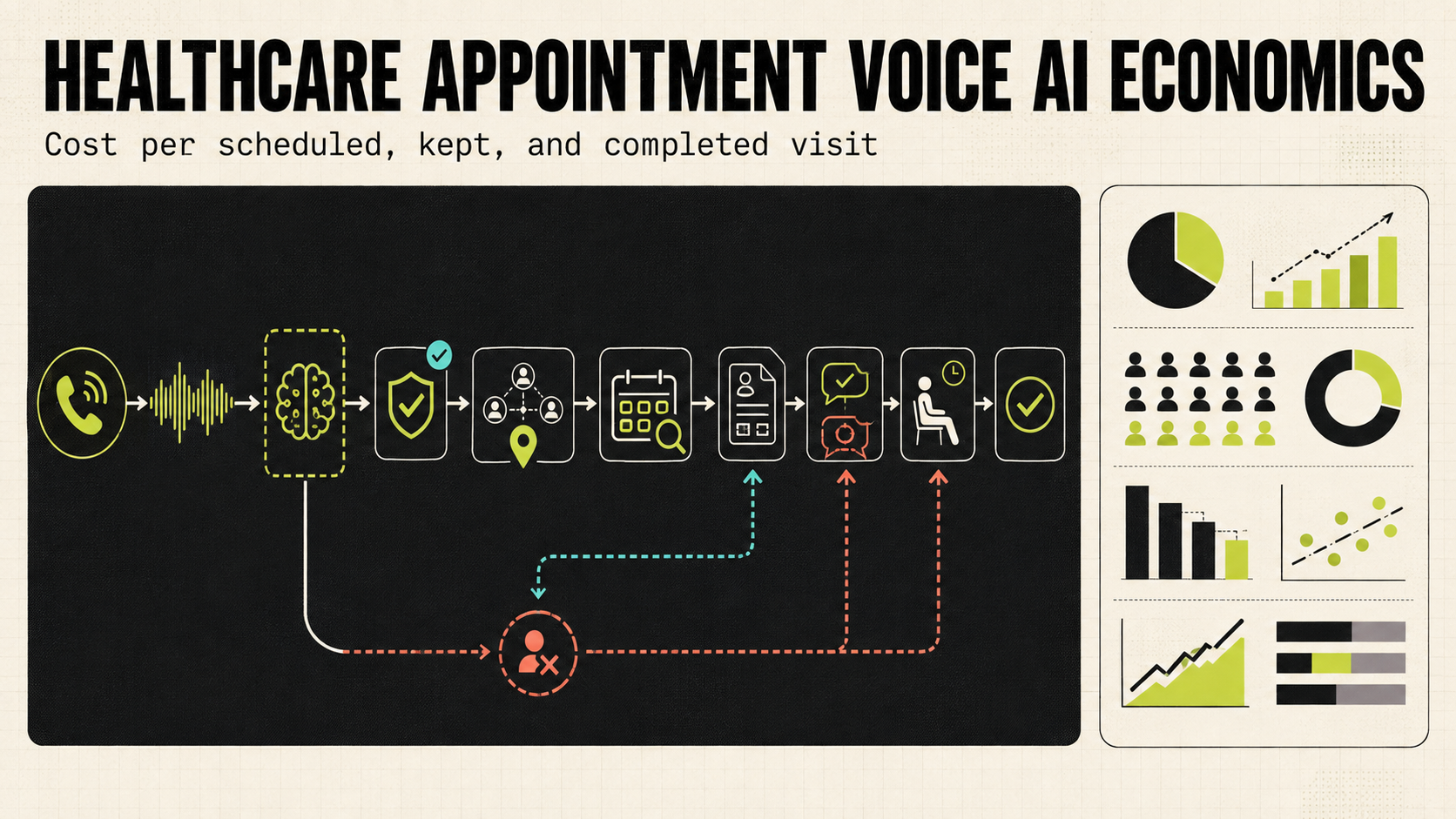
The best denominator is not calls answered, contained calls, or calendar events created. It is a rule-valid appointment acknowledged by the source system and later observed as kept or completed. Wrong-provider, wrong-visit-type, duplicate, no-show, and human-escalation outcomes must remain visible.
The patient-access call-to-completed-visit funnel
| Stage | Required evidence | Economic question |
|---|---|---|
| Connected call | Channel, queue, language, connected duration, and call state | How much paid traffic becomes a conversation? |
| Eligible scheduling intent | Administrative purpose, supported service, location, and non-duplicate request | How much call volume is addressable? |
| Permitted identity and context match | Approved verification state and new or established patient path | Can the workflow use the required context safely? |
| Rule-valid slot match | Provider, specialty, visit type, duration, location, modality, referral, payer, and modifier rules | Was eligible capacity offered? |
| EHR-acknowledged booking | Correct department write-back, stable appointment link, and duplicate guard | Did conversation become usable system state? |
| Confirmed or rescheduled appointment | Communication outcome, preference, cancellation or replacement link | Did the patient retain a usable appointment? |
| Kept appointment | Verified arrival, check-in, or equivalent attendance state | What does realized access cost? |
| Completed visit | Defined encounter terminal state and correction or void window | What does an attributable clinical-service outcome cost? |
Segment by provider organization, medical group, specialty, department, location, visit type, new or established status, language, channel, referral path, payer rule, scheduling-rule version, reminder path, and patient-access customer. Blended scheduling conversion can hide a specialty with frequent rule failures or staff intervention.
A calendar event is not a kept appointment
| Observed event | What it proves | What it does not prove |
|---|---|---|
| Call contained | No live transfer occurred | Accuracy, access, satisfaction, or valid booking |
| Slot selected | An available time appeared in the workflow | Eligibility, patient confirmation, or EHR write-back |
| Appointment created | A scheduling record exists | Correct provider, visit type, referral state, or deduplication |
| Reminder delivered | A message or call reached the channel | Confirmation, attendance, or incremental no-show reduction |
| Appointment confirmed | The patient acknowledged the plan | Arrival or completed visit |
| Check-in recorded | The patient reached an attendance state | Completed encounter or retained value |
Write the outcome standard first. Include eligibility, identity state, provider and visit-type rules, referral or authorization handling, EHR acknowledgement, duplicate treatment, cancellation, rescheduling, no-show, arrival, completion, correction window, and attribution.
Healthcare Voice AI is moving from routing calls to completing access workflows
Hyro's scheduling product page describes provider search, appointment booking, verification, rescheduling, cancellation, and synchronization with EHR scheduling rules. A recent Microsoft customer story describes healthcare AI agents handling appointment and other patient-access requests across voice and digital channels.
Those sources demonstrate current workflow and vendor positioning, not independent economic benchmarks. Health systems and practices still need their own evidence for valid booking, staff work, repeated contact, accessibility, no-shows, kept appointments, completed visits, patient experience, cost-to-serve, and provider-customer margin.
Ganivra links telephony, model, directory, scheduling, EHR, messaging, and human cost to the later appointment and visit state. That turns “calls automated” into a defensible cost per realized access outcome.
The complete healthcare appointment Voice AI cost stack
- 01Telephony and speech
Numbers, routing, connected minutes, recognition, realtime or language models, speech generation, silence, interruption, recording where permitted, and transfers.
- 02Identity and patient-access context
Patient matching, new or established status, communication preference, proxy or caregiver handling, identity checks, provider directory, locations, languages, accessibility, and approved administrative content.
- 03Scheduling rules and EHR tools
Specialty, provider, department, visit type, duration, modality, age or patient-status rules, referral and authorization state, payer rules, slot search, EHR create or update, duplicate checks, and acknowledgement.
- 04Messaging and appointment management
Confirmation, reminder, preparation information, cancellation, rescheduling, waitlist, released-slot refill, channel switching, and repeated contact.
- 05Human intervention
Patient-access transfer, complex referral or authorization work, interpreter, clinical routing, registration correction, scheduling override, complaint handling, and support.
- 06No-shows, corrections, and service recovery
Wrong provider or visit type, duplicate, invalid slot, missing prerequisite, cancellation, no-show, staff cleanup, repeated calls, patient complaint, and recovery.
- 07Implementation, privacy, and safeguards
EHR integration, scheduling-rule mapping, testing, BAA and vendor management, privacy and security controls, role-based access, monitoring, audit, incident response, multilingual QA, and accessibility.
For a Voice AI vendor, allocate the same stack to each healthcare customer. Similar call volume can produce different margins when one account has many specialties, complex scheduling modifiers, custom EHR work, referral workflows, multiple languages, sensitive categories, or frequent human review.
Healthcare appointment Voice AI unit-economics formulas
cost_per_eligible_scheduling_intent = total_appointment_voice_program_cost ÷ eligible_scheduling_intents
cost_per_valid_booking = total_appointment_voice_program_cost ÷ EHR_acknowledged_rule_valid_bookings
cost_per_kept_appointment = total_appointment_voice_program_cost ÷ attributable_kept_appointments
cost_per_completed_visit = total_appointment_voice_program_cost ÷ attributable_completed_visits
booking_to_kept_rate = attributable_kept_appointments ÷ valid_bookings
incremental_visit_contribution = attributable_collected_or_expected_net_revenue − variable_clinical_and_visit_cost − appointment_voice_and_human_cost − correction_and_recovery
appointment_voice_AI_ROI = (validated_patient_access_labor_value + incremental_completed_visit_contribution + verified_slot_refill_and_rework_savings − program_cost − correction_and_service_recovery) ÷ program_cost
customer_margin = (customer_revenue − voice_stack − EHR_and_access_tools − human_ops − privacy_security_and_support) ÷ customer_revenue
Do not count every automated call as avoided labor, every booking as a kept visit, or every delivered reminder as a prevented no-show. Use observed baselines, valid attribution, and conservative contribution rather than gross charges.
Worked example: a multi-specialty outpatient group
The following figures are illustrative—not a benchmark, health-system result, staffing recommendation, reimbursement estimate, or vendor quote.
| Input | Illustrative value | Economic result |
|---|---|---|
| Monthly patient-access calls | 10,000 calls | The full paid call population |
| Eligible appointment intents | 6,500 intents | Billing, clinical, duplicate, spam, and unsupported requests separated |
| EHR-acknowledged valid bookings | 4,800 bookings | Source scheduling standard passed |
| Kept appointments | 4,000 appointments | Verified attendance under the observation rule |
| Completed visits | 3,800 visits | Defined encounter terminal state reached |
| Voice stack and platform | $15,000 | Telephony, speech, models, and platform |
| EHR, directory, eligibility, and messaging tools | $10,000 | Connected patient-access operations |
| Human patient-access and exception work | $12,000 | Retained staff work |
| QA, privacy, security, implementation, and support | $6,000 | Control and customer cost-to-serve |
| Corrections and service recovery | $5,000 | Observed failure and cleanup cost |
| Total program cost | $48,000 | $7.38 per eligible intent, $10.00 per valid booking, $12.00 per kept appointment, $12.63 per completed visit |
| Validated patient-access labor value | $34,000 | Observed staff time returned in comparable queues |
| Incremental completed-visit contribution | $28,000 | Contribution after variable visit and access cost |
| Verified slot-refill and rework savings | $8,000 | Observed value, not theoretical capacity |
| Net observable benefit | $22,000 monthly | About 46% illustrative ROI on program cost |
Calendar creation does not establish attendance, completion, or incremental value.
Loaded program and correction cost against an observed encounter outcome.
Test causality by specialty, provider, location, visit type, patient status, season, channel, access rules, staffing, and capacity. A higher completion rate can reflect easier mix or newly available providers rather than better Voice AI.
No-show economics require a booking cohort and observation window
| Event | Value or cost | Measurement rule |
|---|---|---|
| Patient cancels early | Slot can potentially be refilled | Credit value only if the slot is actually refilled and completed |
| Patient self-reschedules | Original slot released; replacement retained | Link both appointments and avoid double counting |
| Reminder confirmed | Intent signal | Do not count as attendance |
| No-show after reminders | Unused capacity plus communication cost | Keep in the original booking cohort |
| Staff recovers a complex case | Kept appointment with human cost | Include patient-access minutes in loaded cost |
| Released slot refilled and completed | Observed capacity recovery | Attribute using explicit slot and replacement links |
Compare reminder and rescheduling policies with a credible baseline or experiment. Patient mix, transportation, work schedules, language, access barriers, specialty, lead time, and appointment type can change attendance independently of Voice AI.
How appointment Voice AI economics change by provider type
| Operator | Useful outcome | Costs hidden by averages |
|---|---|---|
| Independent medical practice | Valid booking and kept visit without front-desk interruption | Low volume, setup, staff handoff, and limited provider capacity |
| Multi-specialty medical group | Correct provider, visit type, location, and completed visit | Scheduling modifiers, referrals, payer rules, cross-specialty routing, and EHR configuration |
| Health-system patient access center | Completed administrative outcome across centralized queues | Scale, departments, legacy routing, complex identity, languages, security, and governance |
| Imaging or diagnostic network | Correct study, site, prerequisites, and completed appointment | Orders, authorization, preparation, equipment, duration, and rescheduling |
| Procedure-heavy specialty | Rule-valid booking that reaches completed service | Referral, clinical review, preparation, scheduling blocks, cancellations, and high-value unused capacity |
| Healthcare Voice AI vendor | Verified provider outcome at positive contribution margin | Custom rules, EHR connectors, BAAs, security, implementation, QA, human services, and support |
Healthcare appointment Voice AI metrics worth tracking
| Metric | What it reveals | Decision |
|---|---|---|
| Calls, intents, eligibility, and match outcomes | The true patient-access funnel | Coverage, routing, identity, and denominator design |
| Slot searches, valid bookings, EHR acknowledgement, and duplicates | Scheduling and integration quality | Rules, directories, EHR tools, and retries |
| Wrong-provider, visit-type, location, and rule-error rates | Operational and patient-access risk | Automation boundary, QA, and review thresholds |
| Transfers and patient-access minutes | Retained human work and exception mix | Staffing, prompts, and workflow scope |
| Cancellations, reschedules, confirmations, no-shows, and repeated contacts | Appointment durability and patient effort | Reminder, waitlist, and self-service design |
| Kept appointments, completed visits, cost, and customer margin | Realized access and economics | Investment, pricing, and optimization |
Emit one event for each expensive or outcome-changing step, then join those steps to the final appointment and encounter state. The example below is intentionally free of patient, member, appointment, and clinical content.
{
  "event_id": "evt_healthcare_schedule_7284",
  "execution_id": "patient_access_call_4fd2",
  "step_id": "step_ehr_schedule_08",
  "parent_step_id": "step_slot_validate_07",
  "provider": "openai",
  "model": "realtime-voice-model",
  "operation": "create_valid_appointment",
  "input_tokens": 2380,
  "output_tokens": 252,
  "cached_input_tokens": 1360,
  "latency_ms": 624,
  "status": "success",
  "environment": "production",
  "provider_reported_cost_usd": 0.0391,
  "attributes": {
    "application": "healthcare-appointment-voice-agent",
    "workflow": "inbound_appointment_scheduling",
    "feature": "provider_slot_match_and_booking",
    "customer_id": "provider_org_1842",
    "medical_group_id": "medical_group_07",
    "location_id": "outpatient_location_42",
    "specialty_category": "cardiology",
    "visit_type_category": "new_patient_consult",
    "patient_status_category": "new",
    "channel": "inbound_voice",
    "prompt_version": "v12",
    "scheduling_rule_version": "v31",
    "booking_outcome": "EHR_acknowledged",
    "human_handoff_required": false,
    "data_classification": "no_patient_member_appointment_or_clinical_content"
  }
}
Ganivra's event integration connects model and access-tool spend to specialty, location, booking stage, attendance, completed visit, provider customer, and pricing version without making PHI part of cost analytics.
Privacy, security, clinical boundaries, and calling rules belong in the cost model
HHS explicitly lists a third-party AI tool that handles PHI for services such as appointment scheduling as an example of a potential business associate. HHS also explains minimum-necessary policies and the contractual safeguards expected in business associate agreements.
HHS states that appointment reminders are part of treatment and can be made without a HIPAA authorization. That does not remove the need to follow patient communication preferences, verify identity where appropriate, limit message content, secure systems, or comply with other laws.
The FCC's AI voice declaratory ruling applies TCPA artificial- or prerecorded-voice requirements to outbound AI calls. Requested reminders, operational calls, recalls, care-gap outreach, and marketing require distinct policy and legal review.
Keep the agent administrative unless a separately governed clinical workflow exists. Include approved emergency routing, no diagnosis or medical advice, role-based access, least-privilege EHR tools, data minimization, encryption, vendor and subcontractor controls, retention, accessibility, interpreter paths, human fallback, audit, monitoring, incident response, and patient service recovery in both design and cost. This guide is an economics framework, not clinical, privacy, legal, reimbursement, or regulatory advice.
How to measure healthcare appointment Voice AI economics
- 01Define valid booking, kept appointment, and completed visit
Write the patient, provider, visit-type, referral, scheduling-rule, EHR acknowledgement, attendance, completion, cancellation, no-show, and observation-window standards.
- 02Build a comparable patient-access baseline
Measure calls, administrative intents, bookings, handle time, transfers, cancellations, no-shows, kept and completed visits, corrections, and cost for equivalent specialties and locations.
- 03Create one call-to-visit execution ID
Join telephony, speech, patient matching, provider directory, scheduling, referral or eligibility, EHR, messaging, human review, attendance, and terminal-visit events.
- 04Version rules and safeguards
Record specialty, provider, visit type, patient status, referral, payer, location, slot, prompt, model, tool, identity, escalation, and reviewer versions.
- 05Attach provider and commercial context
Add provider customer, medical group, specialty, department, location, plan, pricing version, and revenue or cost allocation at the source.
- 06Monitor risk-weighted economics
Alert on wrong-provider and wrong-visit-type errors, duplicate bookings, failed handoffs, no-shows, repeated contact, cost per completed visit, PHI exposure risk, and customer margin.
Start with bounded administrative visit types, verify source-system acknowledgement and attendance, review high-consequence routing separately, and expand only after no-show- and correction-adjusted economics hold. Continue with the healthcare revenue-cycle economics guide, the dental appointment economics guide, the Voice AI unit economics guide, and the Voice AI pricing guide.
Frequently asked questions
Healthcare appointment Voice AI economics FAQ
What is healthcare appointment Voice AI?
Healthcare appointment Voice AI is a voice-enabled patient-access system that handles administrative calls under provider-approved rules. It can identify scheduling intent, verify permitted patient context, search providers and locations, offer eligible slots, book, reschedule, cancel, confirm, and hand off exceptions.
How does AI medical appointment scheduling work?
The agent identifies the administrative request, verifies the patient and permitted context, follows provider, visit-type, referral, payer, location, age, and scheduling rules, offers eligible availability, writes the appointment to the EHR or practice-management system, and confirms the result. Later events should verify attendance and visit completion.
What counts as a valid healthcare appointment booking?
A valid booking satisfies the organization's written rules for patient identity, new or established status, provider and visit type, location, referral or authorization state where required, duration, scheduling modifiers, availability, and EHR acknowledgement. A selected slot or completed call is not enough.
What is the difference between a scheduled and kept appointment?
A scheduled appointment exists in the source scheduling system. A kept appointment reaches the organization's verified arrival, check-in, or equivalent attendance state. Cancellations, no-shows, duplicates, and invalid bookings remain outside the kept denominator.
What counts as a completed healthcare visit?
Use a defined terminal state in the EHR or practice-management system that proves the attributable encounter occurred, then apply correction and void windows. A reminder delivered, patient checked in, or appointment marked arrived does not necessarily prove a completed encounter.
How much does healthcare appointment Voice AI cost?
Loaded cost can include telephony, speech recognition, model reasoning, speech generation, patient matching, provider directory and scheduling tools, EHR integration, messaging, referral or eligibility tools, human patient-access work, implementation, security, privacy, quality assurance, corrections, and service recovery.
How do you calculate healthcare appointment Voice AI ROI?
Compare equivalent specialties, locations, visit types, access rules, seasons, staffing, and demand before and after deployment. Credit validated patient-access labor value, incremental completed-visit contribution, and observed slot-refill or rework savings; subtract the loaded program, human, correction, and recovery costs.
Should scheduling Voice AI perform clinical triage?
Administrative scheduling and clinical triage are different workflows. The safer scope is bounded administrative intake and routing. Symptom assessment, diagnosis, medical advice, acuity decisions, and emergency handling require separately governed clinical workflows, qualified oversight, approved content, and explicit authority.
When should healthcare Voice AI transfer to a person?
Transfer or escalate for emergencies under the provider's approved policy, clinical questions, uncertain identity, unsupported language or accessibility need, complex referrals or authorizations, unavailable required context, scheduling-rule conflict, sensitive service categories, distressed callers, complaints, and tool failures.
Does appointment Voice AI need an EHR integration?
Reliable EHR or practice-management integration is essential when the system promises autonomous scheduling. It should use current provider, location, visit-type, modifier, and slot data; prevent duplicates; write to the correct department; and verify acknowledgement. Otherwise it is request capture, not completed booking.
How should provider and visit-type matching be measured?
Measure whether the selected provider, specialty, location, visit type, duration, modality, patient status, age rule, referral state, payer rule, and scheduling modifier matched the source policy. Review wrong-provider and wrong-visit-type outcomes separately from harmless formatting errors.
How should appointment cancellations and rescheduling affect economics?
Link cancellations and reschedules to the original booking and the replacement slot. Measure successful self-service, staff intervention, released-slot refill, repeated calls, and final attendance. A reschedule is not a new incremental appointment unless attribution rules prevent double counting.
How should no-shows affect appointment Voice AI ROI?
Keep no-shows in the booking-to-kept funnel and value only observed incremental attendance or successfully refilled capacity. Do not claim that every reminder prevented a no-show or that every released slot became incremental revenue.
Are healthcare appointment reminders allowed under HIPAA?
HHS states that appointment reminders are considered part of treatment and can be made without a HIPAA authorization. Organizations still need appropriate privacy, security, caller-verification, communication-preference, content, and applicable calling-law controls.
Does a healthcare Voice AI vendor need a business associate agreement?
HHS identifies third-party AI tools that handle PHI for services such as appointment scheduling as potential business associates. The actual relationship and obligations depend on the facts. Covered entities and vendors should obtain qualified privacy and legal review and establish required contracts and safeguards.
Can appointment Voice AI make outbound confirmation or recall calls?
Technically yes, but requested reminders, transactional updates, care-gap outreach, recalls, and marketing are different workflows. Define permitted purpose, recipients, consent or another lawful basis, identity, disclosure, timing, opt-out where relevant, content, and records before activation.
Does healthcare Voice AI cost tracking require PHI or call transcripts?
No. Unit economics can use provider organization, execution, workflow, specialty category, visit-type category, location, scheduling-rule version, booking, reminder, attendance, completion, cost, review, and outcome metadata without names, dates of birth, phone numbers, addresses, member IDs, recordings, transcripts, or clinical details.
How should multi-location health systems measure scheduling Voice AI?
Attach provider customer, medical group, specialty, department, location, channel, visit-type category, patient-status category, plan, pricing version, and revenue or cost allocation to each execution. Measure cost and outcomes by segment so a high-volume primary-care queue does not hide an expensive specialty workflow.
How do Voice AI vendors measure margin by healthcare customer?
Attribute telephony, models, EHR connectors, provider-directory work, messaging, referral or eligibility tools, implementation, custom rules, human operations, privacy and security, quality assurance, support, corrections, and service recovery to each provider customer under the actual commercial terms.
Which healthcare appointment Voice AI metrics matter most?
Track calls, valid administrative intents, patient-match outcomes, eligible slot searches, EHR write and acknowledgement, valid bookings, cancellations, reschedules, reminders, human handoffs, kept appointments, completed visits, repeated contact, corrections, latency, cost per outcome, customer margin, and unpriced usage.
Measure the completed visit
See which patient-access Voice AI workflows are actually economical.
Connect telephony, models, EHR tools, patient-access staff, scheduling outcomes, attendance, completed visits, and provider-customer revenue in one cost ledger.