Quick answer
How do you measure auto dealership Voice AI economics?
Add telephony, speech, models, DMS and scheduling tools, messages, retries, service-advisor handoffs, quality review, implementation, security, and correction cost. Attribute that loaded cost to eligible service calls, valid bookings, kept appointments, closed repair orders, rooftops, dealer customers, and service-and-parts gross profit.
Cost per answered call measures activity. Cost per valid booking measures pipeline. Cost per kept appointment reveals scheduling durability. Cost per closed repair order and per attributable gross-profit dollar show whether the Voice AI created fixed-operations value.
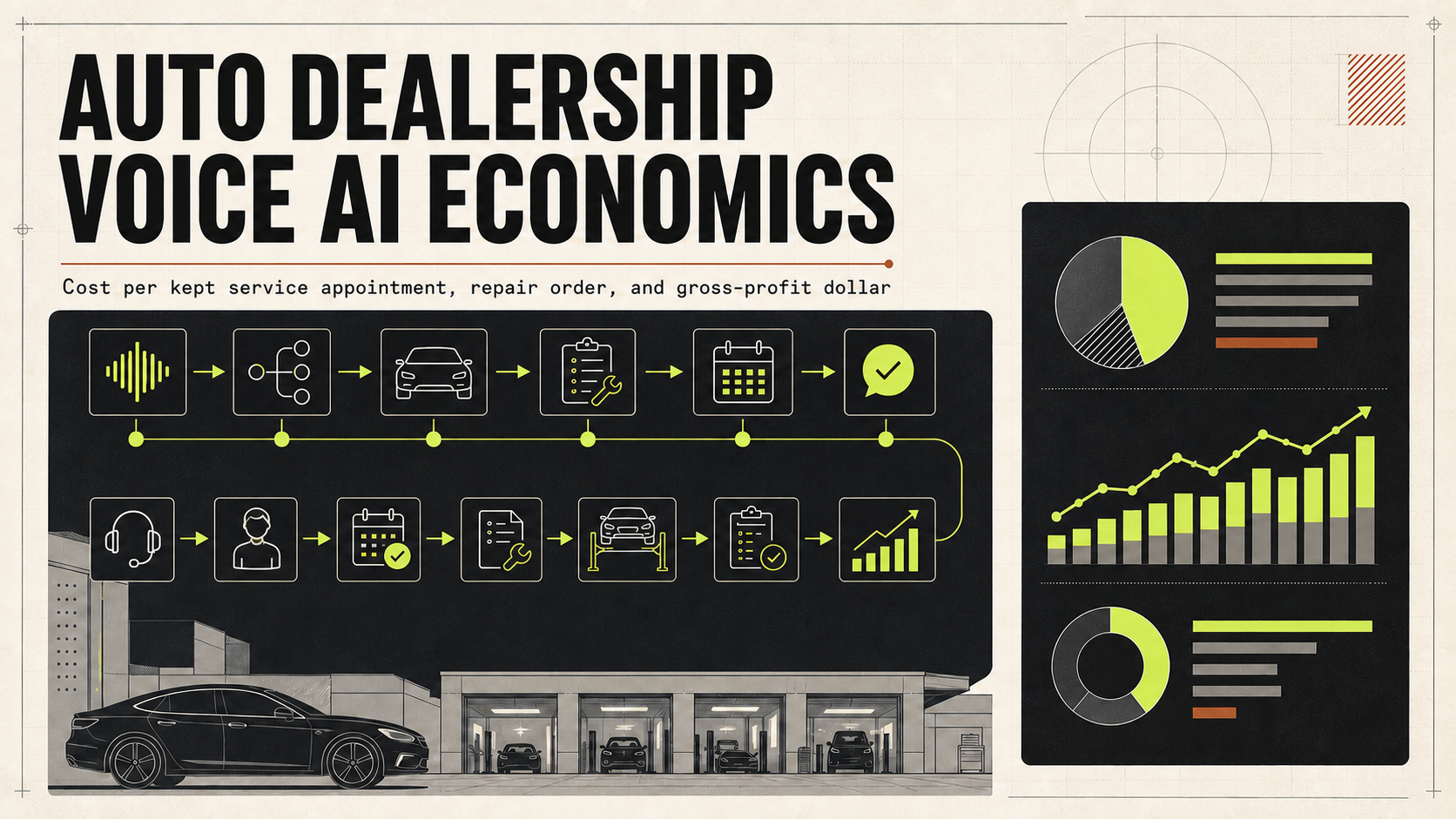
The dealership Voice AI call-to-repair-order funnel
| Stage | Required evidence | Economic question |
|---|---|---|
| Attempted and connected service call | Phone line, department route, telephony state, and connected duration | How much paid traffic becomes a real conversation? |
| Eligible service intent | Supported rooftop, administrative intent, coverage window, and non-spam call | How much demand can the workflow serve? |
| Correctly captured request | Approved service category, limited vehicle-intake state, and escalation decision | Did the agent create usable intake or advisor cleanup? |
| Valid service booking | Correct slot, duration, capacity rule, successful system write-back, and confirmation | What does a booking the service drive can trust cost? |
| Kept appointment | Verified arrival, check-in, or other written dealership state | How many bookings become service-lane visits? |
| Repair order opened | Linked RO state in the system of record | How many visits enter an operational service workflow? |
| Closed repair order | Completed and financially closed under policy | What work and gross profit can be attributed? |
Segment by rooftop, phone line, business hours, overflow, after hours, new versus returning customer, service category, warranty or customer-pay class, transportation need, language, and campaign. Blended results can hide a profitable after-hours workflow or a weak location with poor appointment-to-RO conversion.
A booked service appointment is not a closed repair order
Voice dashboards commonly emphasize answer rate, containment, captured leads, or calendar events. Those signals matter, but fixed operations earns value when valid demand arrives, the service lane opens an RO, work is completed, and the repair order reaches the chosen financial state.
| Observed event | What it proves | What it does not prove |
|---|---|---|
| Call answered | The phone connected | Correct department, eligible demand, booking, or revenue |
| Call contained | No live transfer occurred | Correct resolution, safety, or customer satisfaction |
| Appointment created | A scheduling record exists | Validity, confirmation, arrival, capacity, or work |
| Appointment kept | The chosen arrival or check-in state was reached | An RO, completed work, or attributable value |
| RO opened | Service intake began | Completed work, payment, or gross profit |
| RO closed | The dealership's terminal service state was reached | Incremental value unless compared with a credible baseline |
Write the definition before rollout. Include the source line, eligible intents, booking requirements, scheduler or DMS state, duplicate prevention, cancellation and rescheduling window, kept-appointment state, RO linkage, close state, and attribution window.
Why DMS write-back and repair orders belong in the economic model
NADA fixed-operations material identifies repair-order count and revenue among metrics that matter and describes analysis across service, parts, and dealership system reports. That makes a repair order a stronger economic bridge than a generic “call handled” metric.
Current automotive Voice AI vendors emphasize direct scheduling and dealership-system context. Numa describes DMS-connected service booking and repair-order context; Flexbone markets live appointment write-back across major dealership systems; and Viova describes availability, booking, rescheduling, and cancellation integrations. Treat vendor claims as inputs to diligence, not proof of your dealership's economics.
The measurement opportunity is to connect those technical actions with appointment quality, arrivals, ROs, corrections, advisor time, and gross profit—by rooftop and call cohort.
The complete auto dealership Voice AI cost stack
- 01Telephony and department routing
Numbers, inbound minutes, menus, forwarding, transfers, voicemail, recording where used, messages, and carrier charges.
- 02Speech and model reasoning
Speech recognition, realtime or language models, speech generation, context, caching, silence, and interruptions.
- 03Fixed-operations knowledge and rules
Rooftops, hours, service categories, approved intake, duration, capacity, transportation, status, and escalation rules.
- 04DMS, scheduler, CRM, and messaging
Customer and vehicle matching, availability, appointment write-back, modification, confirmation, status, and system validation.
- 05Human handoffs and operations
Service-advisor transfer, BDC review, urgent routing, QA, configuration, supervision, and vendor support.
- 06Retries and follow-up
Failed tool actions, callbacks, repeat callers, reminders, rescheduling, waitlist work, and abandoned-call recovery.
- 07Errors and cleanup
Wrong rooftop, duplicate customer, mismatched vehicle, invalid slot, incorrect service category, complaint, rework, and service recovery.
- 08Implementation, security, and controls
Integration, testing, access, data minimization, retention, monitoring, incident response, model evaluation, and change control.
For a Voice AI vendor, attribute these costs to every dealer customer. Rooftop count, call mix, DMS variation, bespoke operation-code mapping, long status calls, bilingual traffic, heavy advisor handoffs, and support can make similarly priced accounts economically different.
Auto dealership Voice AI unit-economics formulas
cost_per_valid_booking = (voice_stack + DMS_tools + handoffs + QA + cleanup + allocated_ops) ÷ valid_service_bookings
cost_per_kept_service_appointment = total_voice_program_cost ÷ attributed_kept_service_appointments
cost_per_closed_repair_order = total_voice_program_cost ÷ attributed_closed_repair_orders
booking_to_closed_RO_rate = attributed_closed_repair_orders ÷ valid_service_bookings
cost_per_gross_profit_dollar = total_voice_program_cost ÷ attributable_service_and_parts_gross_profit
dealership_voice_AI_ROI = (incremental_RO_gross_profit + validated_labor_value − program_cost − incremental_error_loss) ÷ program_cost
customer_margin = (customer_revenue − voice_stack − DMS_tools − human_ops − support_and_integration_allocation) ÷ customer_revenue
Do not multiply every AI booking by an average repair-order value and call it incremental revenue. Subtract the outcomes that voicemail callbacks, advisors, the BDC, web scheduling, an answering service, or walk-in demand would have produced.
Worked example: service-line overflow and after-hours calls
The following values are illustrative—not a benchmark, vendor quote, dealership result, financial projection, repair recommendation, or operating instruction. They demonstrate a conservative model that credits only incremental closed ROs.
| Input | Illustrative value | Economic result |
|---|---|---|
| Monthly eligible service calls | 2,400 calls | The complete measured cohort |
| Qualified scheduling and administrative requests | 1,650 calls | Spam, sales, unsupported, and unrelated calls are separated |
| Valid service bookings | 620 appointments | Bookings pass the dealership's written scheduling standard |
| Kept appointments | 500 appointments | 80.6% illustrative booking-to-kept conversion |
| Closed repair orders linked to the cohort | 390 ROs | 62.9% illustrative booking-to-closed-RO conversion |
| Voice stack and platform | $2,400 | Telephony, speech, models, and platform consumption |
| Advisor handoffs and QA | $2,300 | Transfers, supervision, review, and retained human work |
| DMS integration, messaging, and operations | $1,600 | Scheduling, write-back, monitoring, and allocated support |
| Correction and service recovery | $700 | Observed rework and exception cost |
| Total program cost | $7,000 | $11.29 per booking, $14.00 per kept appointment, $17.95 per closed RO |
| Incremental closed ROs versus baseline | 55 ROs | Only the attributable improvement is credited |
| Illustrative service-and-parts gross profit per incremental RO | $190 | $10,450 incremental gross profit |
| Validated advisor or BDC labor value returned | $1,000 | Only time demonstrably reassigned or avoided |
| Incremental error or service-recovery cost | $900 | Observed downside attributed to the cohort |
| Net observable benefit | $3,550 monthly | About 51% illustrative ROI on program cost |
Coverage does not establish correct routing, bookings, arrivals, repair orders, or incremental value.
Includes the complete program cost and uses a verified fixed-operations outcome.
Test causality by rooftop, source line, coverage window, service category, customer-pay versus warranty mix, capacity, and season. Promotions, recalls, weather, staffing, advisor availability, and shop capacity can change repair-order volume independently of the Voice AI.
Dealership Voice AI workflows need separate economics
| Workflow | Useful terminal outcome | Cost or risk to measure |
|---|---|---|
| Inbound service booking | Valid booking that becomes a kept appointment and linked RO | Capacity, service category, duration, DMS write-back, cancellation, and no-show |
| Cancellation and rescheduling | Correct system update with recoverable capacity exposed | Duplicate slots, policy exceptions, confirmation, and staff cleanup |
| Repair-order status | Correct approved answer or advisor route | Identity, system freshness, repeated calls, false promises, and advisor interruption |
| Maintenance or recall reminder | Incremental kept appointment and closed RO within the observation window | Eligibility, consent, attempts, opt-outs, attribution, and campaign cost |
| Declined-service follow-up | Verified approved follow-up outcome under dealership policy | Attribution, offer boundaries, consent, complaint risk, and later human work |
| Transportation and special requests | Correctly captured request or controlled advisor handoff | Loaner, shuttle, pickup, capacity, policy, and confirmation failure |
| Urgent or safety-related intake | Correct controlled transfer or emergency pathway | Inappropriate diagnosis, latency, transfer failure, and policy review |
| Sales, parts, body shop, and F&I routing | Correct department resolution or handoff | Misrouting, duplicate lead credit, hold time, and cross-department attribution |
Do not blend booking, status, reminder, recall, declined-service, and sales workflows. Each needs its own eligibility rule, denominator, attribution window, controls, cost pool, and commercial value.
How Voice AI economics change by dealership operator
| Operator | Useful outcome | Costs hidden by averages |
|---|---|---|
| Single rooftop | Kept appointment, closed RO, and advisor time returned | Low volume, setup overhead, local capacity, and manager handoffs |
| Multi-rooftop dealer group | Closed RO and gross profit by rooftop and source line | DMS variation, brands, phone systems, operation codes, local rules, and support |
| Centralized service BDC | Valid appointment or durable administrative resolution | Queue, transfer, duplicated intake, BDC staffing, and rooftop coordination |
| Independent repair group | Completed repair job and location contribution | Shop-management platforms, service mix, estimate workflows, and parts coordination |
| Automotive Voice AI vendor | Verified dealer outcome at positive customer contribution | Telephony, custom workflows, DMS integration, human services, support, and usage mix |
Auto dealership Voice AI metrics worth tracking
| Metric | What it reveals | Decision it supports |
|---|---|---|
| Attempts, connections, eligible calls, and correct routes | The true service-demand funnel | Coverage, phone routing, and denominator design |
| Valid bookings, write-back, and confirmation | Usable scheduled demand | DMS integration, rules, prompts, and messaging |
| Cancellation, reschedule, no-show, and kept state | Booking durability | Reminder, waitlist, and capacity strategy |
| RO opened, closed, corrected, and reversed | Downstream fixed-operations outcomes | Attribution and ROI |
| Service and parts gross profit linked to the cohort | Economic value beyond appointments | Rollout and workflow prioritization |
| Handoff rate, transfer success, hold time, and advisor time | Retained human work and caller friction | Escalation policy and staffing |
| Duplicate, wrong-rooftop, invalid-slot, and cleanup rate | The cost of incorrect outcomes | Quality thresholds and workflow scope |
| Cost per call, booking, kept appointment, RO, and gross-profit dollar | Activity versus outcome economics | Architecture, vendor, and pricing comparison |
| Cost and margin by rooftop, dealer customer, and pricing version | Who creates or erodes contribution | Commercial plans and rollout |
| Latency, abandonment, tool failure, and unpriced usage | Technical and cost blind spots | Model, voice, provider, and telemetry optimization |
A machine-readable dealership Voice AI cost event without customer, vehicle, or RO content
Use internal dealer, rooftop, workflow, coverage, service-category, booking, handoff, and outcome categories instead of names, phone numbers, VINs, license plates, recordings, transcripts, repair details, estimates, warranty information, or RO content:
{
  "event_id": "evt_dealer_voice_7284",
  "execution_id": "call_dealer_4fd2",
  "step_id": "step_service_booking_07",
  "parent_step_id": "step_capacity_match_06",
  "provider": "openai",
  "model": "realtime-voice-model",
  "operation": "confirm_service_booking",
  "input_tokens": 2240,
  "output_tokens": 232,
  "cached_input_tokens": 1280,
  "latency_ms": 581,
  "status": "success",
  "environment": "production",
  "provider_reported_cost_usd": 0.0362,
  "attributes": {
    "application": "dealership-voice-agent",
    "workflow": "after_hours_service_booking",
    "feature": "service_scheduling",
    "customer_id": "dealer_group_1842",
    "location_id": "rooftop_north",
    "prompt_id": "fixed-ops-booking",
    "prompt_version": "v11",
    "pricing_version": "dealer_voice_v3",
    "coverage_window": "after_hours",
    "intent_category": "service_appointment",
    "service_category": "scheduled_maintenance",
    "booking_outcome": "confirmed",
    "human_handoff_required": false,
    "data_classification": "no_customer_vehicle_or_ro_content"
  }
}
Send separate events for telephony, speech recognition, model turns, generation, scheduler and DMS tools, messages, transfers, reviews, retries, bookings, arrivals, and repair-order outcomes with the same execution_id. Attach a later closed-RO and gross-profit event without turning the cost ledger into a duplicate DMS.
Vehicle safety, customer trust, and outbound-call rules are part of unit cost
This article is an economics and observability framework, not vehicle repair, diagnostic, warranty, emergency, privacy, security, telemarketing, financial, regulatory, or legal advice. Dealerships and vendors should define permitted administrative conversations, identity checks, disclosures, recording, urgent and safety routing, scheduling authority, data access, retention, outbound-contact rules, and incident processes with qualified teams.
Inbound service scheduling, a reminder for an existing appointment, manufacturer recall communication, declined-service follow-up, and a promotional offer are different workflows. For U.S. outbound activity, review the FTC's Telemarketing Sales Rule guidance and the FCC's treatment of AI-generated artificial or prerecorded voice, plus applicable state, manufacturer, and contractual requirements.
- Bound technical behavior: capture approved administrative intake; do not improvise mechanical diagnosis, warranty coverage, repair price, or completion time.
- Route safety correctly: define warning-light, breakdown, towing, collision, urgent, and emergency pathways with dealership leadership.
- Minimize telemetry: economic measurement rarely needs caller content, VINs, license plates, recordings, transcripts, or repair details.
- Make handoffs reliable: distinguish service advisor, BDC, parts, sales, body shop, F&I, roadside, and emergency routes.
- Price safeguards: access, security, QA, compliance operations, monitoring, change control, and incident response belong in loaded cost.
How to implement dealership Voice AI cost attribution
- 01Define the fixed-operations outcome
Write the exact valid-booking, kept-appointment, RO-open, RO-close, cancellation, rescheduling, and observation-window rules before measuring automation.
- 02Establish a comparable service-call baseline
Measure the same rooftops, lines, hours, service categories, capacity, staffing, bookings, show rate, repair orders, advisor time, and gross profit before rollout.
- 03Create one call-to-repair-order execution ID
Join telephony, speech, model turns, tools, scheduler or DMS actions, confirmation, handoff, arrival, repair order, completion, and financial outcome under one durable identifier.
- 04Capture cost and control metadata
Record provider cost, duration, tokens, latency, department, service category, rule and prompt versions, retries, handoffs, booking state, and outcome without copying customer, vehicle, or RO content into the cost ledger.
- 05Attach rooftop and commercial context
Add the dealer customer, rooftop, phone line, workflow, coverage window, pricing version, and attributable service or parts economics at the source.
- 06Monitor funnel economics
Alert on cost per valid booking, kept appointment, closed RO, gross-profit dollar, transfer failure, correction, rooftop margin, customer margin, and unpriced usage.
Ganivra's AI and MCP event model links provider cost, call duration, models, tools, retries, pricing versions, dealer customers, rooftops, workflows, and outcomes without proxying calls or storing their content. Start with the Voice AI unit economics guide, compare commercial structures in the Voice AI pricing models guide, or see another call-to-job workflow in the HVAC AI receptionist guide.
Auto dealership Voice AI economics FAQ
What is an auto dealership Voice AI agent?
An auto dealership Voice AI agent is a voice-enabled system that answers dealership calls, identifies department and intent, applies approved service rules, captures limited vehicle and service-request information, books or changes eligible appointments in the dealership system, provides approved status information, and transfers exceptions to the correct employee.
How much does dealership Voice AI cost?
There is no universal price. Loaded cost can include telephony, speech recognition, language or realtime models, speech generation, platform fees, DMS and scheduler integrations, messages, human handoffs, quality review, implementation, security, and correction work. Compare cost per kept service appointment and closed repair order rather than subscription price alone.
How do you calculate auto dealership Voice AI ROI?
Compare a defined call cohort with a credible baseline. Measure total program cost, valid bookings, kept appointments, opened and closed repair orders, attributable service and parts gross profit, validated staff time returned, human handoffs, corrections, and service-recovery cost. Credit only incremental outcomes rather than every repair order touched by the agent.
What counts as a valid dealership service appointment?
A valid booking should satisfy the dealership's written rules: a real eligible request, correct rooftop and service category, required intake, appropriate appointment type and duration, available capacity, successful scheduler or DMS write-back, and confirmation. Spam, duplicates, unsupported requests, tentative holds, and failed write-backs should not count.
What counts as a kept service appointment?
A kept service appointment is a valid booking that reaches the dealership's verified arrival, check-in, or repair-order-open state within the chosen observation window. The dealership should document which system state is authoritative and how cancellations, reschedules, tow-ins, walk-ins, and duplicate appointments are handled.
What is a repair order in dealership Voice AI economics?
A repair order is the dealership's operational record for service work. For Voice AI measurement, distinguish an RO opened from an RO closed under the dealership's policy. An opened RO proves intake began; a closed RO, paired with appropriate financial fields, supports completed-work and gross-profit attribution.
Can dealership Voice AI book directly into a DMS?
It can when the agent has a reliable, authorized integration with the dealership's DMS or service scheduler and can apply location, operation-code, duration, advisor, transportation, capacity, and write-back rules. Without validated write-back, the result is a captured request for staff follow-up, not a completed booking.
Can dealership Voice AI integrate with Xtime, CDK, Reynolds, or Tekion?
Integration availability depends on the vendor, dealership system, permissions, APIs, contracts, and workflow. Evaluate real-time availability reads, booking and modification rights, customer and vehicle matching, operation-code mapping, duplicate prevention, error handling, auditability, and support—not a logo on an integration page alone.
Should dealership Voice AI diagnose vehicle problems?
The safer operating model is bounded service intake and routing rather than mechanical diagnosis or safety advice. The dealership should define approved questions, prohibited statements, warning-light and urgent-safety paths, towing or emergency directions, and required service-advisor handoffs.
Can dealership Voice AI provide repair-order status updates?
It can provide approved system-of-record status information when identity, authorization, data access, and disclosure rules are satisfied. The agent should avoid inventing completion times, explaining technical findings, promising price or warranty coverage, or exposing information beyond the dealership's approved policy.
How should service-advisor handoffs be measured?
Track the reason, timing, transfer success, destination, wait time, advisor handling time, final booking or repair-order outcome, and whether the caller had to repeat information. Include retained human cost in the ledger. A transfer is a successful controlled outcome when policy or customer need requires it.
How should after-hours dealership calls be measured?
Create a separate after-hours cohort with its own eligible intents, answer rate, valid bookings, confirmation, kept appointments, advisor follow-up, repair orders, gross profit, cancellations, and cost. Compare it with the previous voicemail, answering-service, web-booking, or next-day callback baseline.
Can dealership Voice AI make outbound service reminder calls?
Technically yes, but reminders, recalls, declined-service follow-up, and promotional campaigns can have different consent, disclosure, do-not-call, timing, recordkeeping, manufacturer, federal, and state requirements. Define the permitted audience, purpose, approved script, opt-out process, and legal basis before activation.
How do dealer groups measure Voice AI economics by rooftop?
Attach dealer group, rooftop, phone line, department, workflow, coverage window, service category, DMS configuration, prompt and rule version, and financial allocation to each execution. Compare cost per booking, kept appointment, closed repair order, gross-profit dollar, and human hour by rooftop so blended results do not hide weak stores.
How do dealership Voice AI vendors measure customer margin?
Attribute telephony, models, speech, tools, DMS integration, messaging, human operations, support, QA, security, correction, and implementation allocation to each dealer customer. Compare that cost with contracted customer revenue and monitor margin by rooftop, workflow, pricing version, and usage mix.
Which auto dealership Voice AI metrics matter most?
Track attempts, connections, eligible service calls, correct routing, valid bookings, confirmations, cancellations, reschedules, kept appointments, ROs opened and closed, attributable service and parts gross profit, handoffs, advisor time, corrections, cost per booking, kept appointment, repair order, rooftop, customer, and gross-profit dollar, plus unpriced usage.
From service calls to fixed-operations economics
Know what every kept appointment and closed RO costs.
Connect model, voice, DMS tool, handoff, rooftop, customer, and repair-order economics in one execution ledger—without sending call or repair content.