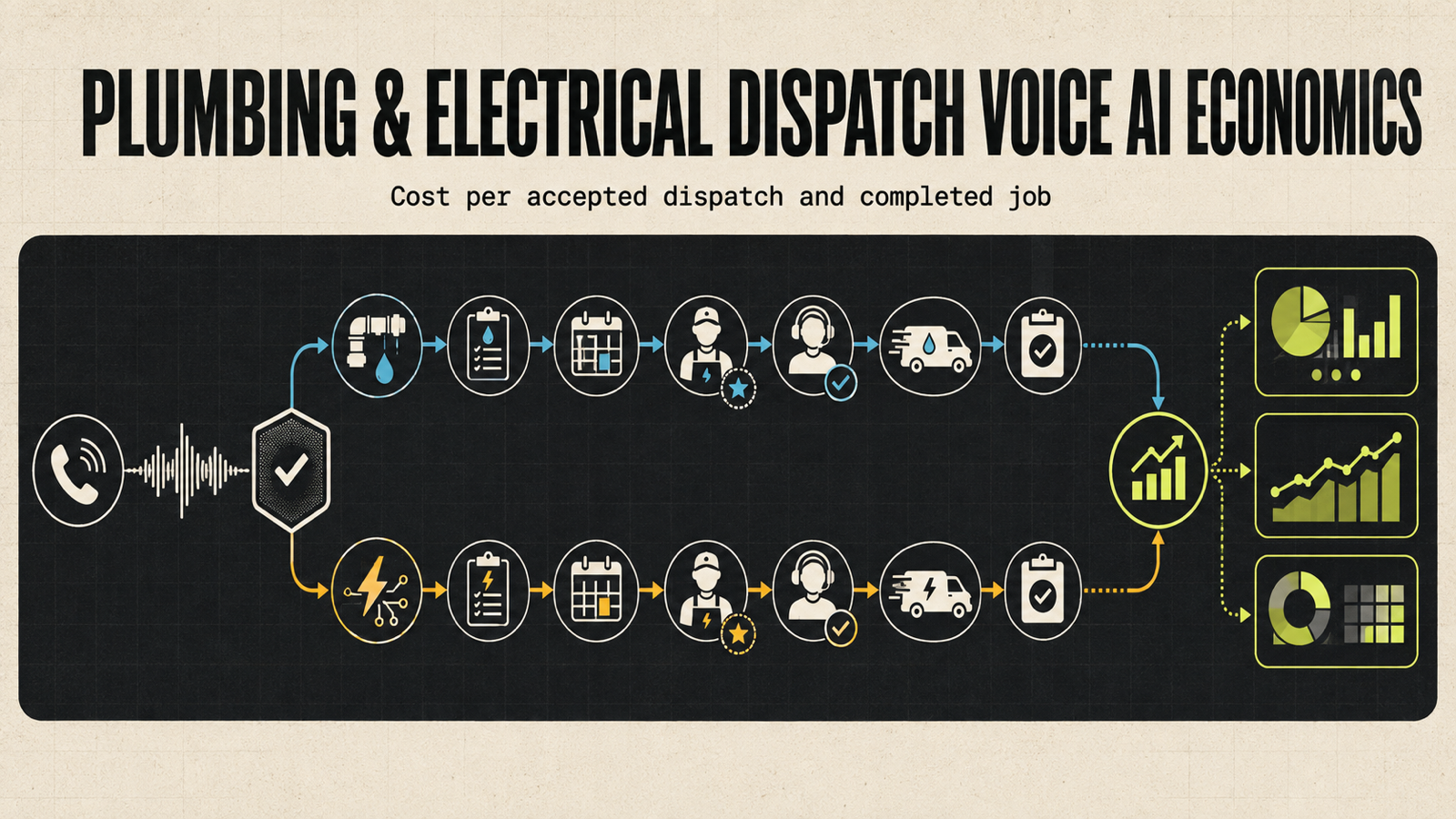
Quick answer
How do you measure plumbing and electrical dispatch Voice AI economics?
Add telephony, speech, models, customer and membership lookup, field-service tools, capacity, maps, messaging, technician notifications, human dispatch, implementation, QA, safeguards, callbacks, and service recovery. Attribute loaded cost to valid service requests, correctly booked jobs, accepted dispatches, completed jobs, locations, and contractor customers.
The best denominator is not an answered or contained call. It is a correctly typed job that entered the field-service system, was accepted by the proper dispatch path, and reached a verified completion state. Keep wrong-trade routing and safety-critical misses visible beside average cost.
The home-service call-to-completion funnel
| Stage | Required evidence | Economic question |
|---|---|---|
| Connected call | Location, daypart, connected duration, and call state | How much paid traffic becomes a real conversation? |
| Valid service request | Eligible trade, service area, customer type, and non-spam intent | How many calls contain addressable demand? |
| Bounded safety screen | Applicable approved rule, caller response, and escalation state | Was the request kept inside the safe automation boundary? |
| Correct booking | Trade, job type, priority, business unit, arrival window, fee, and FSM acknowledgement | Did intake become a usable job? |
| Accepted dispatch | Correct shift, skill, geography, technician or dispatcher acknowledgement, and fallback | Did the job acquire operational ownership? |
| Arrival or work started | Observed field-service state and arrival time | Did a promised appointment become field work? |
| Durable completed job | Completion, invoice or defined closure, plus cancellation, callback, and correction window | What does a real outcome cost? |
Segment by trade, branch, business unit, daypart, service area, job type, urgency, membership, lead source, technician capacity, rule version, dispatch path, and contractor customer. A routine daytime plumbing call should not hide an after-hours electrical workflow with scarce licensed capacity.
A booked job is not a completed service outcome
| Observed event | What it proves | What it does not prove |
|---|---|---|
| Call contained | No live CSR transfer occurred | Correct trade, safe handling, booking, or satisfaction |
| Appointment selected | A time window was offered or chosen | FSM write-back or capacity validity |
| Job created | A field-service record exists | Correct job type, priority, technician, or deduplication |
| Technician notified | A message or call was sent | Acknowledgement, ownership, or arrival |
| Dispatch accepted | The assigned path acknowledged the job | Arrival, diagnosis, sale, or completion |
| Job completed | A terminal operational state exists | Durability until callbacks, cancellations, and corrections are observed |
Define eligible demand, safety boundaries, required intake, correct booking, acknowledgement, arrival, completion, cancellation, no-access, callback, warranty, and attribution rules before presenting ROI.
Plumbing and electrical need separate dispatch logic
| Dimension | Plumbing path | Electrical path |
|---|---|---|
| Job-type model | Leaks, drains, fixtures, water heaters, sewer, supply, and approved service categories | Outlets, lighting, breakers, panels, partial or full outages, inspections, and approved service categories |
| High-consequence screen | Approved rules for major water release, sewage, gas-related context, and property risk | Approved rules for smoke or fire, sparking, burning odor, downed lines, shock, energized water, and utility context |
| Capacity match | Plumbing skill, equipment, service area, shift, and job duration | Electrical qualification, job type, service area, shift, permit or utility coordination where applicable |
| Common data failure | Wrong fixture or system, missing access context, duplicate leak request | Utility outage confused with contractor work, wrong panel or circuit category, unsafe detail omitted |
| Automation boundary | Structured intake and routing—not improvised repair advice | Structured intake and routing—not live-work, panel, utility, or diagnostic advice |
Trade classification should happen before job creation, but it should never delay an approved emergency or human path. Use explicit uncertainty states instead of forcing every call into a bookable category.
The market is connecting call handling with live dispatch capacity
ServiceTitan's Voice Agent documentation describes after-hours booking, configurable escalation, multiple job types, memberships, dispatch fees, and technician notifications when Dispatch Pro assigns an after-hours job. Its dispatch product page describes capacity, technician matching, route planning, confirmations, and dispatch records across plumbing and electrical businesses.
Housecall Pro positions field-service software around scheduling, dispatch, invoicing, GPS routing, and trade-specific workflows. These sources show the connected workflow buyers expect; product and partner claims are not independent performance benchmarks.
The economic question remains local: did the call become the right job, did an eligible field path accept it, did the technician arrive, and did the work reach a durable completed state at positive contribution? Ganivra attaches model, telephony, FSM, dispatch, messaging, human, and correction cost to that outcome.
The complete plumbing and electrical dispatch Voice AI cost stack
- 01Telephony and speech
Numbers, routing, connected minutes, recognition, realtime or language models, speech generation, silence, interruption, recording where permitted, and transfers.
- 02Trade-specific intake and safeguards
Customer and membership lookup, service area, trade, job type, approved questions, high-consequence triggers, disclosures, fees, and escalation rules.
- 03Scheduling and field-service tools
Business unit, shift, capacity, job duration, arrival windows, equipment or skills, FSM create or update, duplicate checks, write-back validation, and retry.
- 04Dispatch and technician coordination
Roster and skills lookup, GPS or route tools, phone, SMS, paging, acknowledgement, fallback tiers, reassignment, cancellation, and customer updates.
- 05Human intervention
Live CSR or dispatcher transfer, ambiguous intake, safety escalation, price or fee questions, manual capacity override, technician coordination, and supervision.
- 06Corrections and consequence cost
Wrong trade, job type, priority, branch, time, or technician; duplicate jobs; no-access visits; cancellation; callbacks; complaints; and service recovery.
- 07Implementation and controls
FSM integration, job-type configuration, load testing, multilingual QA, accessibility, security, privacy, monitoring, audit, legal and safety review, and incident response.
For a Voice AI vendor, allocate those costs by contractor customer and branch. Similar call volume can produce different margins when one account has many job types, bespoke capacity logic, multiple business units, after-hours technician calling, custom FSM work, or high human-review demand.
Dispatch Voice AI unit-economics formulas
cost_per_valid_service_request = total_dispatch_voice_program_cost ÷ valid_service_requests
cost_per_correct_booking = total_dispatch_voice_program_cost ÷ correctly_booked_FSM_jobs
cost_per_accepted_dispatch = total_dispatch_voice_program_cost ÷ correctly_acknowledged_dispatches
cost_per_durable_completed_job = total_dispatch_voice_program_cost ÷ completed_jobs_surviving_callback_and_correction_window
dispatch_to_completion_rate = durable_completed_jobs ÷ accepted_dispatches
incremental_job_contribution = collected_job_revenue − technician_labor − parts_and_materials − payment_and_vehicle_cost − voice_and_dispatch_cost − callback_and_recovery
dispatch_voice_AI_ROI = (validated_CSR_and_dispatcher_value + incremental_completed_job_contribution + verified_route_savings − program_cost − correction_and_service_recovery) ÷ program_cost
customer_margin = (customer_revenue − voice_stack − FSM_and_routing_tools − human_ops − safeguards_and_support) ÷ customer_revenue
Do not multiply every missed call by average ticket. Some callers call back, contact another branch, book online, seek a different trade, or are not serviceable. Incremental value needs a comparable baseline, experiment, or conservative attribution rule.
Worked example: a multi-trade contractor
The following figures are illustrative—not a benchmark, vendor quote, safety protocol, dispatch standard, staffing recommendation, or contractor result.
| Input | Illustrative value | Economic result |
|---|---|---|
| Monthly inbound calls | 4,000 calls | The full paid call population |
| Valid plumbing or electrical requests | 2,500 requests | Spam, FAQs, duplicates, and unsupported work separated |
| Correctly booked FSM jobs | 2,000 jobs | Trade, job type, capacity, and write-back standard passed |
| Accepted dispatches | 1,700 dispatches | Correct dispatcher or technician path acknowledged ownership |
| Durable completed jobs | 1,500 jobs | Verified completion through callback and correction window |
| Voice stack and platform | $7,000 | Telephony, speech, models, and platform |
| FSM, capacity, maps, and messaging tools | $3,500 | Connected booking and field coordination |
| Human CSR, dispatcher, and after-hours work | $7,500 | Retained human operations |
| QA, safeguards, support, and allocated operations | $2,500 | Control and customer cost-to-serve |
| Corrections, callbacks, and service recovery | $2,000 | Observed consequence cost |
| Total program cost | $22,500 | $9.00 per valid request, $11.25 per correct booking, $13.24 per accepted dispatch, $15.00 per durable completed job |
| Validated CSR and dispatcher value | $16,000 | Observed labor returned in comparable windows |
| Incremental completed-job contribution | $20,000 | Contribution after direct field and order-channel costs |
| Verified routing savings | $2,000 | Observed travel or reassignment savings |
| Net observable benefit | $15,500 monthly | About 69% illustrative ROI on program cost |
Answering does not establish valid demand, correct trade, accepted dispatch, arrival, or completion.
Loaded program and correction cost against an observed field-service outcome.
Test causality by branch, trade, lead source, daypart, job type, demand, weather, capacity, and pricing. Higher completed-job volume can come from easier mix or added technician capacity rather than better Voice AI.
Optimize risk-weighted dispatch, not booking rate
| Dispatch outcome | Hidden cost | Control |
|---|---|---|
| Correct routine booking | Voice, FSM, confirmation, and normal field cost | Complete intake, capacity validation, acknowledgement, and correction window |
| Wrong trade or job type | Reassignment, wasted drive, delay, lost slot, and customer recovery | Separate schemas, required fields, confidence threshold, and review samples |
| Overbooked or unacknowledged dispatch | Broken promise, dispatcher cleanup, rescheduling, and lead loss | Real capacity, acknowledgement deadline, fallback, and alerts |
| Missed high-consequence path | Potentially severe customer, property, employee, and business consequences | Approved hard stops, immediate human or emergency path, monitoring, and incident review |
| Unsafe improvised instruction | Customer harm, liability, complaint, and brand damage | Bounded wording, no diagnosis, retrieval allowlist, and fail-safe escalation |
A blended accuracy score can hide the errors that matter most. Review high-consequence plumbing and electrical categories separately, and price the human and technical controls that prevent them.
How economics change by contractor type
| Operator | Useful outcome | Costs hidden by averages |
|---|---|---|
| Independent plumbing contractor | Correct job accepted without unnecessary owner interruption | Low volume, owner escalation, limited after-hours roster, and setup |
| Independent electrical contractor | Correct job and qualification matched to available capacity | Job-type complexity, utility boundaries, licensing, and scarce emergency coverage |
| Multi-trade home-service company | Right trade, business unit, branch, and technician path | Cross-trade routing, shared call center, capacity competition, and transfers |
| Commercial service contractor | Agreement-aware dispatch with site and authorization context | SLAs, purchase orders, site contacts, assets, on-call rules, and approval limits |
| Franchise or roll-up operator | Comparable outcome and margin by location | Local service areas, owners, fees, FSM setup, staffing, and brand rules |
| Voice AI vendor | Verified completed-job outcome at positive customer margin | Custom rules, connectors, after-hours calls, QA, safeguards, support, and incidents |
Plumbing and electrical dispatch Voice AI metrics worth tracking
| Metric | What it reveals | Decision |
|---|---|---|
| Calls, valid requests, trade and job-type accuracy | The true demand and classification funnel | Coverage, schemas, prompts, and review |
| FSM write, correct booking, and duplicate rate | Integration and intake quality | Connector, job types, retry, and idempotency |
| Dispatch acknowledgement, reassignment, and fallback | Whether a job acquired operational ownership | Roster, capacity, notification, and escalation |
| Arrival, cancellation, no-access, completion, and callback | Durable field outcomes | Promise, follow-up, and attribution rules |
| Human transfer and dispatcher minutes | Retained labor and exception mix | Automation boundary and staffing |
| Job contribution, cost, and margin by contractor | Economic value and cost-to-serve | Channel investment, customer pricing, and optimization |
Emit an event for each expensive or outcome-changing step and join them to the final field-service state. The example below intentionally excludes caller, address, access, recording, transcript, and diagnostic content.
{
  "event_id": "evt_trade_dispatch_7284",
  "execution_id": "service_call_4fd2",
  "step_id": "step_dispatch_accept_08",
  "parent_step_id": "step_job_create_07",
  "provider": "openai",
  "model": "realtime-voice-model",
  "operation": "dispatch_eligible_service_job",
  "input_tokens": 2240,
  "output_tokens": 244,
  "cached_input_tokens": 1280,
  "latency_ms": 598,
  "status": "success",
  "environment": "production",
  "provider_reported_cost_usd": 0.0372,
  "attributes": {
    "application": "home-services-dispatch-agent",
    "workflow": "inbound_service_dispatch",
    "feature": "job_booking_and_dispatch",
    "customer_id": "contractor_group_1842",
    "location_id": "branch_07",
    "business_unit": "residential_service",
    "trade": "electrical",
    "job_type": "diagnostic_service",
    "daypart": "after_hours",
    "capacity_cohort": "on_call",
    "prompt_version": "v12",
    "dispatch_rule_version": "v6",
    "booking_outcome": "FSM_acknowledged",
    "dispatch_outcome": "technician_acknowledged",
    "human_handoff_required": false,
    "data_classification": "no_caller_address_job_note_or_call_content"
  }
}
Ganivra's event integration connects model, telephony, FSM, dispatch, and human cost to branch, trade, job outcome, contractor customer, and pricing version.
Safety, qualification, privacy, and calling controls belong in the cost model
Electrical calls have hard safety boundaries. OSHA's electrical safety guidance warns that downed lines and wet electrical equipment can be deadly and that electrical repair requires qualified, authorized people. The CPSC also provides public guidance for downed lines, wet equipment, carbon monoxide, and gas leaks. Contractors should translate applicable requirements into approved routing and emergency language rather than letting a model generate advice.
Plumbing flows also need bounded rules for major leaks, sewage, water near electrical systems, gas-related context, and property risk. EPA WaterSense home-maintenance guidance discusses leak monitoring and contacting a plumber, but it is not a substitute for the contractor's jurisdiction-specific emergency, utility, insurance, or safety process.
For outbound AI calls, the FCC's AI voice declaratory ruling applies TCPA artificial- or prerecorded-voice requirements, including consent, identification, and—in applicable telemarketing cases—opt-out obligations. Treat technician dispatch calls, requested customer updates, lead follow-up, and marketing as distinct workflows.
Include qualified-person and licensing rules, approved emergency language, least-privilege FSM tools, data minimization, accessibility, multilingual QA, recording and retention policy, human fallback, audit, monitoring, incident response, and service recovery in the cost. This guide is an economics framework, not electrical, plumbing, emergency, legal, or regulatory advice.
How to measure plumbing and electrical dispatch Voice AI economics
- 01Define accepted dispatch and durable completion
Write the eligibility, trade, job-type, safety, FSM acknowledgement, technician acceptance, arrival, completion, cancellation, callback, and observation-window rules.
- 02Build a comparable operating baseline
Measure calls, valid demand, booking, dispatch, human work, drive time, cancellations, completed jobs, contribution, and corrections for equivalent trades, locations, and dayparts.
- 03Create one call-to-completion execution ID
Join telephony, speech, customer and membership lookup, job typing, capacity, booking, dispatch, messaging, technician, arrival, invoice, review, and correction events.
- 04Version trade rules and safeguards
Record job-type, safety, service-area, shift, roster, capacity, prompt, model, tool, fallback, fee, membership, and reviewer versions.
- 05Attach contractor and commercial context
Add contractor customer, brand, location, business unit, trade, plan, pricing version, lead source, and revenue or cost allocation.
- 06Monitor risk-weighted economics
Alert on wrong-trade and priority errors, missed high-consequence routing, failed acknowledgement, cancellation, callback, cost per completed job, and customer margin.
Start with bounded job types and service areas, keep high-consequence paths human-supervised, verify FSM and technician acknowledgement, and expand only after callback-adjusted completion economics hold. Use the HVAC AI receptionist guide for booked-to-completed field-service economics, the property maintenance triage guide for after-hours routing, the Voice AI unit economics guide for the call stack, and the Voice AI pricing guide for vendor contracts.
Frequently asked questions
Plumbing and electrical dispatch Voice AI economics FAQ
What is plumbing and electrical dispatch Voice AI?
It is a voice-enabled system that answers service calls, follows contractor-approved safety and intake rules, identifies the relevant trade and job type, checks service area and capacity, books or escalates the request, and sends an eligible job into the field-service dispatch workflow.
How does Voice AI dispatch a plumber or electrician?
The agent identifies the location and service need, follows a bounded risk screen, captures the fields required for the correct job type, checks membership and customer context where permitted, offers approved availability, creates the job, and verifies dispatcher or technician acknowledgement. Uncertain and high-consequence calls move to a human or emergency path.
What is the difference between a booking and an accepted dispatch?
A booking reserves an appointment or creates a job. An accepted dispatch proves the correct dispatcher or technician received and acknowledged responsibility under the applicable shift, skill, geography, priority, and fallback rules. Neither proves arrival or completed work.
What counts as a valid plumbing or electrical service request?
A valid request is a non-spam call within the contractor's permitted trade, geography, customer, and service scope, with enough approved information to create or update a usable job. FAQs, vendor calls, duplicates, unsupported work, and emergency-service-only events should remain separate.
What counts as a correctly booked service job?
A correctly booked job has the right customer or prospect context, location, trade, job type, priority, arrival window, required skills, business unit, fee or membership treatment, and field-service-system write-back under the rules that applied at the time.
What counts as a completed plumbing or electrical job?
Use a verified terminal state in the field-service system, such as completed with an invoice or another operator-defined closure state. Apply cancellation, no-access, callback, warranty, refund, and correction windows so created or dispatched jobs do not masquerade as durable outcomes.
How much does plumbing or electrical dispatch Voice AI cost?
Loaded cost can include telephony, speech recognition, model reasoning, speech generation, field-service tools, capacity and routing systems, maps, messaging, human dispatchers, after-hours staff, implementation, quality assurance, safeguards, corrections, and service recovery. Compare cost per accepted dispatch and completed job, not subscription price alone.
How do you calculate dispatch Voice AI ROI?
Compare the same locations, trades, dayparts, lead sources, demand, staffing, capacity, and job mix before and after deployment. Credit validated CSR or dispatcher time, incremental completed-job contribution, and observed routing savings; subtract loaded program, human, cancellation, correction, and service-recovery costs.
Should plumbing and electrical calls use the same Voice AI workflow?
They can share telephony and orchestration, but they should use different trade-specific job types, questions, safety boundaries, skills, business units, dispatch rules, and escalation paths. A single generic script can create wrong-trade bookings and unsafe or unusable intake.
Should Voice AI diagnose plumbing or electrical problems?
No open-ended diagnosis should be implied. The safer design is bounded intake, approved safety messaging, and routing. The agent should not improvise repair, utility, gas, flooding, live-wire, panel, appliance, or emergency instructions, and should escalate when facts or authority are uncertain.
How should emergency plumbing and electrical calls be handled?
The contractor should maintain a written, jurisdiction-aware policy for emergency services, utilities, fire or emergency responders, hazardous conditions, human transfer, and after-hours staff. The agent should recognize approved triggers, deliver only approved instructions, fail safe, and record the rule version used.
Does dispatch Voice AI need ServiceTitan, Housecall Pro, or another FSM integration?
A dependable field-service-management integration matters when the agent promises autonomous booking or dispatch. It should read approved availability and customer context, map the correct job type, prevent duplicates, write to the correct business unit, and verify acknowledgement. Without write-back validation, the workflow is closer to message taking.
How should technician capacity and skills be handled?
Use versioned shifts, on-call rosters, service areas, trade licenses or qualifications where applicable, job-type skills, equipment, drive-time constraints, appointment promises, and fallback tiers. Never infer availability from an empty calendar alone or assign work outside approved qualifications.
How does Voice AI compare with a human answering service?
Compare identical call cohorts and include hold time, intake completeness, booking accuracy, dispatch acknowledgement, field-service integration, emergency escalation, human review, cancellation, repeat calls, after-hours coverage, completed jobs, and contribution margin. A hybrid may be best for ambiguous or safety-sensitive requests.
Can Voice AI call technicians or customers after booking?
Technically yes, but technician notifications, requested transactional updates, lead follow-up, and marketing are separate workflows. Define permitted recipients, consent or another lawful basis, identification, disclosure, timing, opt-out where applicable, approved content, and recordkeeping before outbound activation.
Does cost tracking require call recordings, addresses, or job notes?
No. Economics telemetry can use contractor, location, execution, trade, job type, daypart, coverage window, rule version, booking, dispatch, acknowledgement, completion, cost, and outcome metadata without names, phone numbers, addresses, access details, recordings, transcripts, or diagnostic notes.
How should multi-location or multi-trade contractors measure Voice AI?
Attach contractor customer, brand, location, business unit, trade, service area, daypart, plan, pricing version, capacity cohort, job type, and commercial allocation to every execution. Measure cost and outcomes by segment so one large plumbing branch does not hide an expensive electrical workflow.
How do Voice AI vendors measure margin by contractor customer?
Attribute telephony, models, field-service connectors, configuration, capacity and routing tools, messaging, human operations, QA, safeguards, support, and corrections to each contractor. Compare that cost-to-serve with actual subscription, usage, or outcome revenue under the applicable pricing version.
Which plumbing and electrical dispatch Voice AI metrics matter most?
Track calls, valid requests, trade and job-type accuracy, bookings, FSM write success, accepted dispatches, acknowledgement and arrival time, cancellations, no-access, human handoffs, callbacks, completed jobs, invoices, gross profit, cost per outcome, customer margin, and unpriced usage.
Measure the completed job
See which dispatch Voice AI workflows are actually profitable.
Connect telephony, models, field-service tools, human dispatch, technician acknowledgement, corrections, completed work, and contractor-customer revenue in one cost ledger.