Quick answer
How do you measure property-management Voice AI economics?
Add telephony, speech, models, property-management-system tools, messaging, on-call staff, vendor contacts, human review, implementation, quality assurance, fallback, and correction cost. Attribute that loaded cost to valid after-hours requests, correctly routed incidents, verified work-order resolutions, properties, portfolios, and customers.
The best denominator is not a call answered or contained. It is a request that followed the policy that applied at the time and reached a verified terminal state. Safety-critical misses and unnecessary escalations must remain visible beside the average cost.
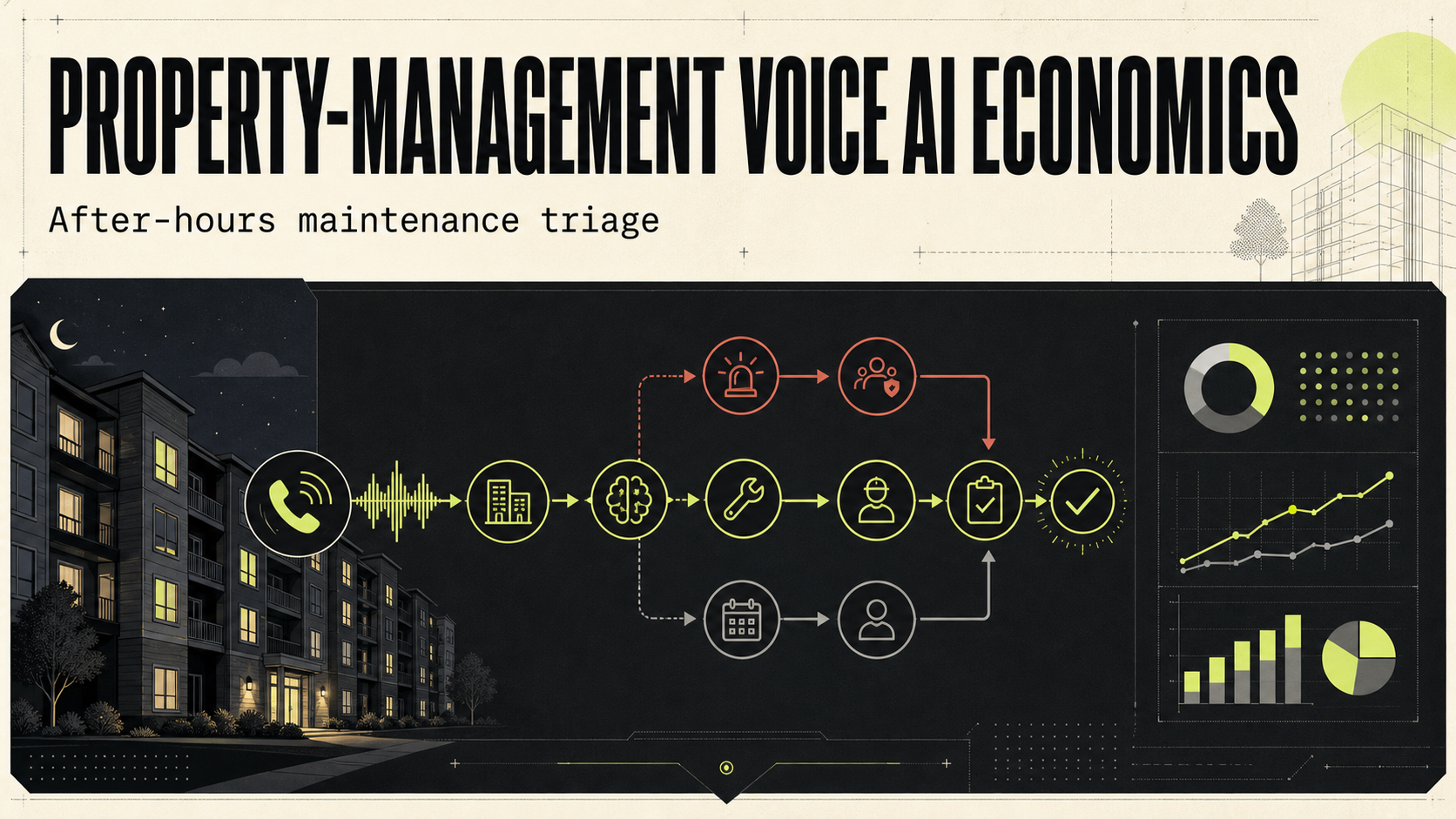
The after-hours maintenance call-to-resolution funnel
| Stage | Required evidence | Economic question |
|---|---|---|
| Connected call | Telephony state, coverage window, and connected duration | How much paid traffic becomes a real conversation? |
| Valid maintenance request | Correct property context, non-spam request, required intake, and duplicate check | Did the call create usable operational demand? |
| Policy classification | Versioned safety-critical, urgent, or routine rule and evidence | Was the request placed on the right path? |
| Routing initiated | Correct contact tier, roster, vendor, channel, and fallback | What does reliable escalation cost? |
| Acknowledged or accepted | On-call or vendor acknowledgement within the policy window | Did notification become ownership? |
| Work order created or updated | Validated PMS write-back and deduplication | Did intake become usable system state? |
| Verified resolution | Completed, mitigated, duplicate, canceled, or another defined terminal state | What does an economically closed request cost? |
Segment the funnel by portfolio, property, region, request category, coverage window, language, policy version, on-call tier, vendor, and management agreement. A blended answer rate can hide a property with delayed acknowledgements or an expensive account with constant manual review.
A call answered is not a maintenance incident resolved
Voice dashboards commonly show answer rate, containment, call completion, or work orders created. Those are useful operating signals, but each proves a different stage.
| Observed event | What it proves | What it does not prove |
|---|---|---|
| Call answered | The phone connected | Resident context, valid intake, or correct routing |
| Call contained | No live transfer occurred | Safety, accuracy, satisfaction, or resolution |
| Request classified | A category and urgency state exist | That the classification was correct |
| Contact notified | A message or call was sent | Acknowledgement, dispatch, or ownership |
| Work order created | A PMS record exists | Completeness, deduplication, dispatch, or completion |
| Work order closed | A terminal state was recorded | Durable resolution unless reopening and repeat contact are observed |
Write the outcome standard first. Include the policy version, eligible request, required fields, acknowledgement window, correct routing, PMS state, reopening period, and how mitigated-but-not-permanently-repaired incidents are represented.
The market is moving from message taking to operational action
Current property-maintenance products illustrate the expected workflow. JobCall describes emergency classification, escalation, and work-order creation. Haven describes intake, urgency identification, work-order support, vendor coordination, and resident follow-up. Open describes PMS-connected triage, work-order write-back, and on-call routing.
Those pages demonstrate market positioning, not independent performance benchmarks. Buyers still need their own evidence for correct routing, response time, resolved work orders, resident experience, cost-to-serve, and customer margin.
Safety classifications also need operating context. HUD's NSPIRE terms distinguish low, moderate, severe, and life-threatening deficiencies for covered programs. That is useful evidence that urgency is not a single binary label, but it is not a universal maintenance policy for every property or jurisdiction.
The complete after-hours maintenance Voice AI cost stack
- 01Telephony and speech
Numbers, forwarding, connected minutes, recognition, realtime or language models, speech generation, silence, interruption, recording where used, and transfers.
- 02Property and policy context
Property lookup, portfolio rules, management agreements, maintenance responsibility, coverage windows, approved questions, urgency classes, and safety paths.
- 03PMS and work-order tools
Resident or property matching, duplicate search, work-order create or update, status lookup, notes, attachments, access preferences, and system write-back validation.
- 04On-call and vendor routing
Roster lookup, phone, SMS, email, paging, acknowledgement, fallback tiers, vendor dispatch, scheduling, and cancellation.
- 05Human review and intervention
Live transfer, ambiguous classification, supervisor review, staff callback, dispatch override, vendor coordination, and resident service recovery.
- 06Follow-up and closure
Confirmation, status updates, repeat contacts, access coordination, work-order synchronization, completion checks, reopen handling, and satisfaction workflows.
- 07Errors and consequence cost
False escalation, missed escalation, wrong property or vendor, duplicate work, incomplete intake, delayed acknowledgement, cleanup, complaints, and incident review.
- 08Implementation and safeguards
Integration, testing, property onboarding, policy versioning, multilingual QA, accessibility, security, privacy, monitoring, audit, and incident response.
For a Voice AI vendor, attribute the same costs to every property-management customer. Similar call volumes can produce different margins when one account has many properties, complex rosters, bespoke PMS work, multilingual traffic, vendor coordination, or frequent human review.
Property-management Voice AI unit-economics formulas
cost_per_valid_maintenance_request = total_after_hours_program_cost ÷ valid_maintenance_requests
cost_per_correct_routing = total_after_hours_program_cost ÷ correctly_routed_requests
cost_per_verified_resolution = total_after_hours_program_cost ÷ verified_resolved_requests
missed_critical_event_rate = reviewed_critical_requests_not_sent_to_required_path ÷ reviewed_true_critical_requests
unnecessary_after_hours_dispatch_rate = reviewed_dispatches_not_required_under_policy ÷ reviewed_after_hours_dispatches
after_hours_triage_ROI = (validated_baseline_cost_avoided + verified_labor_value + verified_dispatch_savings − program_cost − correction_and_service_recovery) ÷ program_cost
customer_margin = (customer_revenue − voice_stack − tools − human_ops − support_and_integration_allocation) ÷ customer_revenue
Do not count every contained call as avoided labor or every urgent escalation as avoided property damage. Use observed baselines and verified outcomes, and keep speculative loss prevention outside the core ROI case.
Worked example: a multi-property after-hours line
The following values are illustrative—not a benchmark, vendor quote, property result, dispatch standard, or safety instruction. They show how to calculate economics without turning activity into value.
| Input | Illustrative value | Economic result |
|---|---|---|
| Monthly after-hours calls | 2,000 calls | The full paid call population is measured |
| Valid maintenance requests | 1,200 requests | Spam, leasing, rent, duplicates, and unsupported contacts are separated |
| Correctly routed requests after review | 1,080 requests | 90% illustrative correct-routing rate under the written policy |
| Verified resolved requests in the observation window | 900 requests | Reopens and unresolved incidents remain visible |
| Voice stack and platform | $3,200 | Telephony, speech, models, and platform consumption |
| PMS, messaging, and routing tools | $1,400 | Work-order, notification, roster, and acknowledgement tools |
| Human on-call, review, and vendor coordination | $5,400 | Retained human work is included |
| QA, safeguards, support, and allocated operations | $1,800 | Control and customer cost-to-serve |
| Correction and service recovery | $1,200 | Observed error and cleanup cost |
| Total program cost | $13,000 | $10.83 per valid request, $12.04 per correct routing, and $14.44 per verified resolution |
| Validated baseline cost avoided | $10,000 | Answering-service and comparable staffing cost displaced |
| Verified labor value and dispatch savings | $8,000 | Measured staff time returned and unnecessary dispatch avoided |
| Net observable benefit | $5,000 monthly | About 38% illustrative ROI on program cost |
Answering does not establish valid intake, correct routing, acknowledgement, or resolution.
Includes the loaded program cost and uses an observed terminal work-order outcome.
Test causality by property, request category, season, weather, staffing, vendor availability, and policy version. A lower result can come from easier request mix rather than better automation.
Optimize risk-weighted routing, not containment
| Routing outcome | Operational cost | Control |
|---|---|---|
| Correct routine deferral | Work-order and next-day follow-up | Complete intake, resident confirmation, and reopen path |
| Correct urgent escalation | On-call interruption, coordination, and possible dispatch | Policy evidence, acknowledgement deadline, and fallback |
| False urgent escalation | Unnecessary wake-up, dispatch, vendor charge, and resident friction | Reviewed samples, threshold tuning, and human confirmation where appropriate |
| Missed critical path | Potentially severe resident, property, compliance, and service consequences | Hard-coded safety paths, low-confidence escalation, monitoring, and incident review |
| Unknown or ambiguous | Human review and response delay | Fail safe, preserve context, and never invent a diagnosis |
Accuracy is asymmetric. A false routine classification on a reviewed safety-critical request should not be averaged together with a harmless category mismatch. Track severity-weighted errors and price the controls that prevent them.
How the economics change by property operator
| Operator | Useful outcome | Costs hidden by averages |
|---|---|---|
| Small rental portfolio | Complete request routed without waking the owner unnecessarily | Low volume, configuration overhead, owner escalation, and vendor availability |
| Multifamily operator | Correctly routed incident and verified work-order resolution | Property variation, on-site teams, shared vendors, language, and high call concurrency |
| Single-family rental manager | Resolution across distributed homes and approved vendors | Geography, owner responsibility, home systems, access, and vendor travel |
| Student or senior housing operator | Policy-compliant routing with reliable human fallback | Seasonality, accessibility, resident needs, staffing, and elevated escalation requirements |
| Third-party property manager | Outcome and service level by owner, portfolio, and agreement | Different responsibilities, approval limits, vendors, pricing, and owner reporting |
| Voice AI vendor | Verified customer outcome at positive contribution margin | Custom policies, PMS connectors, support, QA, human services, and incident handling |
After-hours maintenance Voice AI metrics worth tracking
| Metric | What it reveals | Decision it supports |
|---|---|---|
| Attempted, connected, valid, duplicate, and spam | The true request funnel | Coverage, routing, and denominator design |
| Urgency class and reviewed correct-routing rate | Whether classification is operationally trustworthy | Policy, prompts, model, and review thresholds |
| Critical miss and false-escalation rate | Asymmetric routing risk | Hard stops, fallback, and rollout scope |
| Acknowledgement, dispatch, and fallback time | Whether notification becomes action | Roster, contact tiers, and vendor coverage |
| Work-order creation, duplicate, completion, and reopen | Durable operational outcomes | PMS integration and resolution definition |
| Repeat call and information-repetition rate | Resident effort and broken handoffs | Context transfer and follow-up design |
| Human touches, minutes, and override reason | Retained labor and necessary control cost | Hybrid design and staffing |
| Cost per request, correct routing, and resolution | Activity versus outcome economics | Architecture, vendor, and pricing comparison |
| Cost and margin by property, portfolio, and customer | Who creates or erodes contribution | Commercial plans and rollout |
| Unpriced usage coverage | How much cost remains unknown | Provider catalog and reconciliation work |
A machine-readable maintenance triage cost event without resident content
Use internal customer, portfolio, property, workflow, policy, category, urgency, routing, work-order, and outcome metadata instead of resident names, phone numbers, addresses, access codes, recordings, transcripts, or work-order text:
{
  "event_id": "evt_property_voice_7284",
  "execution_id": "maintenance_call_4fd2",
  "step_id": "step_route_08",
  "parent_step_id": "step_policy_07",
  "provider": "openai",
  "model": "realtime-voice-model",
  "operation": "route_after_hours_request",
  "input_tokens": 2180,
  "output_tokens": 236,
  "cached_input_tokens": 1280,
  "latency_ms": 584,
  "status": "success",
  "environment": "production",
  "provider_reported_cost_usd": 0.0356,
  "attributes": {
    "application": "property-management-voice-agent",
    "workflow": "after_hours_maintenance_triage",
    "feature": "incident_routing",
    "customer_id": "property_manager_1842",
    "portfolio_id": "portfolio_midwest_07",
    "property_id": "property_group_42",
    "prompt_id": "maintenance-intake-routing",
    "prompt_version": "v12",
    "policy_id": "after_hours_policy_09",
    "policy_version": "v6",
    "coverage_window": "after_hours",
    "request_category": "plumbing",
    "urgency_class": "urgent",
    "routing_outcome": "on_call_acknowledged",
    "work_order_state": "created",
    "human_handoff_required": true,
    "data_classification": "no_resident_call_or_work_order_content"
  }
}
Send separate events for telephony, recognition, model turns, speech generation, property lookup, policy checks, PMS actions, messages, on-call attempts, acknowledgements, transfers, reviews, retries, and outcomes with the same execution_id. Later attach the verified resolution without turning the cost ledger into another resident or work-order database.
Safety, resident trust, and compliance are part of unit cost
This article is an economics and observability framework, not emergency, maintenance, housing, accessibility, privacy, telecommunications, regulatory, legal, or financial advice. Property operators and vendors should define applicable duties, permitted conversations, identity checks, recording, safety messages, emergency routing, reasonable accommodations, data access, retention, and outbound-contact rules with qualified teams.
Some conditions need a hard-coded path outside ordinary maintenance workflow. For example, the U.S. Consumer Product Safety Commission's carbon-monoxide alarm guidance directs occupants to get outside and call the fire department when an alarm sounds. An AI system should use the property operator's approved emergency language and routing rather than generate improvised troubleshooting.
Inbound resident triage and outbound updates are different workflows. The FTC's Telemarketing Sales Rule guidance distinguishes purely informational messages from messages that contain solicitation. The FCC has confirmed that TCPA restrictions on artificial or prerecorded voice encompass current AI voice technologies. Determine which federal, state, local, contractual, and property-specific requirements apply.
- Bound the role: use approved intake and routing, not open-ended diagnosis or improvised emergency advice.
- Fail safe: low confidence, missing context, safety-critical indicators, and unreachable contacts need explicit escalation and fallback.
- Design for access: test language support, speech differences, hearing and communication needs, alternate channels, and human assistance.
- Make write-back reliable: validate property context, deduplicate requests, use idempotency, and preserve the PMS as the operational source of truth.
- Minimize analytics data: cost and outcome measurement rarely needs resident identity, addresses, recordings, transcripts, access codes, or work-order content.
- Price safeguards: policy design, testing, QA, review, monitoring, incident response, complaint handling, and service recovery are real cost-to-serve.
How to measure property-management Voice AI economics
Start with one bounded after-hours line, a small group of properties, a versioned maintenance policy, and a workflow whose acknowledgement and resolution states can be verified.
- 01Define a policy-backed terminal outcome
Choose the work-order or incident state that proves a request was correctly routed and economically closed, including mitigation, completion, duplicate, cancellation, and reopening windows.
- 02Measure a comparable after-hours baseline
Capture calls, valid requests, urgency mix, answering-service cost, staff and vendor touches, dispatches, response time, repeat contact, work-order resolution, and correction for the same properties and coverage windows.
- 03Create one call-to-resolution execution ID
Join telephony, speech, model, policy, property lookup, work-order, messaging, on-call, vendor, acknowledgement, dispatch, review, and resolution events under one durable identifier.
- 04Version rules and safeguards
Record the policy, on-call roster, property configuration, prompt, model, tool, fallback, and reviewer versions that governed each decision.
- 05Attach portfolio and commercial context
Add the property-management customer, portfolio, property, region, coverage window, plan, pricing version, and revenue or cost allocation at the source.
- 06Monitor risk-weighted economics
Alert on cost per valid request, correct routing, verified resolution, critical misses, false escalation, acknowledgement delay, repeat contact, customer margin, and unpriced usage.
Ganivra's AI and MCP event model links provider cost, voice turns, tools, retries, policy versions, customers, portfolios, properties, workflows, human review, and outcomes without proxying calls or storing their content.
Use the Voice AI Unit Economics guide for the full call stack, the Voice AI Pricing Models guide to compare per-minute, per-call, and per-outcome contracts, the HVAC AI Receptionist guide for another safety-sensitive after-hours workflow, and the Agentic Workflow Automation guide for tool, retry, and human-review economics.
Property-management Voice AI FAQ
What is property-management Voice AI?
Property-management Voice AI is a voice-enabled system that handles resident, prospect, owner, or vendor calls under defined property and portfolio rules. In after-hours maintenance, it can verify context, capture the issue, classify the permitted urgency path, create a work order, contact an approved on-call person or vendor, and confirm the next step.
How does AI after-hours maintenance triage work?
The agent identifies the property and request category, follows a property-approved question and escalation tree, records the evidence required for a usable work order, and routes the incident to an emergency, urgent on-call, or routine next-business-day path. Later events should verify acknowledgement, dispatch, work-order state, and resolution.
What counts as an emergency maintenance request?
There is no universal commercial definition. The property operator should maintain a written, jurisdiction-aware policy covering safety-critical, urgent, and routine conditions, along with approved instructions and contacts. HUD's NSPIRE categories can inform some federally assisted housing workflows, but they are not a substitute for the property’s applicable duties, agreements, and local requirements.
Should Voice AI diagnose a maintenance problem?
The safer design is bounded intake and routing rather than open-ended diagnosis. The system should use approved questions and actions, avoid improvising technical or emergency advice, and transfer or escalate when the answer, property context, safety state, or routing rule is uncertain.
How much does property-management Voice AI cost?
Loaded cost can include telephony, speech recognition, model reasoning, speech generation, platform fees, property-management-system tools, messaging, on-call contacts, vendor dispatch, human review, implementation, quality assurance, and corrections. Compare cost per valid request, correct routing, and verified resolution rather than subscription price alone.
How do you calculate after-hours maintenance triage ROI?
Compare the same properties, call windows, request mix, staffing, season, and quality standard before and after deployment. Credit validated answering-service savings, staff time returned, unnecessary dispatch avoided, and other observed value; subtract the loaded program cost, corrections, service recovery, and incremental risk cost. Do not claim avoided property damage without defensible causal evidence.
What is a valid maintenance request?
A valid request is a non-spam incident tied to the correct property context with enough approved information to create or update a usable work order. It should pass the operator's identity, duplicate, responsibility, access, category, and required-field checks without treating sensitive resident details as analytics metadata.
What is a correctly routed maintenance incident?
A correctly routed incident follows the written policy that applied at the time: the right urgency class, contact tier, property or portfolio, on-call schedule, vendor or staff path, acknowledgement requirement, and fallback. Audit samples and final outcomes should verify correctness rather than assuming that every completed transfer was right.
What counts as a verified maintenance resolution?
Use a defined terminal state in the property-management or work-order system, such as completed, mitigated pending permanent repair, canceled as duplicate, resident-unreachable under policy, or otherwise economically closed. A call answered, message sent, work order created, or technician paged is not by itself a verified resolution.
Does maintenance Voice AI need AppFolio, Buildium, Yardi, or another PMS integration?
A reliable integration is important when the agent must identify the property context, check open requests, create a work order, apply on-call rules, notify staff or vendors, and record acknowledgement. Without validated write-back, the system may only take a message; that should be measured as a different outcome.
How does Voice AI compare with a property-management answering service?
Compare the same after-hours cohort and routing standard. Include setup, per-minute or per-call charges, hold time, message completeness, work-order integration, on-call escalation, vendor coordination, human review, multilingual coverage, false escalation, missed escalation, and final resolution. A hybrid can be economically superior for ambiguous or safety-sensitive incidents.
How should false emergencies and missed emergencies be measured?
Create a reviewed ground-truth sample and track false critical classification, missed critical classification, unnecessary on-call escalation, delayed acknowledgement, fallback activation, and service recovery. Weight missed safety-critical incidents separately from routine classification errors; a blended accuracy score can conceal the most consequential failures.
Does Voice AI cost tracking require resident calls or transcripts?
No. Unit economics can usually use stable execution, customer, portfolio, property, workflow, policy version, coverage window, request category, urgency class, routing, work-order state, provider usage, cost, latency, review, and outcome metadata without names, phone numbers, addresses, access codes, recordings, transcripts, or work-order content.
Can Voice AI call residents with maintenance updates?
Technically yes, but inbound triage, a requested informational update, and a call containing marketing or solicitation are different workflows. Define permitted recipients, consent or other lawful basis, identity and disclosure, timing, opt-out where applicable, approved content, and recordkeeping with qualified legal and compliance teams before outbound activation.
How should multi-property operators measure maintenance Voice AI?
Attach portfolio, property, region, management agreement, coverage window, request category, policy version, on-call roster version, vendor path, and revenue or cost allocation to every execution. Measure cost per valid request, correct routing, resolution, door, and property so a large high-performing asset does not hide a smaller broken workflow.
How do Voice AI vendors measure margin by property-management customer?
Attach a stable property-management customer ID, plan and pricing version, portfolios and property bands, telephony and model usage, PMS tools, messaging, custom policy work, human review, support, and verified outcomes. Compare allocated cost-to-serve with customer revenue and keep high-risk safeguards in the cost base.
Which after-hours maintenance triage metrics matter most?
Track attempted and connected calls; valid requests; duplicate and spam rate; urgency distribution; correct-routing rate; critical miss and false-escalation rates; acknowledgement and dispatch time; fallback use; work orders created and resolved; repeat contact; staff and vendor touches; cost per request, correct routing, resolution, property, and door; customer margin; and unpriced usage.
Make every after-hours request economically legible
See cost per valid request, correct routing, resolution, property, and customer.
Ganivra connects telephony, speech, model, tool, human, and operations cost to maintenance routing, work-order outcomes, portfolio economics, and customer margin—without requiring resident call content in cost telemetry.