Quick answer
How do you measure restaurant phone-ordering AI economics?
Add telephony, speech, models, menu and POS tools, payments, messaging, human intervention, implementation, QA, support, refunds, remakes, and service recovery. Attribute that loaded cost to valid order intents, confirmed orders, POS-accepted orders, durable fulfilled orders, locations, and restaurant customers.
The denominator that matters is not calls answered or calls contained. It is an eligible order that the restaurant accepted and fulfilled under a written accuracy and correction standard. Measure contribution after food, packaging, discounts, payment, delivery, and automation costs before calling it profitable.
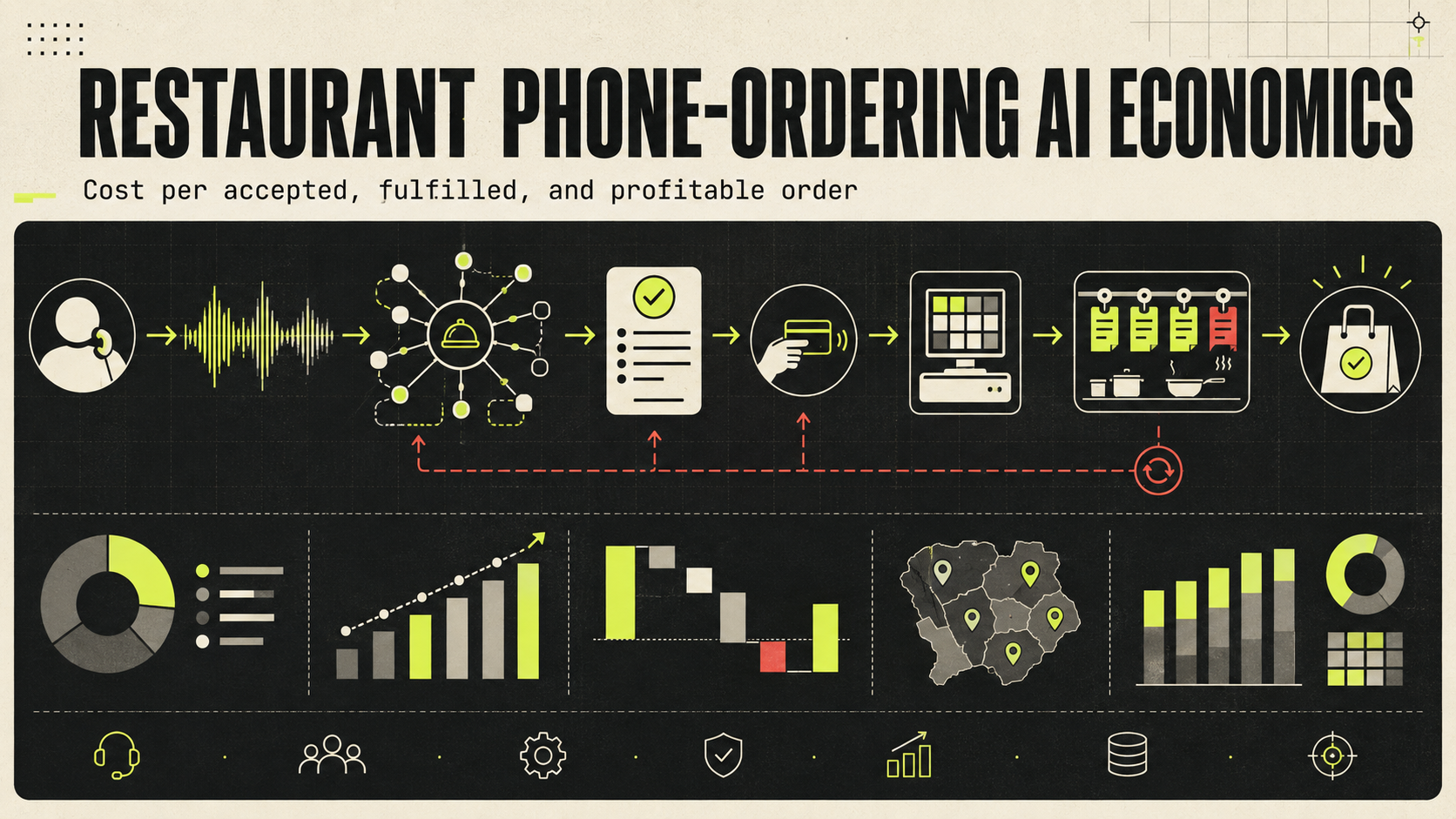
The restaurant call-to-fulfillment funnel
| Stage | Required evidence | Economic question |
|---|---|---|
| Connected call | Location, daypart, connected duration, and call state | How much paid traffic becomes a conversation? |
| Valid order intent | Eligible location, service window, order type, and non-spam intent | How many calls contain addressable demand? |
| Complete cart | Available items, required modifiers, price, taxes, fees, and timing | Can the order be executed as captured? |
| Confirmed order | Customer-approved read-back and payment or pay-later state | Did conversation become an authorized purchase? |
| POS accepted | Correct-location write-back, acknowledgement, and duplicate guard | Did the order enter production? |
| Fulfilled order | Pickup, delivery, or defined completion state | What does a delivered outcome cost? |
| Durable profitable order | Refund, remake, chargeback window and net contribution | Did revenue survive correction and cost? |
Segment by brand, location, daypart, order type, menu version, promotion, language, call source, POS, payment path, and customer. Dinner-rush concurrency and complex pizza modifiers should not be averaged together with simple FAQ calls.
An order placed is not an order fulfilled
| Observed event | What it proves | What it does not prove |
|---|---|---|
| Call contained | No live transfer occurred | Accuracy, acceptance, revenue, or customer satisfaction |
| Order confirmed | The caller approved a captured cart | POS acceptance or kitchen execution |
| POS write attempted | An integration call occurred | Correct location, acknowledgement, or deduplication |
| Payment authorized | A payment method was authorized | Fulfillment or retained revenue |
| Ticket completed | A restaurant terminal state exists | Durability until refunds, remakes, and disputes are observed |
Write the outcome standard first: eligible calls, required menu fields, confirmation, POS acknowledgement, kitchen acceptance, fulfillment state, refund and remake window, attribution rule, and treatment of transfers, duplicates, cancellations, discounts, and delivery expense.
Phone ordering is becoming a connected restaurant channel
The National Restaurant Association's 2025 research reported that takeout, drive-thru, and delivery are deeply embedded in restaurant demand. Phone orders are only one part of that channel mix, so operators should compare voice with web, app, marketplace, drive-thru, and staff-assisted ordering—not assume every automated call is incremental.
Current products illustrate the expected workflow. Kea describes menu-aware voice ordering, direct POS and KDS connection, payment links, availability updates, and call reporting. ConverseNow describes phone-order automation, localization, promotions, order injection, and POS partners. These are vendor descriptions, not independent performance benchmarks.
The operational question is whether an accurate, confirmed order reaches the right kitchen at the right time and produces retained contribution. Ganivra makes the model, telephony, POS, payment, human, correction, and support cost attributable to that outcome and to the restaurant customer funding it.
The complete restaurant phone-ordering AI cost stack
- 01Telephony and speech
Numbers, routing, connected minutes, recognition, realtime or language models, speech generation, silence, interruption, transfers, and recording where permitted.
- 02Menu and conversation orchestration
Location selection, hours, items, modifiers, combos, availability, prices, taxes, fees, promotions, upsell rules, multilingual behavior, and confirmation.
- 03POS, KDS, and order tools
Menu synchronization, item mapping, duplicate checks, order creation, acknowledgement, throttling, kitchen routing, status reads, cancellation, and correction.
- 04Payments and messaging
Payment links, authorization, processor fees, fraud controls, receipts, pickup or delivery updates, and failed-payment recovery.
- 05Human intervention
Live transfers, ambiguous customizations, allergy escalation, manager approval, order correction, customer callbacks, and support.
- 06Refunds, remakes, and service recovery
Wrong items, missed modifiers, price disputes, late orders, cancellations, refunds, comps, remakes, chargebacks, and guest recovery.
- 07Implementation and controls
POS connectors, restaurant onboarding, menu QA, load testing, payment security, privacy, consent, monitoring, audit, incident response, and ongoing support.
For a Voice AI vendor, allocate the same costs by customer and location. Similar call volume can produce very different margins when one restaurant has complex modifiers, high turnover in menu configuration, many locations, bespoke integrations, heavy human review, or frequent refunds.
Restaurant phone-ordering AI unit-economics formulas
cost_per_valid_order_intent = total_phone_ordering_program_cost ÷ valid_order_intents
cost_per_pos_accepted_order = total_phone_ordering_program_cost ÷ POS_accepted_orders
cost_per_durable_fulfilled_order = total_phone_ordering_program_cost ÷ fulfilled_orders_surviving_correction_window
order_correction_rate = orders_with_refund_remake_or_material_correction ÷ fulfilled_AI_phone_orders
incremental_order_contribution = net_sales − food_and_packaging − discounts − payment_and_delivery − AI_and_human_order_cost − refunds_and_remakes
restaurant_voice_AI_ROI = (validated_labor_value + incremental_fulfilled_order_contribution + verified_error_savings − program_cost − service_recovery) ÷ program_cost
customer_margin = (customer_revenue − telephony − models − POS_and_payment_tools − human_ops − support_allocation) ÷ customer_revenue
Do not multiply all previously missed calls by average order value. Some callers would order online, visit, call back, abandon, or choose another channel. Incrementality needs a comparable baseline, experiment, or defensible attribution method.
Worked example: a 12-location quick-service group
The following values are illustrative—not a benchmark, vendor quote, restaurant result, menu price, or operating recommendation.
| Input | Illustrative value | Economic result |
|---|---|---|
| Monthly inbound calls | 18,000 calls | The full paid call population |
| Valid order intents | 11,000 intents | FAQs, spam, status, and unsupported calls separated |
| POS-accepted orders | 8,200 orders | Confirmed orders acknowledged by the correct location |
| Durable fulfilled orders | 7,600 orders | Fulfilled without full refund, chargeback, or material remake in the window |
| Voice stack and platform | $9,500 | Telephony, speech, models, and platform |
| POS, menu, payment, and messaging tools | $4,500 | Connected order and customer workflows |
| Human review, transfers, and support | $6,500 | Retained restaurant and vendor labor |
| QA, implementation, and allocated operations | $3,500 | Control and customer cost-to-serve |
| Refund, remake, and service recovery | $4,000 | Observed consequence cost |
| Total program cost | $28,000 | $2.55 per valid intent, $3.41 per accepted order, $3.68 per durable fulfilled order |
| Validated labor value | $18,000 | Observed staff time returned in comparable windows |
| Incremental fulfilled-order contribution | $22,000 | Net contribution, not gross order value |
| Verified error savings | $2,000 | Observed avoided corrections versus baseline |
| Net observable benefit | $14,000 monthly | 50% illustrative ROI on program cost |
Answering does not establish a valid order, POS acceptance, fulfillment, or contribution.
Includes loaded program and correction cost against a verified outcome.
Optimize order integrity, not containment
| Failure | Hidden cost | Control |
|---|---|---|
| Wrong item or modifier | Remake, refund, waste, delay, and guest recovery | Versioned menu, required fields, read-back, and review samples |
| Sold-out or stale item | Callback, substitution, cancellation, and kitchen disruption | Real-time availability, fail-closed rules, and staff handoff |
| Duplicate or wrong-location order | Waste, refund, chargeback, and guest frustration | Idempotency, location confirmation, and POS acknowledgement |
| Unsafe allergy assurance | Potentially severe customer and business consequence | Approved information, no improvisation, and conservative escalation |
| Payment-data exposure | Security incident, investigation, and compliance cost | Validated payment flow and no sensitive data in recordings or telemetry |
How the economics change by restaurant type
| Operator | Useful outcome | Costs hidden by averages |
|---|---|---|
| Independent restaurant | Correct fulfilled order without interrupting service | Low volume, setup, menu changes, and owner handoffs |
| Pizza or highly configurable menu | Modifier-complete order accepted by the kitchen | Combinatorial choices, half-and-half items, substitutions, and remakes |
| Quick-service chain | Durable fulfillment and contribution by location | Concurrency, local prices, promotions, franchise rules, and POS variation |
| Full-service restaurant | Correct distinction between orders, reservations, and questions | Complex intent mix, catering, availability, and staff escalation |
| Franchise group | Comparable outcome by brand, store, and agreement | Local menus, owners, fees, systems, support, and reporting |
| Voice AI vendor | Verified restaurant outcome at positive contribution margin | Onboarding, integrations, menu QA, human operations, and customer support |
Restaurant phone-ordering AI metrics worth tracking
| Metric | What it reveals | Decision |
|---|---|---|
| Calls, intents, carts, confirmations, and abandonments | The true conversion funnel | Coverage, flow, and denominator design |
| POS writes, acknowledgements, duplicates, and location errors | Integration reliability | Connector, retry, and fallback policy |
| Transfers and staff intervention minutes | Retained human cost and exception mix | Automation boundary and staffing |
| Fulfillment, cancellation, refund, remake, and chargeback | Durable order quality | Menu, confirmation, QA, and recovery |
| Net sales and contribution by order | Commercial value after variable cost | Channel investment and pricing |
| Cost and margin by customer and location | Who is profitable to serve | Packaging, limits, support, and optimization |
Emit one event for each expensive or outcome-changing step, then join those steps to the final restaurant state. The schema below is intentionally free of guest, order, payment, or call content.
{
  "event_id": "evt_restaurant_voice_7284",
  "execution_id": "phone_order_4fd2",
  "step_id": "step_pos_accept_08",
  "parent_step_id": "step_order_confirm_07",
  "provider": "openai",
  "model": "realtime-voice-model",
  "operation": "submit_confirmed_order_to_pos",
  "input_tokens": 2310,
  "output_tokens": 248,
  "cached_input_tokens": 1320,
  "latency_ms": 612,
  "status": "success",
  "environment": "production",
  "provider_reported_cost_usd": 0.0384,
  "attributes": {
    "application": "restaurant-phone-ordering-agent",
    "workflow": "inbound_takeout_order",
    "feature": "pos_order_submission",
    "customer_id": "restaurant_group_1842",
    "brand_id": "brand_07",
    "location_id": "location_42",
    "daypart": "dinner",
    "order_type": "pickup",
    "menu_version": "location-menu-v31",
    "prompt_version": "v12",
    "policy_version": "v6",
    "order_validation": "complete",
    "pos_outcome": "accepted",
    "human_handoff_required": false,
    "data_classification": "no_guest_order_payment_or_call_content"
  }
}
Ganivra's event integration can connect model and tool spend to restaurant, location, order stage, and outcome without putting menu-order text or payment data into cost telemetry.
Food safety, payments, privacy, and calling controls belong in the cost model
Food allergy flows need approved information and human escalation. The FDA's current food-allergen guidance explains federal labeling requirements and the inclusion of sesame as a major allergen, but a packaged-food labeling guide is not a restaurant's cross-contact guarantee.
Telephone payments require deliberate scope. The PCI Security Standards Council says VoIP traffic containing payment account data is in scope for applicable PCI DSS controls and prohibits retaining card validation codes in audio after authorization. Prefer payment links or segregated compliant capture, and keep sensitive data out of recordings, prompts, traces, and analytics.
For outbound AI calls, the FCC's AI voice declaratory ruling applies TCPA artificial- or prerecorded-voice requirements, including consent, identification, and—in relevant telemarketing cases—opt-out obligations. Inbound ordering does not authorize unrelated outbound marketing.
Include human fallback, accessibility, language QA, menu freshness, least-privilege tools, recording and retention rules, incident response, and service recovery in both design and cost. This guide is an economics framework, not legal, food-safety, tax, or PCI compliance advice.
How to measure restaurant phone-ordering AI economics
- 01Define an accepted and durable order
Write the eligibility, confirmation, POS acknowledgement, fulfillment, cancellation, refund, remake, and observation-window rules before measuring automation.
- 02Build a comparable baseline
Measure the same locations, hours, menu mix, promotions, demand, staffing, phone outcomes, order states, labor, refunds, and remakes.
- 03Create one call-to-fulfillment execution ID
Join telephony, speech, menu, POS, payment, messaging, transfer, kitchen, fulfillment, refund, and correction events.
- 04Version menus and controls
Record location, menu, modifier, availability, promotion, price, prompt, model, tool, fallback, payment, and review versions.
- 05Attach restaurant and commercial context
Add restaurant customer, brand, location, plan, pricing version, order channel, and revenue or cost allocation at the source.
- 06Monitor risk-weighted economics
Alert on acceptance, fulfillment, wrong-order and remake rates, payment failures, customer friction, cost per fulfilled order, and customer margin.
Start with a narrow location and menu cohort, shadow or review risky cases, verify POS and kitchen outcomes, and expand only after correction-adjusted economics hold. Use the Voice AI unit economics guide for the underlying call stack, the Voice AI pricing guide for vendor contracts, and the agentic workflow economics guide for multi-step tool orchestration.
Frequently asked questions
Restaurant phone-ordering AI economics FAQ
What is restaurant phone-ordering AI?
Restaurant phone-ordering AI is a voice system that answers inbound calls, uses a restaurant-approved menu and ordering rules, captures items and modifiers, confirms the order, and writes an accepted order into the point-of-sale or approved human workflow. It can also answer bounded questions, take a permitted payment path, and hand off exceptions.
How does AI phone ordering work for restaurants?
The system connects the call, identifies the location and order type, checks the live menu and availability, validates required modifiers, reads back the price and order, obtains confirmation, sends the order to the POS, and verifies restaurant acceptance. Later events should confirm fulfillment, cancellation, refund, remake, or another terminal state.
What counts as a valid AI phone order?
A valid order meets the restaurant's written rules for service area, operating hours, menu availability, required modifiers, minimums, taxes and fees, customer confirmation, and payment or pay-at-store state. Spam, FAQs, abandoned carts, unsupported requests, and test calls should remain separate.
What counts as an accepted restaurant order?
An accepted order has passed validation, been written to the correct POS and location, and received a system or staff acknowledgement that it entered the restaurant's production queue. A completed conversation or attempted POS write is not enough.
What counts as a fulfilled phone order?
Use an observed restaurant state such as completed pickup, completed delivery, or another defined terminal state, then apply a refund, chargeback, remake, and cancellation window. A ticket printed or payment authorized does not prove fulfillment.
How much does restaurant phone-ordering AI cost?
Loaded cost can include telephony, speech recognition, model reasoning, speech generation, vendor fees, POS and menu tools, payments, messaging, human intervention, implementation, quality assurance, support, refunds, remakes, and service recovery. Measure cost per valid, accepted, fulfilled, and contribution-positive order.
How do you calculate restaurant voice AI ROI?
Compare equivalent locations, hours, menu mix, promotions, season, staffing, and demand before and after launch. Credit validated labor value, incremental fulfilled-order contribution, and observed error reduction; subtract the full program, human, refund, remake, discount, and recovery costs. Do not treat every answered or contained call as incremental revenue.
Is AI phone ordering better than a restaurant call center?
It depends on menu complexity, call concurrency, labor cost, integration reliability, language, and exception rate. Compare both options using the same valid-order definition and include transfers, hold time, order accuracy, POS acceptance, refunds, remakes, and fulfilled-order economics. A hybrid may be best for complex requests.
Does restaurant Voice AI need a POS integration?
Reliable POS integration matters when the system promises autonomous ordering. It should read current menus and availability, map modifiers and prices, write to the correct location, prevent duplicates, and verify acceptance. Without validated write-back, the system is closer to message-taking and should use a different outcome label.
How should menu modifiers and sold-out items be handled?
Use location-specific, versioned menus with required modifier groups, supported substitutions, time windows, prices, taxes, fees, and item availability. Reject unsupported combinations, confirm material changes, and route ambiguity to staff. Never invent an item, allergen answer, price, or customization.
How should food-allergy questions be handled?
Use only restaurant-approved, current information and a conservative escalation policy. The phone agent should not improvise medical or cross-contact assurances. Food-allergy handling must reflect the restaurant's menu, kitchen practices, applicable law, and qualified food-safety guidance.
Can restaurant Voice AI take card payments by phone?
It can use an approved payment flow, but phone payment data can bring systems into PCI DSS scope. Keep account data out of recordings, transcripts, prompts, analytics, and ordinary application logs; use a validated payment provider and obtain qualified compliance advice.
Can the AI call customers with order updates or promotions?
Requested transactional updates and marketing calls are different workflows. Define consent or another lawful basis, identity and disclosure, timing, opt-out, approved content, and records before outbound activation. FCC rules apply to AI-generated artificial or prerecorded voice calls.
How should refunds, remakes, and chargebacks affect the economics?
Attach them to the originating order during a defined observation window. Report gross order value separately from refunded value, net sales, food and packaging cost, discounts, delivery expense, and service-recovery cost. An order that is later fully refunded should not remain a clean fulfilled outcome.
How should multi-location restaurant groups measure phone-ordering AI?
Attach brand, restaurant customer, location, daypart, channel, menu version, promotion, POS, order type, fulfillment state, and commercial allocation to each execution. Compare cost, conversion, accuracy, acceptance, fulfillment, correction, and contribution by location rather than relying on a chain-wide average.
How do Voice AI vendors measure margin by restaurant customer?
Attribute telephony, models, POS connectors, menu onboarding, payment and messaging tools, human review, support, custom configuration, refunds, and service recovery to each restaurant customer. Compare that cost-to-serve with subscription, usage, or outcome revenue under the actual pricing version.
Which restaurant phone-ordering AI metrics matter most?
Track calls, valid order intents, completed carts, confirmed orders, POS write attempts and acknowledgements, kitchen acceptance, fulfillment, abandonment, transfer, duplicate, cancellation, refund, remake, chargeback, average order value, net contribution, cost per valid order, cost per fulfilled order, location margin, and unpriced usage.
Measure the order, not just the call
See which restaurant Voice AI orders are actually profitable.
Connect telephony, models, menus, POS tools, human intervention, fulfillment, correction, and restaurant-customer revenue in one cost ledger.