Quick answer
Is an AI receptionist cheaper than a human answering service?
AI is usually economically stronger for high-volume, repeatable, integration-ready calls; a human answering service is usually stronger for ambiguous, emotional, persuasive, or exception-heavy conversations. A hybrid model often produces the best risk-adjusted economics: AI handles routine intent and system actions, while people take defined exceptions.
Do not decide from subscription, per-call, or per-minute price alone. Add setup, telephony, usage, tools, integrations, overages, transfers, human escalation, quality assurance, supervision, errors, correction, repeated contact, and service recovery. Divide that loaded cost by a verified outcome such as a qualified lead, valid booking, kept appointment, accepted dispatch, completed job, or fulfilled order.
AI receptionist vs human answering service: the complete comparison
| Dimension | AI receptionist | Human answering service | Economic test |
|---|---|---|---|
| Primary pricing | Subscription, call, minute, conversation, outcome, or custom | Included minutes or calls, plan minimum, and overage | Normalize to loaded cost per verified outcome |
| Availability | Continuous when telephony, models, and tools are healthy | Scheduled or 24/7 depending on the service | Cost and conversion by coverage window |
| Concurrency | Scales across simultaneous calls within limits | Depends on staffed capacity and queue | Answer rate and abandonment during peaks |
| Consistency | High rule consistency; errors can repeat at scale | Variable by person, training, turnover, and fatigue | Risk-weighted error and correction rate |
| Ambiguity and empathy | Improving but bounded by context, policy, and model behavior | Stronger for nuance, reassurance, negotiation, and recovery | Escalation, complaint, and recovery outcome |
| Business-system action | Fast structured writes when integrations and rules are reliable | Possible through portals, integrations, or manual entry | Acknowledged, correct, duplicate-free records |
| Change management | Prompts, tools, knowledge, policies, models, and tests need versioning | Scripts, training, coaching, staffing, and QA need updates | Cost and defect rate after each change |
| Languages and accessibility | Potentially broad, but each language and path needs testing | Depends on recruited staff and plan coverage | Outcome parity by language and accessibility need |
| Human fallback | Must be designed, staffed, timed, and measured | Native to the service, though expertise and authority vary | Transfer completion and retained human minutes |
| Best fit | Repeatable intake, FAQs, scheduling, status, routing, and spikes | Complex intake, distress, persuasion, exceptions, and recovery | Outcome-adjusted cost within acceptable risk |
A contained call only proves that no live transfer occurred. It does not prove that the answer was correct, the lead was qualified, the appointment was valid, the caller was satisfied, or the downstream job was completed.
Public pricing shows why sticker-price comparisons fail
As of September 3, 2026, Smith.ai's public AI Receptionist pricing lists AI-first plans by real call, while its human virtual receptionist pricing lists human-first plans by call at higher published rates. PATLive's public live-answering plans use included minutes plus per-minute overage. Goodcall's public pricing defines usage by unique monthly callers rather than minutes or tokens.
These are dated public examples, not endorsements, negotiated quotes, or evidence that one vendor produces better outcomes. They show four different denominator choices: call, minute, caller, and plan allowance. Before comparing vendors, reconstruct the same monthly call population under each billing definition—including spam rules, short calls, transfers, retries, long calls, and overages.
An in-house employee is another baseline, but salary is not loaded cost. The U.S. Bureau of Labor Statistics reports a May 2025 median hourly wage of $18.27 for receptionists and information clerks. Benefits, payroll burden, management, tools, hiring, training, breaks, absence, coverage, and after-hours staffing still need to be added.
The complete loaded-cost stack for both options
- 01Commercial plan
Base fee, included calls or minutes, overage, minimum commitment, onboarding, custom work, renewal terms, and pricing version.
- 02Telephony and call handling
Numbers, routing, forwarding, connected time, queueing, recordings where permitted, spam treatment, transfers, dropped calls, and retries.
- 03AI or human production
Speech, models, tools, retrieval, and inference for AI; staffed minutes, training, coaching, supervision, scheduling, and turnover for humans.
- 04Business-system integrations
CRM, calendar, field-service, practice-management, DMS, PMS, POS, claims, identity, payment, messaging, maintenance, and failed write-back.
- 05Escalation and retained work
Warm transfers, subject-matter experts, on-call staff, dispatchers, front-desk intervention, callbacks, after-call work, and unanswered fallback.
- 06Quality, security, and governance
Testing, scorecards, audits, monitoring, access control, privacy, compliance, incident response, vendor management, and change review.
- 07Error and opportunity cost
Wrong answers, invalid bookings, missed urgency, bad transfers, lost leads, duplicate work, refunds, complaints, repeated contact, and service recovery.
For a receptionist vendor, allocate these costs to each customer. The same call count can produce very different margin when one account has long calls, custom integrations, frequent human escalation, complex scripts, many locations, multiple languages, or high support demand.
AI receptionist vs answering service cost formulas
AI_total = subscription + telephony + speech_and_models + tools + integrations + human_escalation + QA + corrections + allocated_setup
human_total = base_fee + included_usage + overages + transfers + after_hours + integrations + QA + corrections + allocated_setup
cost_per_valid_call = total_receptionist_cost ÷ valid_nonspam_calls
cost_per_valid_booking = total_receptionist_cost ÷ source_system_acknowledged_rule_valid_bookings
cost_per_completed_outcome = total_receptionist_cost ÷ attributable_completed_jobs_visits_orders_or_claims
human_escalation_rate = AI_calls_requiring_human ÷ valid_AI_calls
incremental_contribution = attributable_outcome_contribution − receptionist_program_cost − correction_and_recovery
customer_margin = (customer_revenue − attributed_receptionist_cost) ÷ customer_revenue
Worked example: AI, human, and hybrid on the same calls
The following figures are illustrative—not a benchmark, vendor quote, staffing recommendation, or guaranteed result. The three models use the same general demand, but the example preserves their observed valid calls and outcomes instead of assuming identical conversion.
| Monthly result | AI-first | Human-first | Hybrid |
|---|---|---|---|
| Inbound calls | 3,000 | 3,000 | 3,000 |
| Valid nonspam calls | 2,100 | 2,100 | 2,200 |
| Valid bookings or qualified outcomes | 1,200 | 1,200 | 1,300 |
| Completed outcomes | 900 | 900 | 1,000 |
| Core reception cost | $4,800 AI, telephony, and models | $10,500 plan, usage, and overage | $5,000 AI routine handling |
| Human or exception work | $2,000 escalations | $2,500 transfers, after-hours, and admin | $3,500 human exceptions |
| Tools and integrations | $1,200 | Included in other loaded cost | $1,200 |
| QA and support | $1,000 | $1,000 | $1,000 |
| Correction and recovery | $1,000 | $1,500 | $800 |
| Total loaded cost | $10,000 | $15,500 | $11,500 |
| Cost per valid call | $4.76 | $7.38 | $5.23 |
| Cost per valid booking | $8.33 | $12.92 | $8.85 |
| Cost per completed outcome | $11.11 | $17.22 | $11.50 |
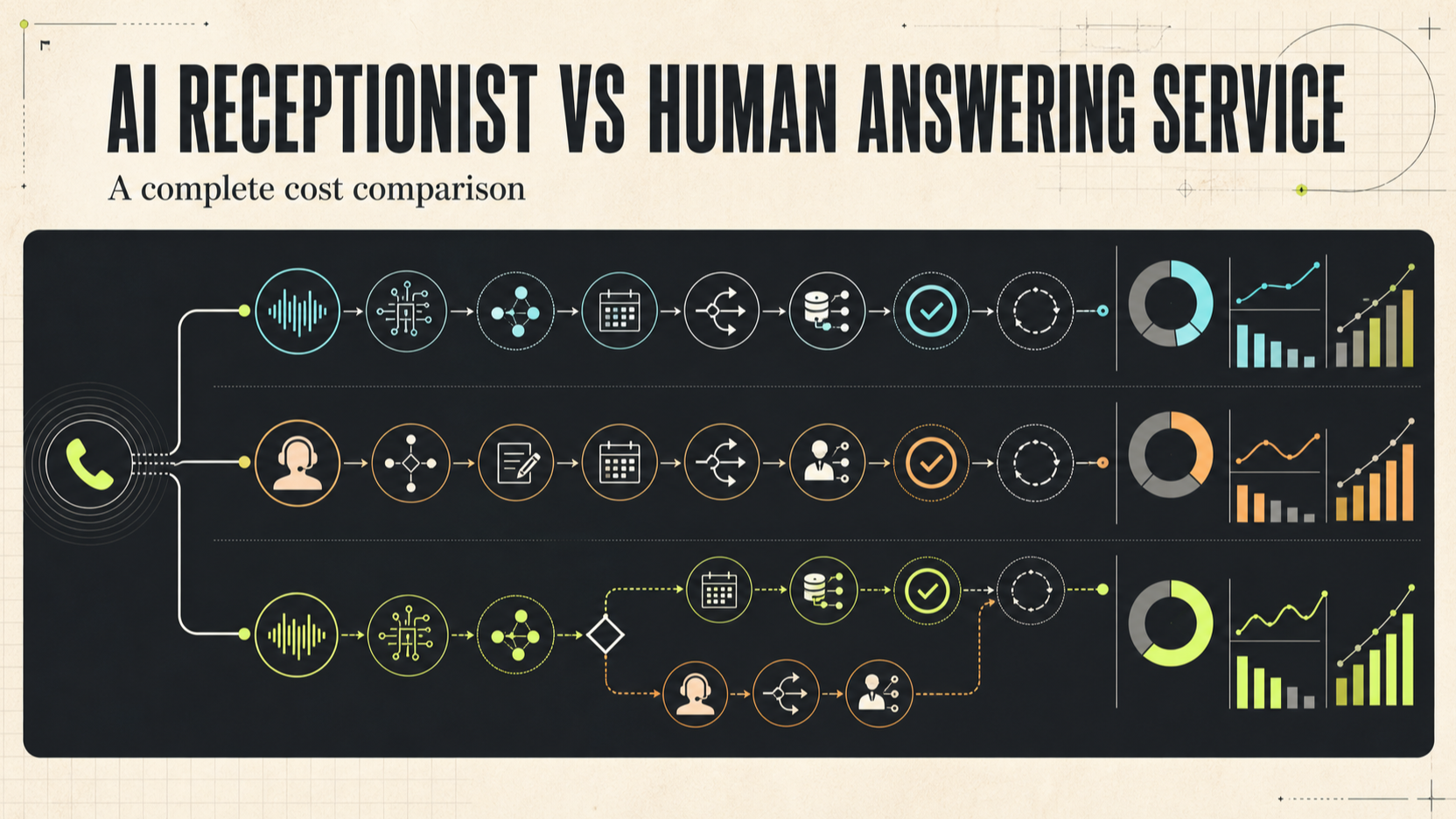
Different billing units and inclusions create a false common denominator.
Loaded cost, conversion, risk, correction, and retained human work become visible.
In this scenario AI-first has the lowest cost per completed outcome, while hybrid creates more completions at a slightly higher unit cost. A buyer that values the 100 additional outcomes may choose hybrid; a buyer optimizing only for low-risk routine volume may choose AI-first. Change the call mix, service level, error cost, or contribution per outcome and the decision can reverse.
When AI, human, or hybrid is the better choice
| Scenario | Likely starting model | Reason |
|---|---|---|
| High-volume routine FAQs, qualification, and system booking | AI-first | Concurrency, consistency, and lower marginal handling cost |
| Low-volume calls with high ambiguity or persuasion | Human-first | Judgment and nuance dominate scale economics |
| Routine majority with valuable or risky exceptions | Hybrid | Automation handles the base; people protect edge cases |
| Sharp after-hours and seasonal spikes | AI-first or hybrid | Coverage scales without staffing every possible peak |
| Distressed, sensitive, or high-consequence callers | Human-first or tightly bounded hybrid | Empathy, authority, and service recovery are central |
| Poor or unavailable business-system integration | Human-first pilot | Autonomous AI cannot reliably complete the promised action |
| Many languages with uneven QA coverage | Phased hybrid | Language-level testing and fallback are required |
| Vendor optimizing customer gross margin | Segmented by workflow | One operating model rarely fits every customer and call type |
Exact industry scenarios need different outcome definitions
| Industry | Useful final outcome | Human boundary |
|---|---|---|
| HVAC, plumbing, and electrical | Accepted dispatch and completed job | Safety ambiguity, unusual site conditions, upset caller, or technician exception |
| Medical and dental appointments | Rule-valid booking, kept appointment, and completed visit | Clinical questions, complex referrals, uncertain identity, or sensitive services |
| Property management | Correct work order, on-call acknowledgement, and verified resolution | Life safety, distressed resident, access exception, or uncertain property context |
| Restaurant ordering | POS-accepted, fulfilled, profitable order | Allergy uncertainty, unavailable menu state, payment issue, complaint, or recovery |
| Auto service | Kept appointment, repair order, and completed work | Safety concern, unclear symptom, warranty exception, or advisor negotiation |
| Insurance FNOL | Complete intake, system-created claim, and adjuster-ready handoff | Emergency, vulnerable claimant, coverage interpretation, dispute, or complex loss |
| Legal and professional services | Qualified consultation or accepted matter under firm rules | Legal advice, conflicts, nuanced fit, sensitive facts, or persuasion |
Use the detailed HVAC AI receptionist, plumbing and electrical dispatch, healthcare appointment, and Voice AI pricing-model guides to build scenario-specific funnels.
Metrics that make the comparison auditable
| Metric group | Track | Decision |
|---|---|---|
| Demand | Offered, answered, abandoned, spam, valid intent, language, location, and coverage window | Staffing, capacity, and denominator |
| Production | Minutes, calls, models, tools, human handling, transfers, hold, after-call work, and latency | Loaded cost and operational design |
| System action | CRM, scheduler, dispatch, order, claim, or work-order attempt and acknowledgement | Integration reliability and usable output |
| Quality | Qualification, booking validity, routing, failed handoff, repeated contact, complaint, and correction | Automation boundary and QA |
| Outcome | Qualified lead, kept appointment, completed job, fulfilled order, accepted claim, revenue, and contribution | ROI and operating-model choice |
| Customer economics | Plan, pricing version, attributed cost, support, custom work, unpriced usage, and revenue | Vendor margin and repricing |
Emit an event for every expensive or outcome-changing step and join the execution to its later business-system state. The example deliberately excludes caller contact details and conversation content.
{
  "event_id": "evt_reception_compare_7284",
  "execution_id": "inbound_call_4fd2",
  "step_id": "step_booking_write_08",
  "parent_step_id": "step_intent_route_07",
  "provider": "openai",
  "model": "realtime-voice-model",
  "operation": "create_valid_booking",
  "latency_ms": 611,
  "status": "success",
  "provider_reported_cost_usd": 0.0368,
  "attributes": {
    "application": "ai-receptionist",
    "workflow": "inbound_booking",
    "feature": "intake_booking_and_transfer",
    "customer_id": "business_1842",
    "industry": "home_services",
    "location_id": "location_07",
    "coverage_window": "after_hours",
    "intent_category": "service_booking",
    "pricing_model": "hybrid_subscription_and_usage",
    "pricing_version": "v4",
    "prompt_version": "v12",
    "booking_outcome": "system_acknowledged",
    "human_handoff_required": false,
    "completed_outcome": "pending",
    "data_classification": "no_caller_contact_or_conversation_content"
  }
}
Ganivra's event integration gives AI receptionist companies and buyers one cost ledger across models, calls, tools, human work, customers, pricing, and completed outcomes.
Risk, disclosure, privacy, and service recovery belong in the comparison
Inbound receptionist automation and outbound AI calling are not the same compliance workflow. The FCC's AI voice declaratory ruling confirms that TCPA restrictions for artificial or prerecorded voices encompass current AI-generated human voices. Outbound marketing, reminders, follow-up, and operational calls need purpose-specific consent, disclosure, opt-out, recordkeeping, and legal review.
For both AI and human services, define permitted data, recording rules, least-privilege system access, retention, approved answers, prohibited advice, authentication, escalation, incident response, accessibility, language quality, audit sampling, and caller complaint handling. A less expensive call is not economical if it creates privacy exposure, an invalid appointment, a missed emergency, or an unrecovered customer.
This guide is an economic measurement framework, not legal, privacy, security, employment, or regulatory advice.
How to run an AI receptionist versus answering-service pilot
- 01Define the final business outcome
Specify valid intent, qualification, booking, source-system acknowledgement, completion, exclusion, correction window, and attribution before comparing prices.
- 02Build one comparable call cohort
Use equivalent hours, locations, languages, intents, seasonality, marketing sources, demand, and operational capacity for AI, human, and hybrid options.
- 03Normalize every pricing model
Translate monthly fees, calls, minutes, overages, transfers, tools, setup, and retained labor into loaded cost against the same valid calls and outcomes.
- 04Instrument the full execution
Join telephony, model, tool, CRM or scheduler, human escalation, correction, and final business-system events with one execution ID.
- 05Audit quality by consequence
Review wrong routing, wrong booking, missed urgency, failed transfer, unsupported request, complaint, and recovery separately from minor conversational defects.
- 06Choose the operating model
Select AI, human, or hybrid by outcome-adjusted cost, conversion, risk, customer experience, operational fit, and customer margin—not demo quality alone.
Start with bounded, repeatable calls; keep human fallback live; and wait long enough to observe the final business outcome. Continue with the answered-call metric guide to choose the right denominator, the Voice AI unit economics guide to instrument the full cost stack, and the AI customer-support economics guide for resolution and retention measurement.
Frequently asked questions
AI receptionist vs human answering service FAQ
What is an AI receptionist?
An AI receptionist is a voice agent that answers calls, identifies intent, follows approved business rules, answers bounded questions, qualifies callers, books appointments, writes to business systems, sends follow-ups, and transfers exceptions. Its useful output is verified business-system state—not a fluent conversation alone.
What is a human answering service?
A human answering service uses remote receptionists to answer calls under a client-approved script. Depending on the service, agents can take messages, qualify leads, book appointments, process intake, transfer callers, and provide after-hours or overflow coverage.
Is an AI receptionist cheaper than a human answering service?
Often at high volumes of repeatable calls, but not automatically. Compare loaded cost per valid booking, qualified lead, completed job, or other verified outcome. Include setup, usage, telephony, integrations, human escalation, quality assurance, errors, corrections, and service recovery for both options.
How much does an AI receptionist cost?
AI receptionist pricing may use a subscription, per-call, per-minute, per-conversation, or custom enterprise model. The loaded program also includes telephony, models, tools, integrations, setup, monitoring, human fallback, corrections, security, and support.
How much does a human answering service cost?
Human answering services commonly charge by included minutes or answered calls, with plan minimums and overages. Transfers, outbound work, complex scripts, integrations, bilingual coverage, dedicated staff, setup, or after-hours policies can affect loaded cost.
Which is better for after-hours calls?
AI is strong when after-hours demand is variable and requests are bounded. Humans are stronger when calls are ambiguous, emotional, or exception-heavy. A hybrid design often lets AI collect routine facts and execute safe actions while a human handles urgent or uncertain cases.
Can AI receptionists book appointments?
Yes, when connected to a current scheduling system and constrained by valid business rules. Count a booking only after the source system acknowledges it, then observe cancellation, no-show, kept appointment, completed job, or other downstream state.
Can an AI receptionist transfer calls to a person?
Yes. Transfer rules should define eligible destinations, hours, warm-transfer context, fallback behavior, maximum wait, privacy boundaries, and what happens when nobody answers. Failed transfers and repeated calls belong in the cost model.
Will AI replace human receptionists?
AI can absorb repeatable intake, routing, scheduling, status, and FAQ work. Humans remain valuable for ambiguity, empathy, negotiation, high-consequence judgment, complaints, unusual requests, and service recovery. The economic question is how the work should be divided.
What is a hybrid AI receptionist?
A hybrid model uses AI as the first line for repeatable calls and routes defined exceptions to trained people. It should measure AI cost, human escalation minutes, transfers, corrections, final outcomes, and customer experience as one program.
Should I compare per-minute and per-call prices directly?
No. Convert both to the same call population and downstream outcome. Minute pricing changes with handle time; call pricing changes with what counts as a billable call, plan allowances, spam rules, and overages. Neither proves booking or completion quality.
What hidden costs should I include?
Include implementation, prompt or script design, integrations, telephony, usage overages, transfers, human escalation, supervision, quality review, multilingual support, security, compliance, vendor management, correction, repeated calls, refunds, lost leads, and service recovery.
What is the best metric for comparing receptionists?
Use the closest verified business outcome: cost per qualified lead, valid booking, kept appointment, accepted dispatch, completed job, fulfilled order, adjuster-ready claim, or resolved maintenance event. Also track conversion, correction, escalation, and contribution margin.
How do I calculate AI receptionist ROI?
Measure incremental contribution and validated labor or interruption value, then subtract the loaded AI program, retained human work, errors, corrections, and recovery. Compare equivalent hours, locations, call types, demand, and capacity, and avoid crediting theoretical automation as realized value.
Is a human answering service better for complex calls?
Usually when the work requires open-ended judgment, empathy, nuanced persuasion, or handling an exception that cannot be encoded safely. But a complex script does not guarantee expertise, so training, permissions, escalation, and quality evidence still matter.
Is AI better for high call volume?
AI can handle concurrency and volume spikes without staffing each simultaneous call, making it attractive for repeatable demand. Its advantage shrinks when most calls need human review, integrations fail, long conversations increase usage, or error recovery is expensive.
Which industries benefit most from AI receptionists?
High-volume, repeatable inbound workflows in home services, auto service, restaurants, property management, appointment scheduling, insurance intake, and professional services can benefit. Each industry needs its own valid-outcome, escalation, privacy, and safety rules.
What should an AI receptionist write to the CRM or scheduling system?
Write only permitted, validated fields with stable execution and outcome identifiers. Record acknowledgement, booking or lead state, location, service, routing, pricing and rule versions, and human-handoff state without putting unnecessary customer conversation content into cost analytics.
How should AI receptionist vendors measure customer margin?
Attribute telephony, speech, models, tools, integrations, human fallback, implementation, quality assurance, support, corrections, and service recovery to each customer under the actual plan and pricing version. Blended margin can hide an expensive customer or workflow.
How should I run an AI versus human receptionist pilot?
Define comparable call cohorts, route bounded intents, instrument every paid and outcome-changing step, preserve human fallback, audit a risk-weighted sample, observe downstream outcomes, and compare loaded cost and conversion against a credible baseline before expanding.
Compare the completed outcome
Know where AI, people, and hybrid reception are actually economical.
Connect calls, models, tools, answering-service invoices, human escalation, corrections, final outcomes, customer revenue, and pricing in one metering ledger.